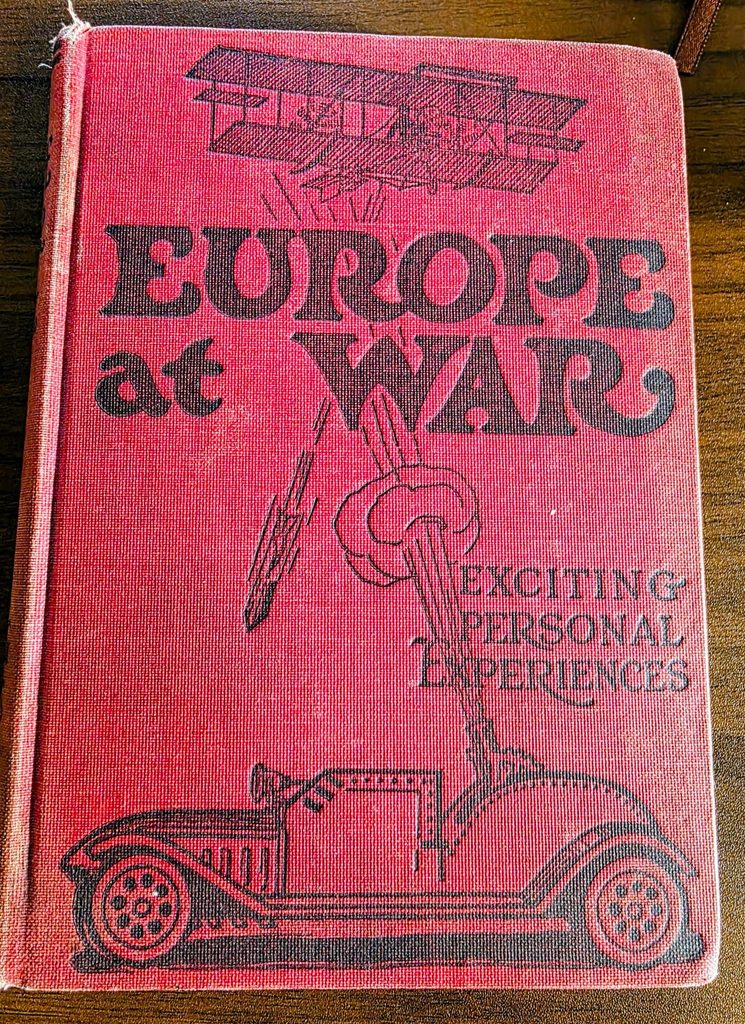
While teaching US history at the high school level, I was blessed to receive my grandfather’s copy of Europe at War by Marshall Everett. In its yellowed and dry pages, I found a level of detail that enriched my understanding and inspired me to share that new knowledge with students. It spurred me to investigate even more.
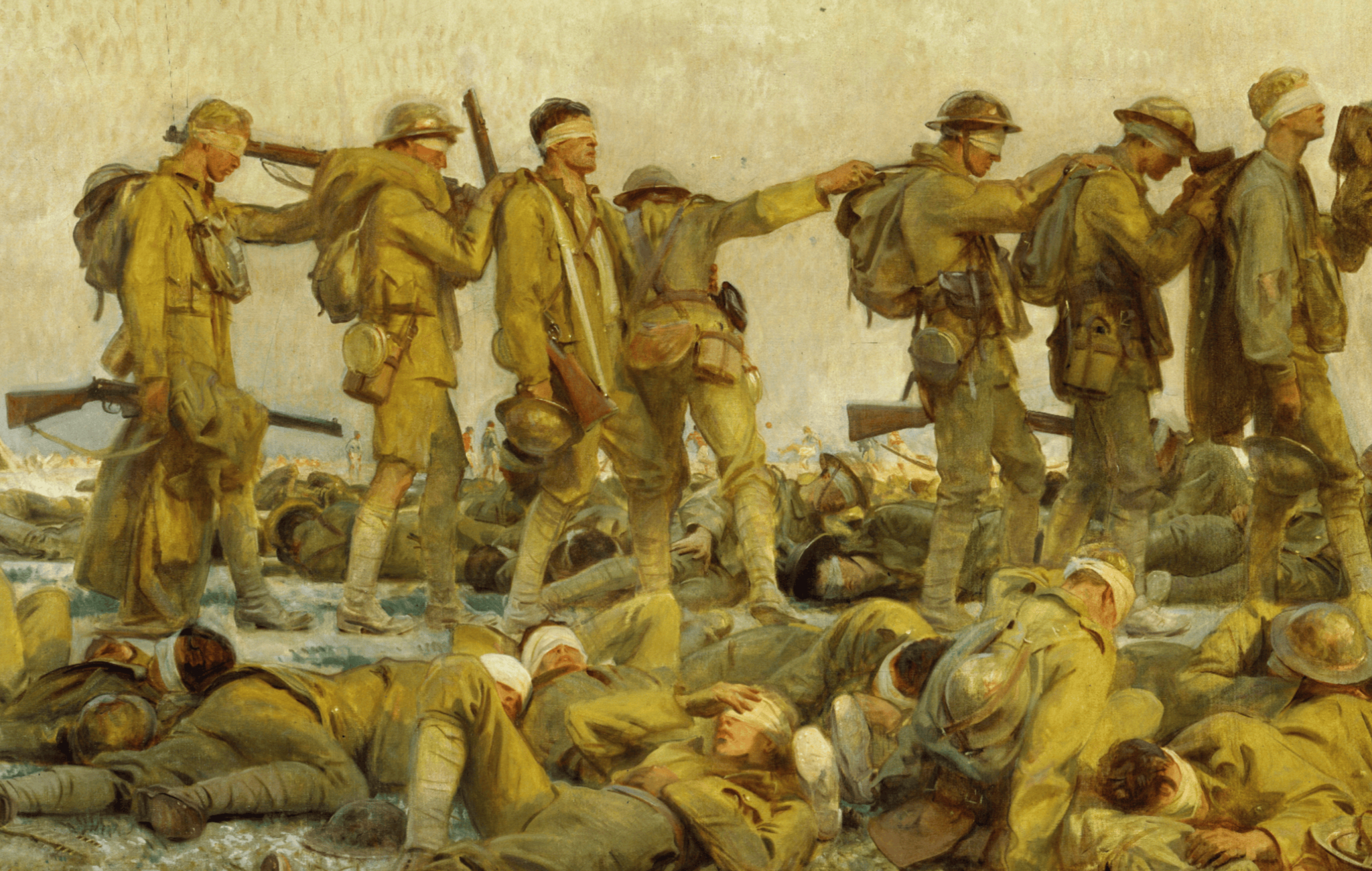
Soon after, I took intellectual delight in reading about the 1914 Christmas Truce in Silent Night by Stanley Weintraub. The gut-wrenching accounts of trench warfare and the demoralization of an entire generation remain with me. I gained a profound understanding that the immiseration of shell-shocked men arose from foolish tactics by military leaders, but also something deeper. The destructive power of the Great War was prolonged by an underappreciated culprit: modern war finance.
The guns of August 1914 finally fell silent on November 11, 1918. Those blasts were facilitated by significant changes in German law on August 4, 1914. Four critical decisions were made.
First, the Reichsbank suspended the redemption of paper money for gold. Second, the bank was given authority to buy short-term treasury bills. By becoming the “lender of last resort,” it was empowered to buy government debt and print new money to meet the government’s financial needs. The tax on notes issued beyond a one-third gold coverage limit, designed to deter the Reichsbank from expanding the circulation of paper money, was eliminated. Finally, loan bureaus, the Darlehnskassen, were created, allowing firms and municipalities to use illiquid securities as collateral for new notes that were accepted by government offices. The face value of these new notes did not have to be backed by Reichsbank gold.
Irredeemable paper money set the stage for the German government to wage war to a greater extent than mere taxation would have allowed. Such statutes, according to Stephen Gross, “preserved the veneer that Germany’s currency was still anchored to gold,” and were an illusion “cultivated by the Reichsbank and most German economists.” These legal maneuvers “effectively removed Germany from the Gold standard and created the potential for serious inflation if misused.”
The tried and true method of war finance, taxation, was also unnecessary to fund the already mighty German military. Or so many believed. Karl Helfferich was its finance minister from 1915-16 and rejected the need for higher taxes under the delusion that the war would be quickly won. He was replaced by Siegfried von Roedern, who introduced a tax on firms (and indirectly on the people) in the form of a war profits tax. Von Roedern never imposed a direct national income tax. Revenues raised by levies on profits were tiny in comparison to the war’s demand on the national budget. Substantial tax reform, Gross writes, “proved politically impossible because it threatened to disturb the Burgfrieden” (the domestic truce between German political parties). The opposition party, the Social Democrats, also opposed new indirect taxes on consumer goods, further limiting sources for floating the war effort. When an unwilling treasury, opposition, and public didn’t directly fund the effort, borrowing and eventually the printing press were deployed to continue the military stalemate.
Researchers have examined the structure of German spending. Historian Gerd Hardach calculated that from April 1914 to March 1919, “87 percent of total expenditure was on the extraordinary budget and were financed by short-term credits or war loans. Only 13 percent of total expenditure was on the ordinary budget and was financed by taxes.” Theo Balderston’s investigation of German finance corroborated Hardach’s findings, as did Nicholas Mulder’s.
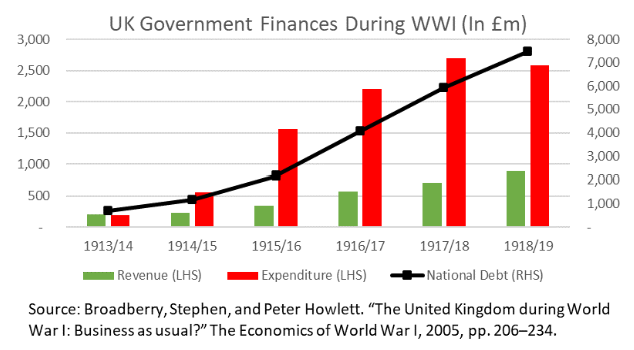
The Germans weren’t alone in finding taxes insufficient to cover wartime spending, nor in supplementing by borrowing or currency printing to fuel their war effort. The British used debt, while the Americans used both debt (war bonds) and the newly minted powers of the Federal Reserve System to buoy their 1917 entry into the conflagration. The Brits saw an extraordinary expansion of their national debt during their campaign against “the Hun.” Britain’s national debt grew more than tenfold in five years.
Woodrow Wilson famously won re-election in 1916 with the slogan, “He kept us out of the war.” That proved to be a short-lived reality. In 1917, American entry sent the “doughboys” across the Atlantic and on to the Western Front. Hugh Rockoff explains that just 22 percent of the cost of the US war effort was financed by taxes. Rosella Cappella Zielinski places the US tax burden at approximately 26.5 percent from 1917 to 1919, as does Edwin Seligman.
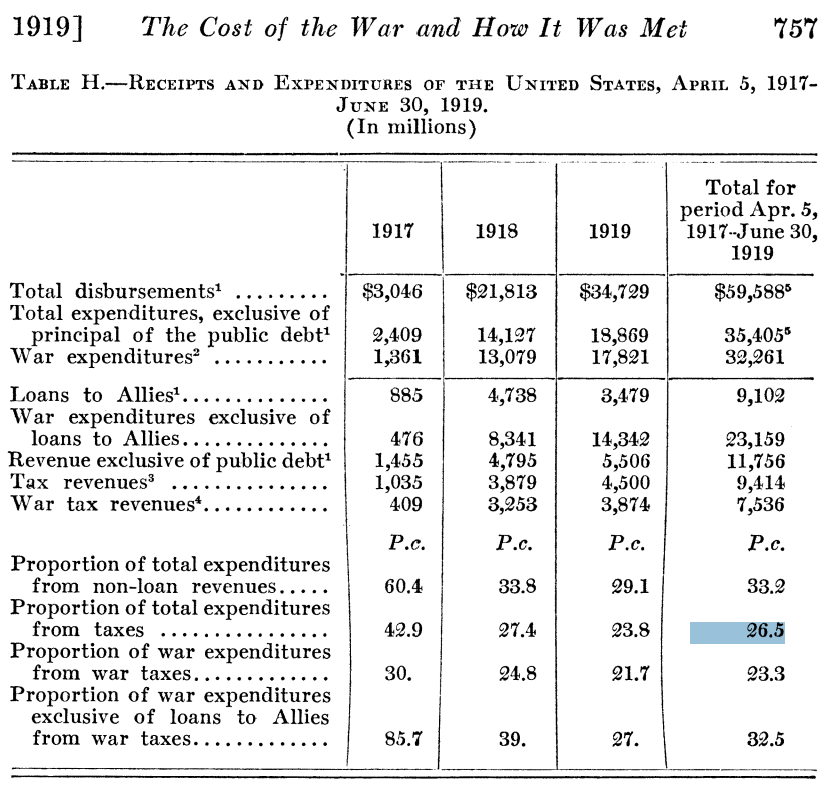
Tax rates in Germany, the UK, and the US were all insufficient to fund their war efforts. Each nation resorted to the heavy use of debt and monetary expansion. Records for the German and American sides are the most complete and in the case of the former, half to three-quarters of their spending came via borrowing, with as much as a quarter of it coming from money printing. The US also borrowed heavily with nearly 60 percent of its war-making budget coming from the sale of bonds, with the remaining one-fifth financed by the money-printing press.
After all the massive expenditures, borrowing, and money creation, and the enormous loss of life on all sides, this war of attrition and civilizational destruction concluded in a ceasefire on November 11, 1918: Armistice Day.
One year later, Ludwig von Mises released Nation, State, and Economy. Having witnessed the war’s devastation firsthand, he lamented how printing money helped prolong the bloodshed.
Creating money, he explained, did not create additional weapons or supplies. War consumed and destroyed actual value: food, ammunition, labor. Those resources had to come from somewhere, and they could not be printed.
Inflation merely “drew a veil over capital consumption,” he wrote. With more paper currency circulating, but no more to buy, “the individual believed that he had become richer… while in truth his wealth was dwindling.”
Inflation obscured the cost of war with an illusion of continued prosperity, fueled by money creation. Currency was available, but it bought less, and there was less to buy.
“Inflation is an indispensable intellectual means of militarism,” Mises continued. “Without it, the repercussions of war on welfare would become obvious much more quickly and penetratingly; war-weariness would set in much earlier.”
The printing of money at home helped governments sustain the killing and dying abroad. If forced to bear the more immediate pain of taxation, the public would sooner demand a halt to the killing and to the destruction of resources. Printing cash, by preserving the illusion of normal life at home, temporarily drowns out the voices of the dead and their families. Could it be that the loss of sons, brothers, and fathers was somehow muted by financial easing?
The past holds a simple lesson for our day, and for those who wish to prosecute war in far-flung places. National leaders seeking military adventurism have learned to finance it through borrowing and printing, so the public doesn’t feel the financial pain right away. Sometimes, civilian budgets are squeezed in other ways, as we currently experience in this wartime energy market disruption. By borrowing and inflating our currency, we suppress the public outrage over endless wars and deny their true cost.
Today, Armistice Day is known as Veterans Day in the US. Americans will repeat the familiar refrain: thank you for your service to those who have worn the uniform. We might not intuitively think to honor their sacrifices by restraining congressional borrowing and central bank credit expansion. But we should.
To silence the guns at last, still the printing press.
Share This Article

Post on Facebook

Post on X

Print Article

Email Article