My colleague, Patrick Coate, recently highlighted a story by Inside Higher Ed that discussed the relationship between the availability of student aid and the rising cost of a college education.
But just how high has that cost gone, relative to other expenses borne by American families?
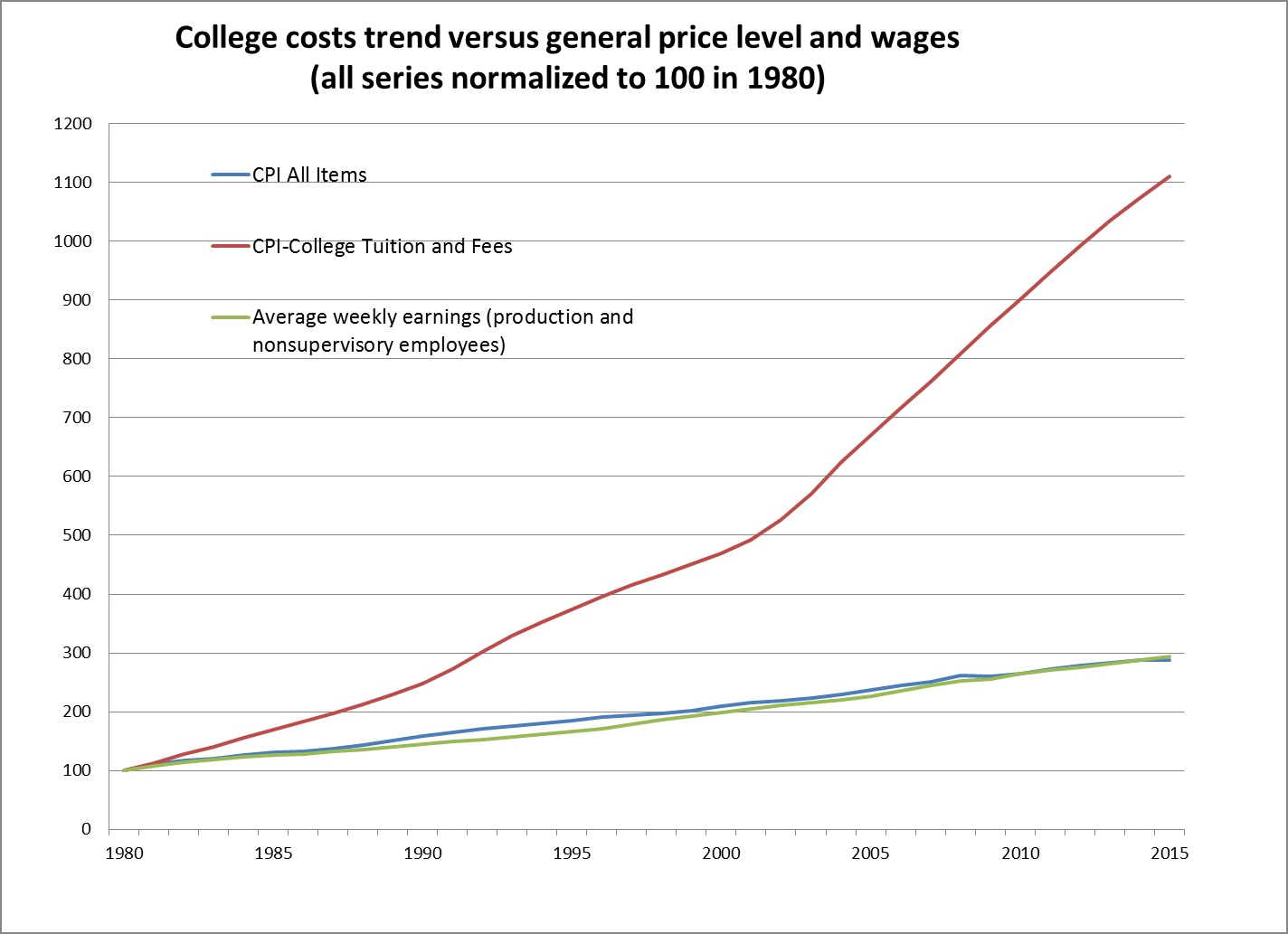
Here is a way to put the increase in college costs in perspective. “College Tuition and Fees” is one category within the general Consumer Price Index, published by the Bureau of Labor Statistics. I compared this to all prices, using the catch-all category “CPI-All Items.”
We can measure whether Americans are able to keep up with the increasing cost of living by comparing it to wage growth. I included that on the chart below, defining wages as average weekly earnings of production and nonsupervisory employees in the private sector. (I would have liked to use the earnings of all employees instead, but that data series does not go back in time far enough).

Here’s the moral of the story: Wages have more or less kept pace with inflation (you can see that the blue and green lines move closely together). But college costs skyrocketed compared to the general price level or to wages.
This is especially impressive given the fact that, in their “College Tuition and Fees” category, the BLS measures the prices students actually pay, NOT the sticker price. This means, for example, that if a college lists tuition at $30,000 per year, but gives financial aid that covers the entire tuition to half of its students, the BLS measure would record a $15,000/year tuition for this college (half the students pay $30,000, half pay nothing).
Click here to sign up for the Daily Economy weekly digest!
Share This Article

Post on Facebook

Post on X

Print Article

Email Article