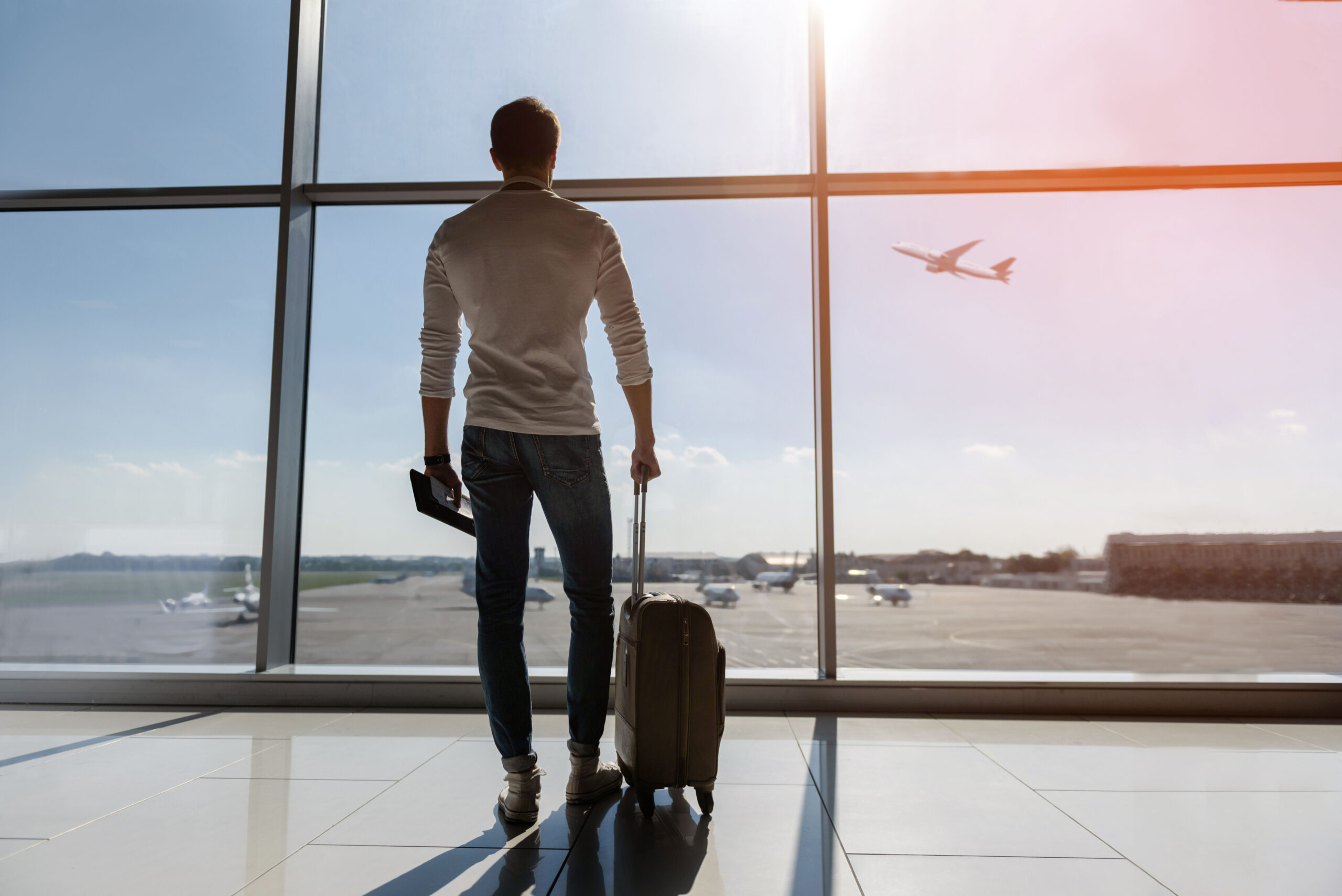

There are four of us, standing self-consciously at an airport jetway, waiting for the ticket agent to finish printing our travel certificates. We chat and joke, as perfect strangers sometimes will, newly united in a little drama of our own making.
The flight, you see, was overbooked. And we were the few, the four lucky few, to be ‘deplaned,’ allowing the rest of the passengers to wing their way toward their days’ uninterrupted plans.
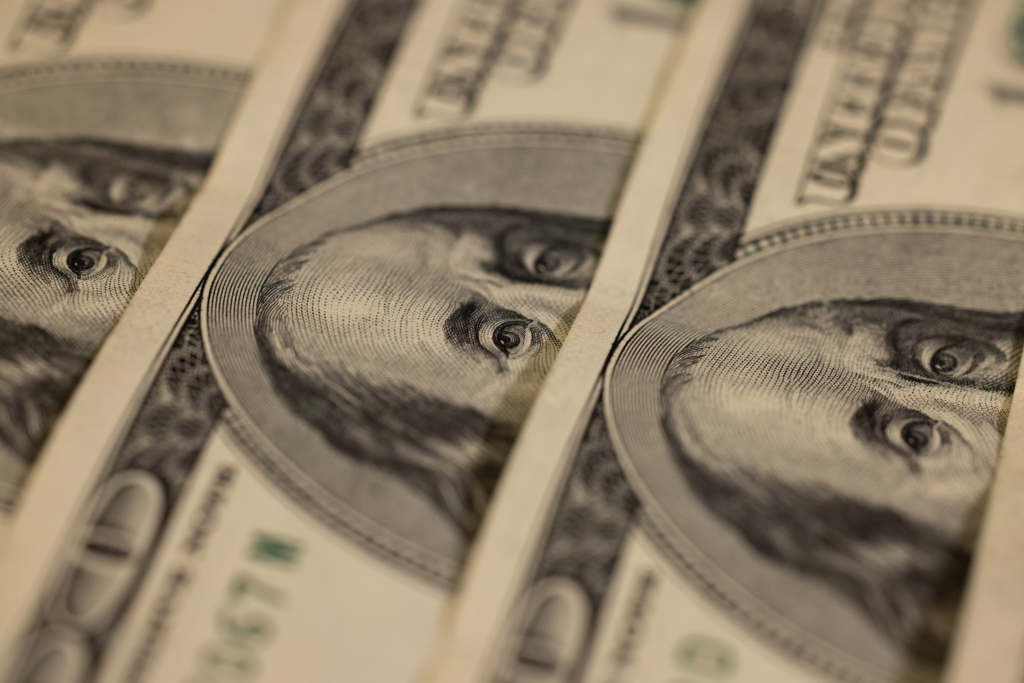
This is not a story of noble sacrifice for the collective, of course. We are chatting and joking happily because each of us is now $1,200 richer, the first four to volunteer when the cabin crew asked if anyone was “willing to change their travel plans” for $1,000. I was the chump—raising my hand first, I ruefully noted bidding went up another $200 before I could even get out of my seat. “Shoulda held out,” I joked with the attendant as I got to the front. “No sir,” she replied, “all of you will get the highest bid.”
Wow.
Like so many actions in a free market, this incident is a veritable kaleidoscope of sparkling details — individuals and collectives cooperating in a voluntary system of exchange. As a rule, the whole miraculous system is spontaneous, brilliant, and in the end, just.
Imagine how it might have gone otherwise. In a system of enforced collective egalitarianism (Cuba, say) it would have gone less smoothly. First, there probably would have been no flight at all—the result of systemic inefficiency and non-innovation. Cuba’s two state-owned airlines operate seven daily domestic flights to service the nation’s eleven million people, expensively and irregularly. Kansas City, by comparison, has over 150 daily flights to offer its population of less than a million. And even if there were a flight, and the call went out for volunteers on an overbooked aircraft, it is unlikely anyone would have given up his seat so that his comrade could travel. In societies of self-induced scarcity, people are not known for their spontaneous generosity to strangers. More likely, it would have come down to thuggery of one sort or another. Either the burliest attendant would pick four passengers randomly and against their will (there is a reason for the stereotype of the heavyset scowling Soviet apparatchik), or else the crew would be pressured into pushing the limits of aeronautical safety to avoid any “unpleasantness.”
A free system, instead, taps into the stunning collective power of Homo Economicus: the rational, self-interested individual with his unique needs and preferences. While the concept of people as “optimizers” is sometimes criticized as too reductive, too reliant on assumptions of “perfect information,” it is nevertheless deeply, revealingly true. Yes, the caricature of a cold, hard, calculating machine is incomplete. People are squishy, socially embedded creatures subject to emotional whim and imperfect notions of what is best for them. But that doesn’t mean the model isn’t fundamentally accurate. Given the choice between hammering your thumb or accepting a warm slice of apple pie, we can guess with near certainty what the overwhelming majority of people will choose. Embracing, rather than refuting, that basic understanding of incentives is what powers the free market and is what allowed today’s airline incident to turn me into a donor-to-the-collective (and like it).
As our little incident demonstrates, people make these decisions quickly, without fuss, and in a fundamentally “fuzzy” way. Nobody had time for steely eyed calculus of costs and benefits, we just made snap decisions based on prior experience and knowledge of our particular circumstances. We each basically gambled that things would turn out for the best. One woman had “accidentally” booked this way-too-early flight and had the day to kill. Another was “just gonna be shopping anyway” and was happy to be making money instead of spending it. I would have preferred to be home as scheduled, but I was willing to show up a little late if a voucher would help pay for later tickets so my children can travel to see their grandparents. It would have taken hours to extract this level of honest, granular detail about travel plans if an authority had been tasked with finding the most “socially just” solution for reducing the aircraft’s takeoff weight. A United representative found it out in 30 seconds, and without even asking for details. Moreover, the rest of our little aircraft commune did not have to suffer the moral abasement of witnessing coercive injustice unfold before their eyes.
Readers will recollect, no doubt, the incident a few years back when a passenger (on United, no less) was forcibly dragged off the aircraft to make room for the flight crew. Apparently, incentive offers up to $400 had been made for volunteers, but there were no takers, so the crew resorted to “algorithmically selecting” four passengers for involuntary removal. It did not go well. Thanks to the polite but firm refusal of Dr. Dao to deplane, the hard face of the coercive alternative appeared: government security officers pummeled Dr. Dao and pulled him, unconscious, down the aisle. The free world quickly responded, concluding clearly that such treatment is intolerable. United’s stock price fell, moral outrage was ubiquitous. The airline eventually settled with Dr. Dao for an “undisclosed sum….” I’ll wager that it was not trivial. In retrospect, how much better (not to mention cheaper, since the two are often entwined), if United had instead simply kept up the voluntary bidding? Somebody would have eventually accepted a voluntary incentive, if only the crew had trusted more in the power of Homo Economicus to do what he does best.
United’s mistake helps explain why they started this morning’s bid in the four-digit range. Self-interested optimizers, even bleary, coffee-deprived ones, help make the world go ‘round. But the real magic of it all is that not only do they help themselves, but they help the entire system be more accountable, efficient, and most important of all, just.
It’s a beautiful thing.
Share This Article

Post on Facebook

Post on X

Print Article

Email Article