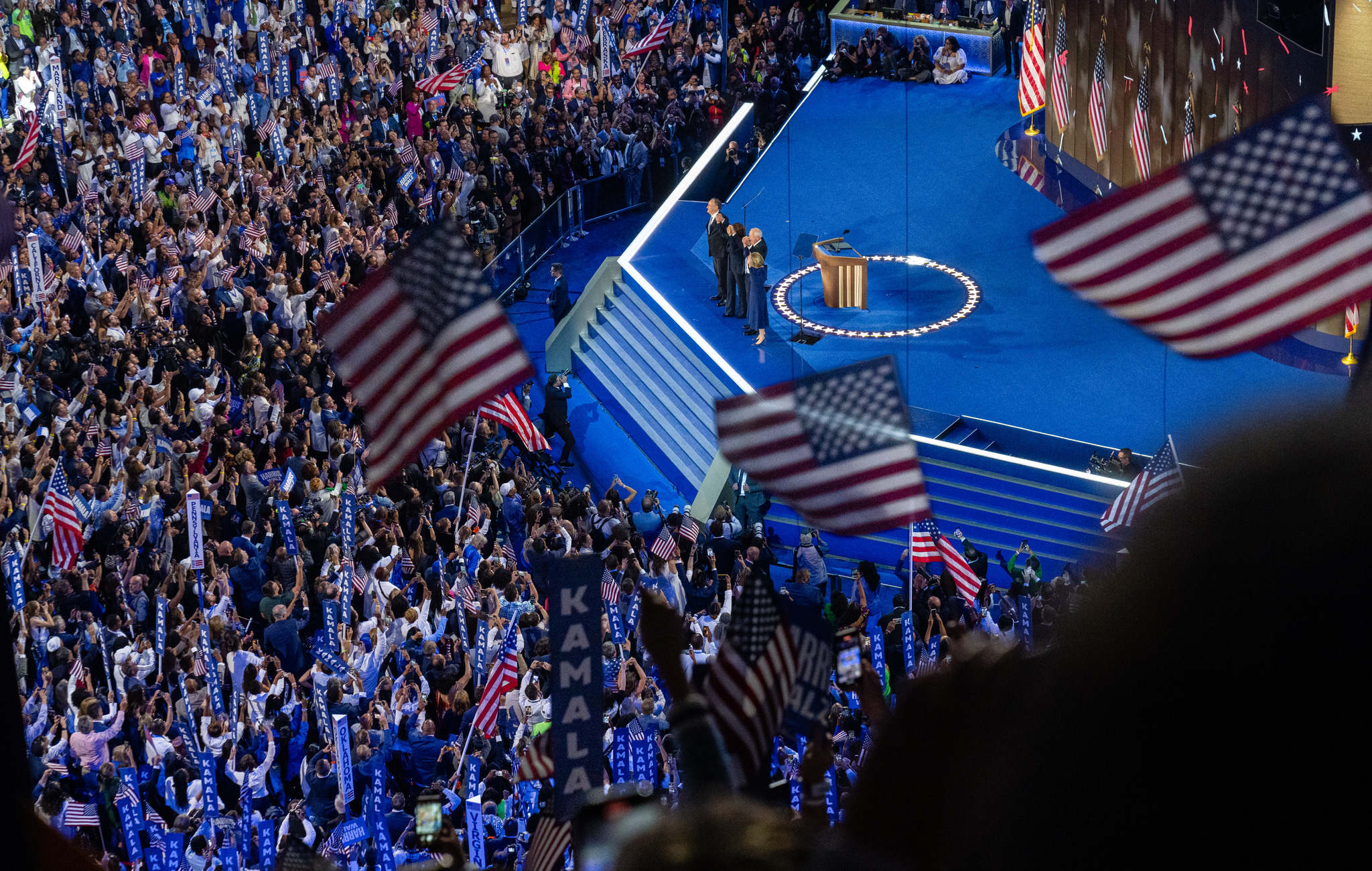

The Democratic National Convention featured the word freedom over and over and over. It used Beyonce’s song, “Freedom.” Kamala Harris said Democrats “choose freedom” and defined her campaign as “a fight for freedom,” to create “a country of freedom, compassion and the rule of law,” which would offer the freedom not to just get by, but to get ahead.” The media also played along. One Los Angeles Times headline I saw proclaimed that “Harris offers freedom.”
The first thing all that hard sell brought to my mind was, “Why did someone from an administration that has been in office three and a half years need to promise such a freedom revolution now, when they have had plenty of time to do it already, or to do it now, for that matter?” Was it just the hope that Will Rogers was a prophet when he said, “The short memories of the American voters is what keeps our politicians in office”?
My second thought was that what was defined in Chicago as freedom was certainly “interesting,” to use a word my Mom would tell me to use when she couldn’t say something good about something. Pushing for ever-stricter gun control and ignoring its highly questionable efficacy and that it violated the freedom specified in the Second Amendment was redefined into “freedom to live without fear of gun violence.” The promise of compassion and “the freedom not to just get by, but to get ahead” ignored all the freedoms that would be infringed to get the trillions of dollars to fund their plans to advance such freedoms. The promise to deliver “the rule of law” ignored not only the striking difference from the Biden-Harris administration’s behavior, but that the laws they overwhelmingly favored involved massive special treatment for favorites at other Americans’ expense, a far cry from the Constitution’s call for the federal government to advance our “General Welfare.” Governor Shapiro even asserted that what Democrats were hawking was “real freedom.”
Then what really struck me was how, for all the freedom talk, there was very little liberty on offer in Chicago. And the distinction was important, explaining among other things why I have always liked the word liberty better than the word freedom.
“Liberty” seems clearer to me about what it is liberty from man-imposed coercion — while “freedom” is more agnostic about what it is freedom from. For instance, I can take your money and call it an increase in my freedom. Perhaps Ludwig von Mises stated what has become my view most clearly when he wrote in Liberty and Property, “Government is essentially the negation of liberty. Liberty is always freedom from the government. It is the restriction of the government’s interference.” And if there is anything the Democrats were not offering, it was less government interference and imposition.
This episode reminds me of FDR’s “Four Freedoms” speech, in which his first two listed freedoms — freedom of expression and freedom of worship — were consistent with liberty because those freedoms for you do not take away from the same freedom for me. The only government role created is preventing others’ intrusions on our equal rights. They are aspects of liberty for all, defending citizens’ rights against man-imposed coercion
However, FDR’s third and fourth freedoms were inconsistent with liberty, because they provided what he called freedoms for some, but took away from others’ freedoms.
His “freedom from want” (“compassion,” in the language used in Chicago) cannot be similarly universal. It commits government to provide some people more goods and services than they would have gotten through voluntary interactions (including voluntary charity) with others. But expanding a recipient’s “freedom” in that sense necessarily constricts others’ equal freedom to attain their desired goods and services with their resources. That is, it must violate liberty.
And his “freedom from fear” was also insufficiently generalized. It proposed protection against international aggression. But it said nothing about constraining a nation’s freedom to aggress against its own citizens. And FDR’s third freedom requires domestic government aggression to get the required resources for its “compassion,” so his freedoms omit the most significant agency most people must fear when it comes to their liberty, quite different from liberty for all.
I have written in defense of Americans’ liberty for decades. In many specific instances, I have substituted the word freedom for the word liberty. But I have come to more clearly distinguish between a specific freedom or privilege for some and liberty as a universally enjoyed freedom from government coercion. “Freedom” can be used to mean “liberty,” but it can also be used to mean freedom for some that denies the same freedom for others, enforced through government coercion. As the DNC has just demonstrated so well, a host of rhetorical abuses can find a foothold in offering so many freedoms but so little liberty.
Googling “liberty” turned up similar distinctions. Liberty was defined as “the state of being free within society from oppressive restrictions imposed by authority on one’s way of life, behavior, or political views.” Independence, autonomy, sovereignty, self-government, self-rule, and self-determination were common synonyms, and constraint was cited as an antonym. That is generalized liberty. And it is no wonder that it played such a central role to America’s founders, as when John Dickinson asserted that “liberty…her sacred cause ought to be espoused by every man on every occasion, to the utmost of his power,” and Patrick Henry’s argued that “Liberty is the greatest of all earthly blessings.” But it is not what Democrats are offering.
Share This Article

Post on Facebook

Post on X

Print Article

Email Article