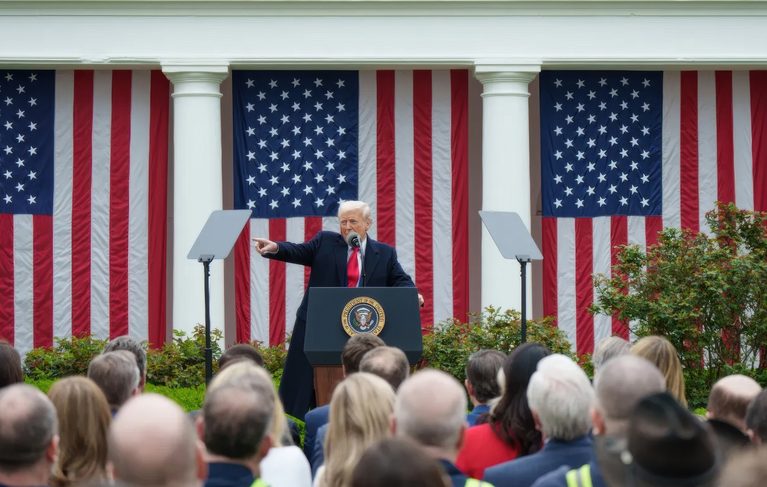
At a time when Federal Reserve independence seems vulnerable to the president-elect, the Fed may, accidentally, have been responsible for Donald J. Trump’s win. Hear me out.
The number one issue for voters this election was inflation. According to Democratic public opinion research initiative Blueprint, this rang true among all voters, including all swing voters, Black voters, and Latino voters. With inflation hitting a 40-year high — the highest many Americans have seen in their lifetimes — and being anything but transitory — as policymakers hoped — it is no surprise voters were disgruntled.
But why do people care so much about inflation? In an economy that most macroeconomists agree is doing just fine, or even great, the boots on the ground tell a different story.
The latest CPI data for October 2024 puts inflation up 2.6 percent compared to a year ago. The Fed’s preferred inflation metric, PCE, puts it at 2.1 percent — a smidge above the Fed’s 2 percent inflation target. Combined with real GDP growth of 2.8 percent and an unemployment rate at a not-too-uncomfortable 4.1 percent, the economic picture is very rosy by macroeconomic standards.
What that headline aggregate data overlooks is that a person is not an average.
Since the pandemic, costs have risen more than 20 percent overall. That means what someone earned in January 2020 buys one-fifth less today. For the 78 percent of Americans living paycheck-to-paycheck, it is hard to cut out one of every $5 you spend without feeling it. And, by some measurements, wage growth has consistently come in below inflation since the last presidential election — with real, inflation-adjusted, wages negative.
Groceries are up 26 percent since 2020. Rent, a lagging indicator, is also up 26 percent, with leases still being renegotiated today that factor in the inflation of yesteryear. Homeowners insurance is up as much as 51 percent in some regions, reflecting higher costs for construction and repairs, among other cost increases. Car insurance has been up nearly 19 percent compared to last year, with premiums 47 percent higher than pre-pandemic levels — causing nearly half of drivers to actively seek cheaper alternatives this year.
Fed Chair Powell called some of these “catch-up” prices at his FOMC press conference earlier this month. He has also been careful to point out that the Fed’s job is to get inflation — the rate of price increases — in check, not to fix the high price level. In other words, the new normal for prices is high.
But it did not have to be this way. Monetary policy missteps in the wake of the pandemic recovery sowed the seeds for rampant inflation. It has left the equivalent of a long-COVID-malaise on the economy that voters are fed up with — no pun intended.
As the pandemic took hold, the Fed pumped up the money supply. Its balance sheet, which started 2020 at $4.1 trillion, quickly grew to $7.1 trillion by that summer, in response to the pandemic-induced economic standstill. But it kept growing even after the economy began reopening, peaking at almost $9 trillion in mid-2022. M2, a broad measure of the money supply — and arguably key evidence of Fed money creation and thus stimulus — increased 40 percent, from $15.5 trillion in early 2020 to more than $22 trillion by April 2022.
Arguments can be made that the initial gush of monetary stimulus was the appropriate counter-cyclical policy choice. And that the one, two, or three rounds of fiscal stimulus that the Fed helped finance also helped. But, in combination — and with too much hesitancy to tighten — the monetary spigot turned into an open floodgate. And all that money ended up somewhere.
At first the new money did mostly two things. Personal savings skyrocketed to 32 percent in April 2020, then subsided, followed by another peak of 22 percent in March 2021. While ordinary folks sat on cash, the financially savvy eventually drove the stock market to new heights — a trend that has yet to subside.
The picture would not remain rosy. Once the economy reopened and supply constraints abated, all the extra money sloshing around drove up prices everywhere.
The sad fact is that while inflation is “always and everywhere a monetary phenomenon,” it does not affect all people equally all at the same time. Those who get the money earliest benefit the most, and it went considerably to the already well-to-do. Those who get the new money last, though, must contend with higher prices of ordinary things like groceries, cars, and shelter.
While CPI may have peaked at 9.1 percent and come down since, voters know their wallets do not stretch as far — 21.8 percent less far, to be exact, on average. Ordinary Americans might not know how things got so bad. But they still felt things were bad. And it drove them to the ballot box in protest, kicking out Biden-Harris and reelecting Trump.
So, the Fed should take this as a cautionary tale and not lose sight of the fact that policy missteps today bear out years later. Like monetary policy itself, a monetary reckoning can hit with long and variable lags.
I hope the American people get the localized recovery they are looking for. And that the Fed remembers that the power over money is a momentous one. In the meantime, Trump can dust off his White House stationery and say, “Thanks!”
Share This Article

Post on Facebook

Post on X

Print Article

Email Article