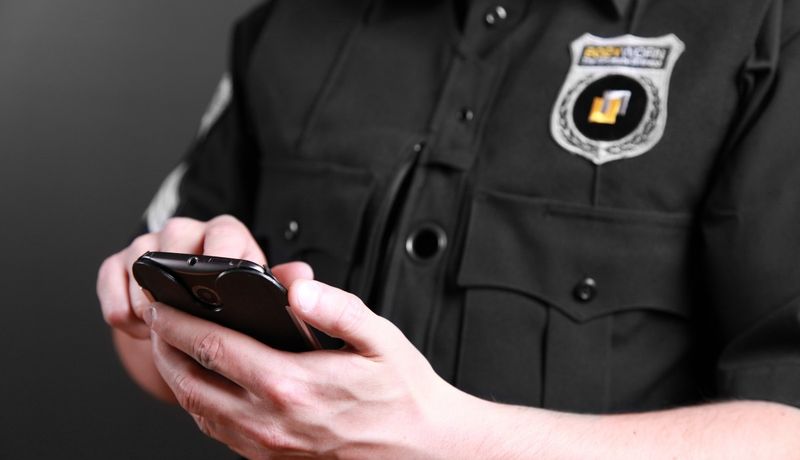

Taking a page out of George Orwell’s 1984, the state of Delaware is testing a mobile driver’s-license program that enables law enforcement to keep track of citizens at all times. Governor John Carney (D) said he “is excited to help move this new technology forward” and will initiate a six-month pilot program.
This fully electronic license, which is encoded into smartphones, will grant police officers the power to monitor citizens without even having to conduct routine traffic stops. As usual, sympathizers justify this program under the grounds of enhancing public safety, but the program should raise the hair on any civil libertarian’s neck.
Delaware’s experiment is nothing new. States like Iowa have recently proposed similar programs, which privacy-minded advocates like the American Civil Liberties Union fear will leave citizens subject to “unreasonable searches and seizures of their phone and its contents during traffic stops.” Even with the Supreme Court ruling in 2014 that phones can’t be searched without a warrant, a mobile driver’s-license program is still susceptible to governmental abuse.
At first glance, a driver’s license stored in someone’s phone along with a boarding pass and insurance information seems convenient for everyone. However, the temptation for police officers to check additional information could turn out to be too strong. By giving police broader access to information they wouldn’t normally get access to, unwarranted privacy invasions could become the norm rather than the exception.
Just like its intrusive Real ID and E-Verify cousins, the mobile driver’s license represents another iteration of the state’s never-ending quest to track law-abiding citizens’ movements and personal information. All such roads point to the eventual creation of a national-ID system.
The plot thickens when cyber-security is taken into account. In the current age, countless citizens have information stored in online databases that is vulnerable to hackers. Countries such as China have already demonstrated a penchant for using cyber-attacks to advance corporate espionage. Should mobile driver’s licenses go nationwide, there is nothing to stop the Chinese and other foreign actors from expanding their hacking crusades to unsuspecting individuals whose sensitive data is stored in poorly defended government databases.
Although the size and scope of Delaware’s program has yet to be fully revealed, citizens should remain skeptical of the alleged benefits. Even the staunchest of mobile driver’s license proponents must concede that there are reasonable privacy concerns. Open debate on this topic is a must.
The right to privacy is one of the pillars of a truly free and civilized society. Ayn Rand said it best: “Civilization is the progress toward a society of privacy. The savage’s whole existence is public, ruled by the laws of his tribe. Civilization is the process of setting man free from men.”
Time will tell how Delaware’s pilot program will play out, but until then, civil-rights advocates of all stripes should remain on guard.
Share This Article

Post on Facebook

Post on X

Print Article

Email Article