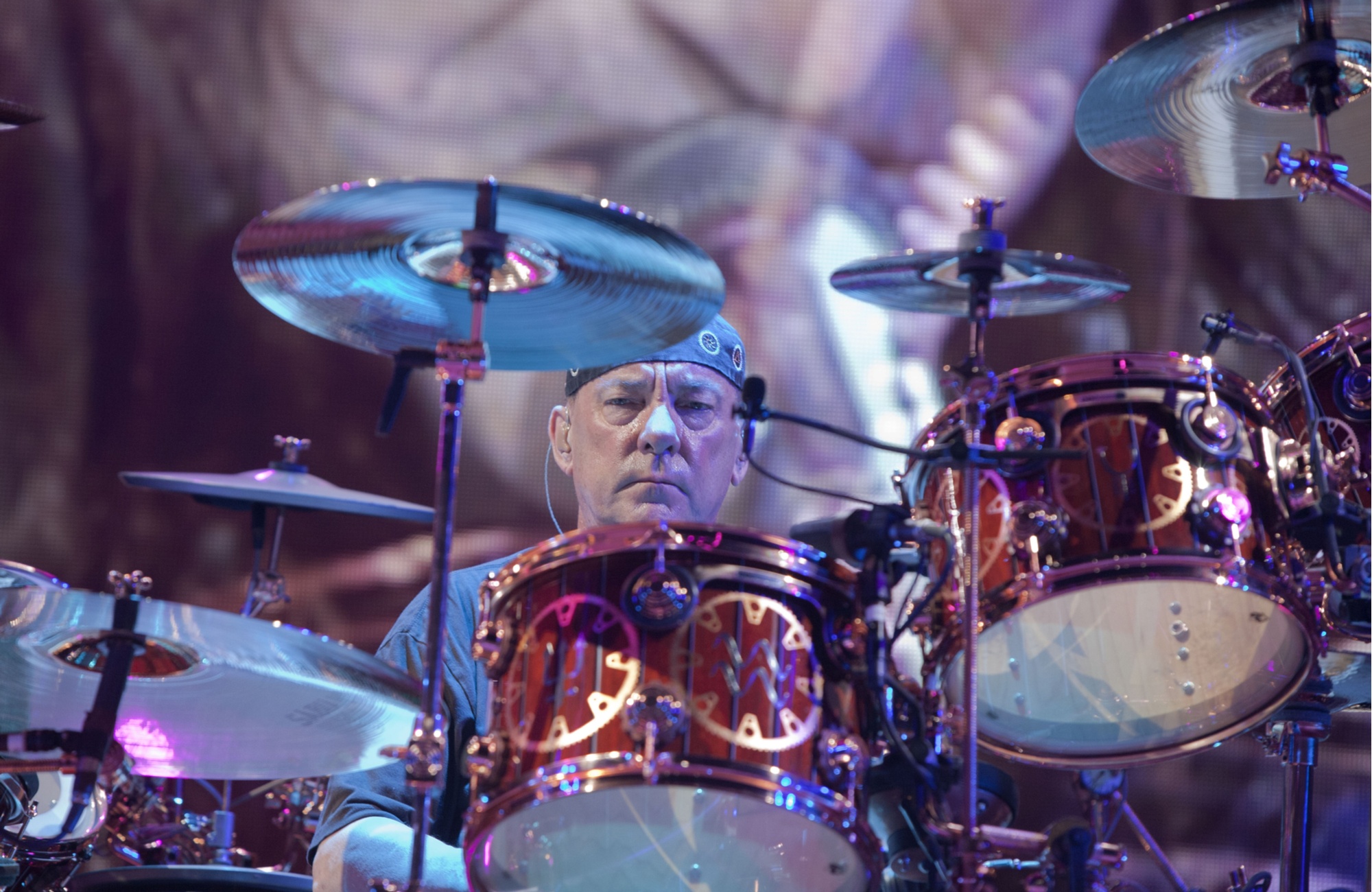

The announcement of the death of Rush drummer Neil Peart came as a tremendous shock. Having only retired about four years ago, so many fans of Rush (myself included) had convinced ourselves that this was a temporary hiatus, and that in a year or two – eventually, at any rate – there would be an announcement of a new album, a short tour, or some other project. Surely musicians of their virtuosity and passion couldn’t stay away from the studio or stage for long. But now we know we were wrong, and we know why.
It was revealed that Neil had been battling a brain tumor for over three years. Characteristically, he, his family, and friends (among the closest of whom, Rush vocalist/bass player Geddy Lee and guitarist Alex Lifeson) upheld his desire for privacy. I haven’t done the math as to whether Neil’s illness was likely a causative factor in the decision to retire, or whether it seems to have come along not long after the decision to retire.
It’s not a calculation I’m going to undertake, in part because it seems unseemly. More importantly it wouldn’t ease the pain that I and millions of others are feeling this Saturday morning.
“This one hurts,” we’re all saying to one another. It sure does.
To say that Peart was a great drummer and percussionist is an understatement of immense proportions; he was an innovator and a lifetime student, at one point breaking down his entire playing style (from matched grip to traditional grip) to more closely emulate his icons, among whom were the legendary Gene Krupa, Buddy Rich, Billy Cobham, and Ed Shaugnessy. (Drum battles were cited as inspirational by Peart, in particularly the legendary battle between Krupa and Rich.) He was inspired as well by various rock drummers. If numerous awards (both individual and for the work of Rush), liner notes, inspiration polls were the equivalent of academic citations, Peart was the reigning percussion laureate.
In his role as the lyricist of Rush, Peart took on such topics as pernicious nationalism (“Territories”), mass hysteria (“Witch Hunt”), the division between constructive and destructive belief (“Faithless”), the fall of Communism (“Heresy”), conflict and power (“The Trees”), the horrors of totalitarian rule (“2112,” “Red Sector A”) and many allusions to individual liberty (“Tom Sawyer,” “Anthem,” “The Analog Kid,” “Caravan”). He did so via lyrics which artfully and passionately evinced those sentiments; sentiments which early on suggested Objectivist perspectives, but over time developed into what he called “Bleeding Heart” libertarianism:
I call myself a bleeding heart libertarian. Because I do believe in the principles of Libertarianism as an ideal – because I’m an idealist. Paul Theroux’s definition of a cynic is a disappointed idealist. So as you go through past your twenties, your idealism is going to be disappointed many many times. And so, I’ve brought my view and also – I’ve just realized this – Libertarianism as I understood it was very good and pure and we’re all going to be successful and generous to the less fortunate and it was, to me, not dark or cynical. But then I soon saw, of course, the way that it gets twisted by the flaws of humanity. And that’s when I evolve now into . . . a bleeding heart Libertarian. That’ll do.
Neil, through his lyrics, managed to do what so many lyricists and writers – even, perhaps especially, so many libertarian intellectuals – fail to do: make liberty neither an alien fixture, a flat slogan, or a utopian slog. It is a way of thinking and living, and one which not only doesn’t ignore, but embraces the flaws and frailty of humanity, tempering realism with hope and optimism.
Despite tremendous success, Peart’s life had more than its share of setbacks and tragedy. A trip to England at 18, made with the intention of becoming the drummer of the next Beatles, Led Zeppelin, or The Who, ended with severe disillusion. The 1975 Rush album “Caress of Steel” was received poorly with the subsequent tour, now known as the “Down the Tubes Tour,” characterized by shrinking venues, crowds, and income. (Indeed, even as Rush grew tremendously successful, the rock establishment has, until very recently, been hostile to them.) And even while Rush gradually became increasingly popular, Peart found himself uncomfortable with fame, as the lyrics to “Limelight” off of the seminal “Moving Pictures” make clear: “I can’t pretend a stranger is a long awaited friend.”
In a space of no more than ten months between 1997 and 1998, Peart’s only daughter and wife passed away. He retired from drumming, got onto his motorcycle, and rode some 55,000 miles around Canada, the United States, and down into Central America, with no schedule or restrictions. From that ultimately came a book detailing his cathartic journey and slow recovery, and ultimately his decision to rejoin Rush. Later he remarried; he leaves behind his wife and ten-year-old daughter.
Travel, in fact, is a recurring theme in Peart’s life and writing. Two other books, one autobiographical (“Traveling Music,” 2004) is told amid his account of driving from Los Angeles to Big Bend State Park in Texas; another (“Masked Rider,” 1996) covers his biking through West Africa in the late 1980s. Driving and travel serve as metaphors for liberty and individualism throughout his writing on nineteen studio albums including in “Red Barchetta,” “Driven,” and “Headlong Flight” among others.
There’s simply too much great work to do justice to, let alone to wrap one’s mind around at such a time as this. “Mission,” about an artist recognizing the virtuosity of others while desperately seeking to reach the pinnacle of his own. “Closer to the Heart,” about the small role each person can – and must – play to build a better, kinder world. “Time Stand Still,” where the irresistible tide of the passage of time drives us to want to “freeze this moment, a little bit longer” and “make each sensation a little bit stronger.”
In “Xanadu” (inspired to some extent by Coleridge’s “Kubla Khan”), off the 1977 “A Farewell to Kings,” a device in the vein of Jonathan Swift’s ‘Struldbrugs’ or Tennyson’s ‘Tithonus’ is employed: a nameless adventurer finds an obscure historical reference to a place where after “scal[ing] the frozen mountaintops of eastern lands” he locates a place wherein one may “taste anew the fruits of life”: he becomes “the last immortal man”. The successful quest is a “bitter triumph,” though, as living forever saps every last morsel of value of life. Despondency and ultimately madness follow.
In “The Garden” – from today’s sad perspective, fittingly the last song on Rush’s last studio album – he wrote
The treasure of a life is a measure of love and respect
The way you live, the gifts that you give
In the fullness of time
It’s the only return that you expect
The future disappears into memory
With only a moment between
Forever dwells in that moment
Hope is what remains to be seen
Only our children and the fruits of our creativity – writing, music, invention, and any other form of innovation – persist. Inscriptions on stone, like memories, fade, but we are better for that; life is, after all, for the living.
As Neil wrote: “We’re only immortal … for a limited time.” But in the way that we influence others, either through words, our skills, or our formulations, we can achieve as close a form of immortality as entropy allows. Neil Peart’s words and music have impacted millions of lives; we who loved him and his work now carry it forward, a simultaneously poignant and ineffable duty.
Share This Article

Post on Facebook

Post on X

Print Article

Email Article