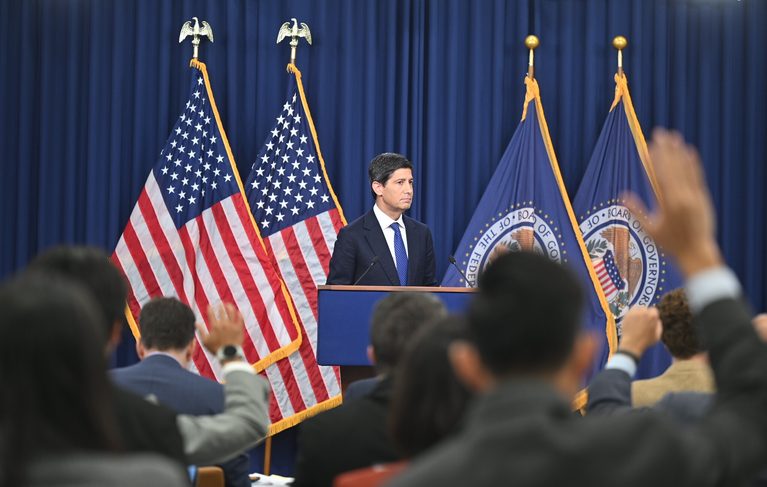
On Monday, Fed Board Member Lael Brainard and Kansas City Fed President Esther George announced the intention of the Federal Reserve to build a real-time payments (RTP) system. The government, including the Federal Reserve, isn’t in the innovation business.
In fact, the private sector has been providing such an RTP system for several years now. There was a true need for it and, by digital trade standards and international comparison, the United States had become embarrassingly slow at clearing of interbank transfers.
This new industry is still in its infancy, but it currently reaches over half of the accounts in the country and is expected to reach nearly all U.S. accounts by the end of 2020. Yet, the Fed decided to create its own system.
A few months ago, when the idea was floating around, I explained that the Fed’s idea was bad. Here are my main arguments:
The Mercatus Center hosted a recent debate on this issue, and all parties agreed on having the Fed extend the hours of its existing wire network facilities (Fedwire). The debate concerned whether the Fed should also establish a “Real Time Gross Settlement facility” to make all Fedwire payments clear and settle instantaneously. That more radical reform will take several years and compete with TCH.
Georgetown University’s Jim Angel argued in support of the Fed directly providing faster payment services. A common argument for that position is that it would prevent a monopoly situation, as there’s only one current, private real-time payments provider. This argument rests on fears that no other player will enter the space given the network effects and regulatory burden that come with being a payments service provider to banks, along with a suspicion that TCH could abuse its power. A lack of trust expressed by small banks against TCH could also be a barrier to achieving “ubiquity.” This is questionable.
This real-time clearing industry is in its infancy. It’s often the case that one supplier of a new technology leads the way, with many more to follow. Faster payment services built on different networks are already being offered by Visa, MasterCard, PayPal, Square and others. More entrants should get in since TCH is better than the status quo but not perfect.
Also, TCH’s real-time payments fee structure is already more generous to small banks than the Fed-operated Automated Clearing House Network. And the governing board for real-time payment systems includes community banks and other representatives, which is reason to doubt that TCH would abuse allegedly monopolistic powers.
The belief that the Fed’s operation of a real-time payment system will enhance competition ignores the past. Instead, it’s likely that the Fed entering the market will discourage others from doing so, which could slow down or stop innovation. Few businesses want to go toe-to-toe with a competitor like the Fed that has the full financial and legal backing of the U.S. government or can write regulations creating demand for its own product.
As the Cato Institute’s George Selgin — who opposes the Fed entering the space as a provider — explains in the debate, the Fed’s entrance may also have the counterintuitive effect of slowing U.S. adoption of real-time payments, as would-be market entrants sit out and wait while the Fed develops and launches its system at the speed of government. The Fed’s proposal has already likely discouraged some banks from joining TCH’s system.
This doesn’t mean there’s no role for the Fed to play here. Selgin summarizes his agreement with Brookings Institution’s Aaron Klein on this point, noting that “the Fed, as a monopoly supplier of final settlement services for the nation’s banks, has an obligation to reform those facilities as needed to expedite payments.… [I]t should do so in part by offering 365-day, round-the-clock interbank settlement services, either by extending the operating hours of Fedwire or by creating a special ‘liquidity management tool’ (LMT) for the purpose.”
Building a system that makes funds available faster to payees, which is different from one that speeds up the settlement of dues among financial institutions, will significantly reduce costs. This change, however, doesn’t require the Fed to build a real-time payment system itself. That move would, in fact, be detrimental to the whole effort.”
I haven’t changed my position about this issue. But, interestingly, we now have some details about this grand new Fed project. You will recognize many of the usual government features.
While there is a system up and running, the Fed estimates that its “FedNow” system will not be functional until 2023 or 2024. You can add a few years to that for the system to achieve nationwide reach.
Why would development of the Fed’s system take so long compared to that of the private sector? I am not sure but I think the answer is synonymous with “bureaucracy”.
What’s more, the distortions will be significant. We know that many businesses and investors believe that there is some safety in a government product. You see this when the government decides to extend a loan guarantee to a particular project, independently of the merit of the project. Private capital tends to follow attracted by the illusion of safety. The same is likely true here. Because of the rumors that the Fed may enter this market, many smaller banks and credit unions have chosen not to participate in the private RTP system, holding out hope that the central bank will build a competing service. Now, they may have to wait for another 4-5 years (even then, by their own acknowledgement, they won’t offer universal reach then).
Government involvement in this space will also reduce the chance of new entrants. Some investors and innovators may feel that competing with the Fed is the business version of bringing a knife to a gunfight. As Steve Moore and Norbert Michel just wrote in a brief on the issue:
“No private firm can safely charge as low a price as the Fed or absorb high costs.
The Fed has an obvious advantage in any venturing into activities now conducted by private lenders: It has effectively the lowest borrowing costs in the world because the full faith and credit of the U.S. government stands behind it. The Fed can’t go bankrupt, and by its enormous size and stature is the behemoth in the banking universe.”
Second, and making matters worse, it is unclear that the Fed RTP system will be interoperable with the Clearing House RTP system. Imagine a replay of the VHS-Betamax format war except that one competitor (the private sector) is now weighted down with rocks and asked to swim among sharks, by its regulator and competitor (the Fed). Unfortunately, in this case, there may not be an innovation like the DVD to save consumers from the Real Time Payment war.
The bottom line is that the Fed should stay in its lane and return to its traditional role of facilitator of real-time payments.
Share This Article

Post on Facebook

Post on X

Print Article

Email Article