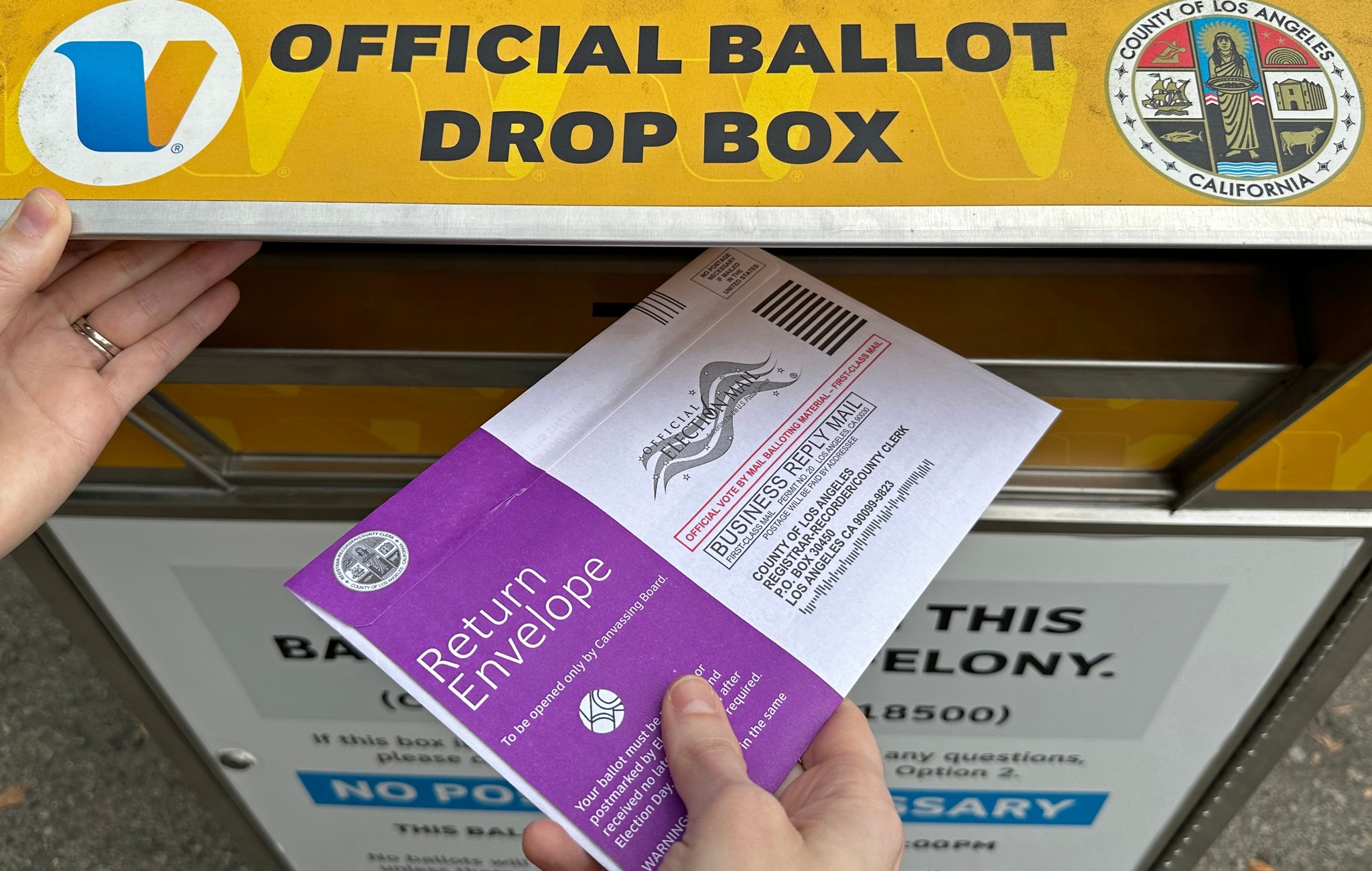
On Tuesday night, millions of Americans will track election results to see which party controls Congress after the ballots are counted. Far less attention will be paid to state elections, including ballot initiatives that could have far-reaching economic consequences.
Here are five outcomes to watch.
1. California Proposition 40: The ‘One-Time’ Billionaire Wealth Tax
Unlike other items on this list, most readers have likely already heard about California’s proposed tax on billionaires, which would impose a “one-time” 5 percent tax on “certain covered assets” above $1 billion. (Don’t ask how this wealth will be determined.)
Even though the proposed tax has yet to pass, let alone be implemented, it has already generated considerable media coverage, in no small part because it has been credited with driving several billionaires from the Golden State, including movie director Steven Spielberg and Google founders Larry Page and Sergey Brin.
There are plenty of problems with this proposal, especially if one cares about property rights. But perhaps its biggest problem is one of utility: factoring in the likelihood of capital flight, it’s actually projected by economists to generate negative revenue for the state.
That may be one reason Prop 40 is expected to lose, according to prediction markets.
Prop 40 only requires a simple majority to pass, but there’s a catch. Even if the initiative does exceed the 50 percent threshold, it could be blocked if competing Propositions 41 or 42 receive more “yes” votes.
2. Florida Amendment 3: Expanding the Homestead Exemption
In Florida, voters will weigh Amendment 3, potentially amending the Florida Constitution to supercharge the property-tax exemption for qualified homeowners and other property owners. The first $50,000 of homestead value is exempt from non-school-district property taxes now; this measure would increase that floor to $150,000 in 2027 and $250,000 in 2028, with inflation adjustments thereafter. (The amendment would also place new restrictions on how local governments use property-tax revenue.)
There’s a lot to hate about property taxes, which invert the moral order of ownership. But tax cuts also come with trade-offs. The most widely discussed tradeoff in this case is the estimated $45 billion in lost revenue for local governments over five years.
That may not be the only trade-off, however.
“Abolishing, or drastically capping, property taxes would centralize government at the state level, making local governments less responsive to residents, especially homeowners,” AIER economist Jason Sorens wrote in a property-tax explainer last year.
While Amendment 3 might be music to the ears of anti-tax advocates, it’s currently facing an uphill battle. Unlike California’s Prop 40, Amendment 3 requires 60 percent voter approval to pass.
3. North Dakota Constitutional Measure 2: School Lunch Funding for All
In North Dakota, voters will have the opportunity to vote for free lunches — literally.
Constitutional Measure 2 would require public schools to offer “free” breakfast and lunch to every student enrolled in a K-12 school, regardless of family income. (Under current means testing, one in three students receives free or reduced-price meals.) The state would require schools to provide the meals, then reimburse them for costs not covered by other government funding.
Students of economics, of course, will point out the obvious: there is no such thing as a free lunch. Somebody always pays. In this case, the costs are simply shifted from school kids’ families to their community’s taxpayers: an estimated $124 million to $134 million in new and ongoing biennial expenditures.
That is unlikely to be the policy’s only trade-off, however. For example, economic research has found significantly higher amounts of food waste in schools offering universal “free” meal programs than in other schools. These programs have also been linked to rising childhood obesity in some research, though a move toward healthier school meals may have halted that trend.
Constitutional Measure 2 would pass with a bare majority under North Dakota’s current rules for constitutional amendments. Another measure on the ballot, however, would raise that threshold to 60 percent, and it’s unclear whether this would apply to Constitutional Measure 2.
4. Wisconsin Question 3: Restrictions on Government Preferences
Should government entities be allowed to discriminate on the basis of race, sex, or national origin? That’s the question Wisconsin voters will decide on Tuesday. Question 3 essentially puts DEI on the ballot:
“A ‘yes’ vote supports this amendment to prohibit any governmental entity from discriminating or granting preferential treatment based on race, sex, color, ethnicity, or national origin in public employment, public education, public contracting, or public administration.”
The stakes for Question 3 may go beyond the borders of Wisconsin.
DEI has been in full-blown retreat in corporate America for two years. Wisconsin’s vote may help determine whether that retreat continues or whether there are attempts to revive policies that discriminate against some to actively benefit preferred groups, despite recent setbacks at the Supreme Court.
While the measure isn’t explicitly economic, its consequences will ripple through public contracting, hiring procedures, and compliance costs.
5. Arizona Proposition 316: Local Taxes on Groceries
Unlike the other measures on this list, Prop 316 isn’t a constitutional amendment. It’s a “legislatively referred state statute” that would cap local grocery taxes at 2 percent and require voter approval for any increase. (Local governments that already have tax rates that exceed 2 percent would be allowed to maintain them, but could not further increase them.)
The great economist Adam Smith once observed, “The tax which each individual is bound to pay ought to be certain, and not arbitrary.” Unfortunately, this discipline is largely forgotten today, which helps explain why the US tax burden is so heavy and falls so broadly and unevenly.
Prop 316 is designed to ensure that food, one of the most vital human necessities, doesn’t become a cash cow for local governments.
The measure requires a simple majority to become law and is currently forecast to pass.
Conclusion
On Tuesday night, many Americans will be glued to their TVs and computers, watching election returns to see who controls the Senate and House of Representatives. But the American system was intentionally designed to divide and frustrate power, which is why the Constitution gave states, in the words of James Madison, “numerous and indefinite” powers.
In many ways, these “laboratories of democracy” are still working today, and voters across the country will determine whether their local governments innovate and thrive or calcify under heavy-handed policies.
Share This Article

Post on Facebook

Post on X

Print Article

Email Article