

The reputation of academic publishing depends upon peer review – the practice by which other experts vet submissions to scholarly journals. A properly functioning peer review process flags potential problems before they appear in print. An anonymous referee might notice complications to a thesis that an author failed to account for, prompting another round of revisions to improve the piece. If an author misrepresents evidence for a claim, an anonymous referee might alert the journal editor to the problem. Usually, the author will be asked to address the issue in a revision. If the problem is severe or intentional, the piece might be rejected outright.
But what happens when academic peer review breaks down? What if an anonymous referee flags serious problems in an article such as misrepresented evidence or basic errors of fact, but the journal’s editor chooses to run the piece anyway? What happens when the same problems are then noticed by other scholars after the article appears in print? Surely a formal correction of some sort would be in order.
Factual corrections used to be a regular practice of most scholarly journals, whether in the form of a short comment or a longer point/counterpoint exchange over the disputed claim. In the hyper-politicized state of academia today, a growing number of scholarly venues no longer see a need to attend to basic standards of factual accuracy in their pages. Factual errors – even egregious ones such as misrepresented evidence and manipulated quotations – are now apparently allowed to stand unchallenged, provided that the error aligns with a politically fashionable viewpoint. This was my own experience after a frustrating year and a half long effort to seek basic factual corrections to an unambiguous error in an article in a journal published by Cambridge University Press.
The saga started in 2019 when Wellesley College historian Quinn Slobodian published a pair of articles in scholarly journals, containing an explosive charge against Ludwig von Mises. Writing for the journal Cultural Politics, Slobodian alleged that “race theory has an ambiguous place in Mises’s work,” which in turn has allowed modern day racists to claim inspiration from the free-market economist. Slobodian repeated and elaborated upon the charge in an article for Contemporary European History (CEH), stating that “libertarians who scour [Mises’s] writings to validate their divergent positions on migration can claim fairly to find confirmation of both sides of the argument.” One side of the story, he continued, derived from Mises “the realist, who saw race as a quasi-permanent category of global social organization. Despite his liberal principles the Habsburg polyglot never became the radical anti-racist.”
While Slobodian acknowledged in both articles that Mises adhered to a broad liberal philosophy that clashed with the racist and imperialist ideologies of his day, his argument held that Mises’s works contained a “parenthetical opening to the possibility of race theory” – a reference to pseudoscientific concepts that purport to link race and intelligence. That posited “parenthetical opening,” in turn, allegedly establishes Mises as a historical progenitor of later defenses of race theory and imperialism.
In his subsequent writings, Slobodian extends this argument into modern politics by crediting Mises and so-called “neoliberals” in general for inspiring the anti-immigration and race theory arguments that are found in the works of economist Hans-Hermann Hoppe, which in turn attained popularity among various Alt-Right and Trumpian political movements in the 2010s. By implication, Mises and “neoliberalism” may be deemed blameworthy for allegedly inspiring these causes.
A Thesis Built on Textual Misrepresentation
When I first encountered Slobodian’s thesis after reading drafts of his CEH article in late 2018, something seemed amiss. Mises had devoted substantial energy in his 1927 book Liberalism to attacking the then-popular field of eugenics. His later works such as 1944’s Omnipotent Government contained a philosophical broadside against Nazism, singling out the errors and evils of Nazi racial theory in particular. How, exactly, had Slobodian discerned a parenthetical opening in Mises’s works for the very concepts and positions that Mises condemned?
It did not take long to find an answer to that question. In both articles, Slobodian displayed a habit of misrepresenting excerpted passages from Mises’s works by either omitting directly pertinent context from surrounding passages or, in some instances, directly removing content from the quotes themselves to change their meaning. In each case, the edits made Mises’s words appear sympathetic, or at least open to, to a variety of racist and imperialist beliefs, when in fact he was condemning them. I flagged several of these passages in my notes when reading. In the months that followed their publication, other scholars began to notice the same patterns in Slobodian’s depictions of Mises as well as his use of quotations.
I’ll summarize a few of the more egregious examples as an illustration. In his CEH article, Slobodian writes:
“When necessary, the opening of world markets had to be achieved through violence. Though ‘one can think only with shudders and anger of the fearful mass murders that prepared the basis for many of the colonial settlements flourishing today’, [Mises] wrote in a book published the year after the First World War, the net gain made it worthwhile; in the end, ‘all other pages of world history were also written in blood’. Violence in the project of expanding the space of foreign investment, wage labour and commercial exchange was not only acceptable, it was necessary.”
Compare that same passage to Mises’s original text from his 1919 book Nation, State, and Economy. The quoted portion is underlined, but in Slobodian’s account the entire second half of the sentence is omitted:
“It is true that those colonies were not taken with smooth talk, and one can think only with shudders and anger of the fearful mass murders that prepared the basis for many of the colonial settlements flourishing today. But all other pages of world history were also written in blood, and nothing is more stupid than efforts to justify today’s imperialism, with all of its brutalities, by reference to atrocities of generations long since gone.”
In another example from Slobodian’s CEH article, he excerpts a descriptive passage from Mises’s 1944 book Omnipotent Government to once again ascribe him with a certain degree of toleration for racist beliefs:
“While [Mises] distanced himself from people who opposed non-white immigration in defence of ‘Western civilization,’ he conceded that:
“[W]e must not close our eyes to the fact that such views meet with the consent of the vast majority. It would be useless to deny that there exists a repugnance to abandoning the geographical segregation of various races. Even men who are fair in their appraisal of the qualities and cultural achievements of the colored races and severely object to any discrimination against those members of these races who are already living in the midst of white populations, are opposed to a mass immigration of colored people. There are few white men who would not shudder at the picture of many millions of black or yellow people living in their own countries.”
By the 1940s Mises partially legitimised closed borders for non-white migrants as a near permanent feature of the world order.”
Slobodian repeats this charge in the second article for Cultural Politics, citing both Mises and his own article in CEH:
“And yet, in his 1944 work, Mises conceded the difficulties of racial integration, writing in a phrase, often cited by latter-day Mises Institute Austrians, about immigration barriers that “there are few white men who would not shudder at the picture of many millions of black or yellow people living in their own countries (1944: 107; Slobodian 2019)”
The problem with his claim may be clearly seen by turning to Mises’s original passage. Once again, Slobodian deleted portions of the text that disconfirmed his thesis. Rather than leaving an ambiguous opening for racism, Mises was actually describing the racist position first and then condemning it in no uncertain terms:
“We must not close our eyes to the fact that such views meet with the consent of the vast majority. It would be useless to deny that there exists a repugnance to abandoning the geographical segregation of various races. Even men who are fair in their appraisal of the qualities and cultural achievements of the colored races and severely object to any discrimination against those members of these races who are already living in the midst of white populations are opposed to a mass immigration of colored people. There are few white men who would not shudder at the picture of many millions of black or yellow people living in their own countries. The elaboration of a system making for harmonious coexistence and peaceful economic and political coöperation among the various races is a task to be accomplished by coming generations. But mankind will certainly fail to solve this problem if it does not entirely discard etatism. Let us not forget that the actual menace to our civilization does not originate from a conflict between the white and colored races but from conflicts among the various peoples of Europe and of European ancestry.”
Note that the omitted passage immediately after the underlined section directly contradicts Slobodian’s claim that “Mises partially legitimised closed borders for non-white migrants as a near permanent feature of the world order.” Far from extending near permanent legitimacy to the racist positions he described, Mises explicitly called on the next generation to solve the problem of racism and pointed out that, contrary to the race theorists’ recurring predictions of a civilizational war between people of different skin colors, the present war – World War II – originated from a white European state invading other white European states.
As an added bonus, Slobodian’s claim that the passage was “often cited by latter-day Mises Institute Austrians” to justify immigration restrictions is itself without evidence. The passage appears nowhere on the Mises Institute website, save for a PDF of the original book.
Another egregious example of quote-editing may be found in Slobodian’s Cultural Politics article, although it is more difficult to detect since it involves his own English-language misrepresentations of an untranslated German-language book by Mises from 1940. I present a textual comparison of the passages side-by-side for consideration.

As may be seen from Slobodian’s depiction, he attempts to portray Mises as making only a narrowly qualified objection to eugenic theory based on its “misuse” by the Nazis. Such “misuse,” Slobodian claims, did “not discredit it permanently” in Mises’s eyes. To reach this conclusion, however, Slobodian engaged in substantial edits to Mises’s text by rearranging the ordering of entire passages to make them fit his thesis. Slobodian once again edited out text that disconfirmed his claims, including a passage where Mises states that attempts to validate eugenic theory had “failed because it is easy to prove that every division of people into types of Verstehen thwarts the organization by ethnicity. Never, however, has one dared to assign the types of Verstehen to innate physical characteristics.”
(As a curious aside, Slobodian also appears to be unaware of Mises’s use of Verstehen, a Weberian sociological concept, and instead translates it literally as the German word for “understanding”)
In another example from the CEH article, Slobodian writes:
“Yet Mises proved incapable of extending a similar cosmopolitan attitude to populations of colour. Even as he argued emphatically that ‘there are today no pure stocks within the class or race of white-skinned people’, he did so by pointing out the difference with black populations. ‘Negroes and whites differ in racial – i.e., bodily – features’, he wrote, ‘but it is impossible to tell a Jewish German from a non-Jewish one by any racial characteristic’. Mises’s rejection of anti-Semitism was premised on an affirmation of white–black race difference.”
Slobodian’s strong insinuation here is that while Mises opposed white discrimination against other white people, most notably seen in anti-Semitism from the Nazi era, he drew a line of distinction between this form of persecution and racism against black people. To make this point, Slobodian presents several excerpted passages from Mises as if they were sequential claims, even asserting that Mises’s objection to anti-Semitism “was premised on” differentiating that form of discrimination from white-against-black discrimination.
Turning to the original text of Mises’s Ominipotent Government, however, we quickly find that Slobodian essentially manufactures this claimed link by excerpting and combining quotations from distinct passages.
The first quotation comes from a passage where Mises is dissecting and rebutting the Nazi racial arguments that were used to justify the persecution of Jewish people (including Mises himself, who was chased out of Austria on account of being Jewish). Mises’s purpose in doing so was to illustrate the falsehood of the Nazis’ own claim to come from “pure” Aryan stock, whereas Jewish and other white Europeans were said to be of “impure” stock
“For more than a hundred years anthropologists have studied the bodily features of various races. The undisputed outcome of these scientific investigations is that the peoples of white skin, Europeans and non-European descendants of emigrated European ancestors, represent a mixture of various bodily characteristics. Men have tried to explain this fact as the result of intermarriage between the members of pure primitive stocks. Whatever the truth of this, it is certain that there are today no pure stocks within the class or race of white-skinned people.
Further efforts have been made to coordinate certain bodily features—racial characteristics—with certain mental and moral characteristics. All these endeavors have also failed.
Finally people have tried, especially in Germany, to discover the physical characteristics of an alleged Jewish or Semitic race as distinguished from the characteristics of European non-Jews. These quests, too, have failed completely.”
Although Slobodian presents it as an adjacent sentence in his excerpt, the second passage comes from several paragraphs later in Mises’s text where he turns to the question of how Nazi racial ideology differed from other forms of discrimination. One distinguishing factor of the Nazis was their attempt to impose discrimination on the grounds of establishing a genealogical link to Judaism.
“The Nazis have chosen a different way. They say, it is true, that they want to discriminate not against people professing the Jewish religion but against people belonging to the Jewish race. Yet they define the members of the Jewish race as people professing the Jewish religion or descended from people professing the Jewish religion. The characteristic legal feature of the Jewish race is, in the so-called racial legislation of Nuremberg, the membership of the individual concerned or of his ancestors in the religious community of Judaism.”
Mises then turns to the second excerpted passage as a point of contrast for how discriminatory institutions operate. He uses the example of the Jim Crow era in the United States, where discrimination was based primarily on appearances and skin color:
“If Americans want to discriminate against Negroes, they do not go to the archives in order to study the racial affiliation of the people concerned; they search the individual’s body for traces of Negro descent. Negroes and whites differ in racial—i.e., bodily—features; but it is impossible to tell a Jewish German from a non-Jewish one by any racial characteristic.”
Contrary to Slobodian’s insinuation, there is no evidence that Mises condones discrimination against African-Americans. Quite the opposite – he condemns discrimination itself. Neither does his objection to anti-Semitism depend upon “an affirmation of white–black race difference,” as Slobodian claims. Rather, he is simply analyzing how the Nazi racial laws turned to characteristics other than skin color as a means of affecting their persecution of Jewish people, focusing instead upon tracing the genealogies of their victims. As Mises pointed out in the very next paragraph though, “The Nazis have claimed that they were fighting the decisive war between the Nordic master race and the human underdogs,” yet the very existence of such a “master race” was itself a myth that the Nazis selectively invoked to rationalize their persecution of Jewish people and other disliked groups.
As with the German-language example in the Cultural Politics article, this depiction from the CEH article relies on taking liberties with Mises’s quotes to rearrange their order in a way that appears to support Slobodian’s preconceived thesis.
These examples only represent some of the most egregious textual edits in Slobodian’s articles. They are nonetheless sufficient to illustrate a recurring pattern of misrepresentation, as opposed to accidental sloppiness. In each case, Slobodian takes a passage from Mises’s works and removes text so as to completely invert the meaning of the passage. He then presents the edited text as a quasi-endorsement of the very same things – racism, imperialism, eugenics – that Mises was condemning in the unedited original.
An Attempted Correction
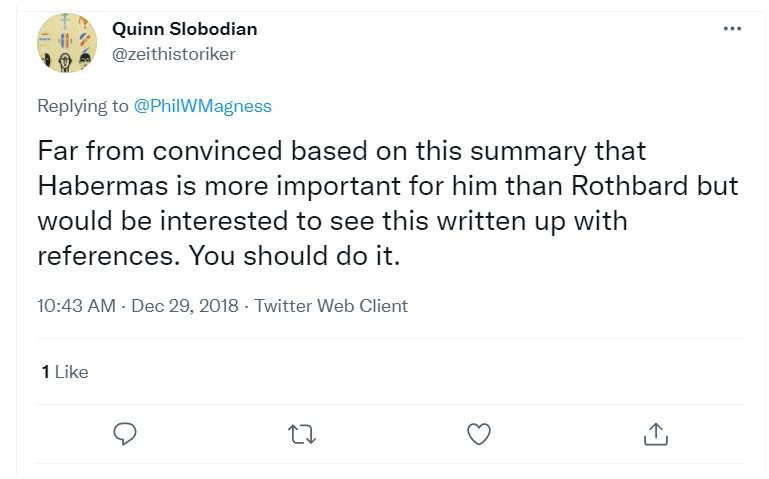
After first noticing some of the aforementioned textual misrepresentations in Slobodian’s article, I attempted to bring them directly to his attention and ask for a clarification or correction. This occurred in late 2018 after Slobodian hinted at the Alt-Right thesis on his Twitter feed. Whereas Slobodian identified Mises as a source for Hoppe’s anti-immigration positions and with it the Alt-Right, I suggested an alternative explanation for their intellectual origins.
Contrary to Slobodian’s insinuations, Hoppe did not appear to draw any of his immigration claims out of Mises’s texts and certainly not the passages that Slobodian misquoted. In fact, Hoppe identifies Mises as an expositor of the “classical” economic argument for open immigration – and then promptly rejects the same as an antiquated view from an earlier time. As Hoppe writes in a 2001 text, “The problem with the above argument is that it suffers from two interrelated shortcomings which invalidate its unconditional pro-immigration conclusion and/or which render the argument applicable only to a highly unrealistic-long bygone-situation in human history.”
My alternative thesis, which I outlined to Slobodian in December 2018, called attention to Hoppe’s use of discursive philosophical reasoning to build up a theory of property rights absolutism, which he then used in turn to justify state action to exclude immigrants from a country. As I noted at the time, the intellectual genesis of Hoppe’s discursive approach did not come from Mises, but rather out of Hoppe’s own academic training under the German philosophers Juergen Habermas and Karl-Otto Apel. This realization may seem strange at first as Habermas and Apel are generally associated with Frankfurt School critical theory and the political far-left, whereas Hoppe comes from the far right. Yet Hoppe wrote his dissertation directly under Habermas, and at least in the earliest iterations of his arguments, specifically claimed to be adapting their discursive analysis in a rightward direction. No less a source than Murray Rothbard would write in 1990 that “Hoppe is a libertarian extension” of “the Habermas-Apel doctrine.”
Slobodian was naturally skeptical of my counter-thesis, and maintained at the time that he had correctly represented Mises’s texts. He nonetheless offered an interesting concession by inviting me to write a rebuttal that explored the idea and laid out the evidence against his soon-to-be-printed article in CEH.
Shortly thereafter I began working on a draft article that traced the influence of Habermas and Apel on the Austrian economic debates of the 1980s, identifying their influence on Hoppe’s later work. In doing so, I engaged Slobodian’s pair of articles where he proposed Mises as the alternative origin. Naturally, this afforded an opportunity to explore Slobodian’s misuse of Mises’s text, calling attention to several examples of edited and misrepresented quotations in both articles. I finished a working draft of this article in the fall of 2019 and presented an early version of it at an economics conference. After incorporating feedback on the draft article, I submitted it to Contemporary European History for consideration on January 8, 2020.
The choice of this venue seemed obvious. Slobodian’s CEH article had appeared in print a few months earlier, and my piece corrected several clear textual misrepresentations in Slobodian’s work while also presenting an alternative thesis for the events that he described. While no journal is obliged to accept every submission it receives, debates of this sort are the essence of scholarly exchange – particularly when they involve a contested thesis that recently appeared in print in the same journal.
What happened next took me by surprise.
Instead of considering my piece or responding to the revelations of misrepresented Mises quotations in Slobodian’s article, the editor of CEH sent me an extremely prejudicial desk rejection in a matter of days. My article, she claimed, had “barely any primary source base or methodology” even though it brought several previously unknown sources to light, such as the aforementioned Rothbard material. Slobodian’s article, by contrast, had no clear methodology and relied almost entirely on quotations from secondary sources such as Mises’s published books, which he then misrepresented. Furthermore, the editor objected that I had uploaded an earlier working draft of the paper for the aforementioned conference presentation – an entirely common and accepted academic practice – and claimed that this draft meant that my article had already been “published” in another journal (by this same standard, almost any scholar who presented at an online academic conference in 2020-21 due to Covid would be disqualified from submitting those papers to scholarly journals on account of simply sharing a draft for the other online participants to read).
Since my paper involved not only a competing thesis to a paper published in CEH a few months prior, but substantive factual corrections to the misrepresented quotations in that paper, I sent the editors of CEH the following inquiry on January 25, 2020:
Dear Editors,
Thank you for your response below. While I am disappointed by your decision, I understand that differences of focus and method carry limitations for a venue such as yours.
Since my argument does contain specific factual corrections to claims made in a recently published article in Contemporary European History, I am writing out of curiosity to ask what an appropriate corrective for the readers of your venue (e.g. letter, comment, or note) might entail.
Sincerely,
Phil Magness
It was my hope at the time that, even if they declined to run a lengthy response to Slobodian’s argument, the journal would at least recognize the factual errors arising from his misrepresented Mises quotations and permit a shorter correction or note acknowledging the dispute over his claims.
I received a short reply from one of CEH’s editors, Victoria Harris, on January 31, 2020, stating “Thanks for this. I sent your first email on to the editor responsible for your piece.” I never received another response, despite sending multiple follow-up inquiries (After over a year of deflection, CEH’s editors eventually claimed that their unresponsiveness to email was caused by Covid-19).
The problems with Slobodian’s articles persisted as other scholars – relying on his account – began repeating and amplifying his allegations against Mises. Building upon the misrepresented quotations, one academic accused Mises of mounting a “racialized attack” on democracy. Another claimed that Slobodian had shown that “many right-wing European founding fathers” – her categorization of Mises and the Austrian school – “basically had the same core beliefs as the Alt-Right supporters.” Allegations of racism against Mises were clearly beginning to snowball, including extending the charge beyond Slobodian’s original insinuations.
At the same time however, other scholars with backgrounds in the history of economic thought began to notice the same problems with Slobodian’s textual misrepresentations, including the passages I documented above. David Gordon posted one such list in early March 2021, comparing Slobodian’s article with Mises’s texts and finding clear evidence of edits that altered the meaning of the original passages. With this list of examples in hand and having never received a response from CEH, I wrote the journal again on March 15, 2021 to inquire about an appropriate correction to Slobodian’s article. I received the following answer from the journal on March 24:
Dear Dr Magness,
Our publication process involves a rigorous peer-review system of multiple reviewers for each piece, a process which ensures the high-quality of our research articles. Scholarship, of course, evolves, and interpretations differ. This is why we host roundtables to discuss different viewpoints on broad topics (the Spanish Civil War, most recently).
However, in this specific case, we are confident about the academic rigour of Slobodian’s piece.
We hope you and yours are keeping well in these difficult times.
All Best,
Contemporary European History
The response not only failed to address any of the factual problems with Slobodian’s misrepresented quotations, it also unintentionally revealed a new and unforeseen twist to our now year-long exchange.
As I learned shortly thereafter, the problems I pointed out about the Mises quotation edits were not unknown to the editors of CEH at the time I brought them to their attention. These issues had, in fact, been flagged over a year prior during the original peer review of Slobodian’s submission to the journal. Despite being aware of the problematic quotations and claims, the editors of CEH decided to accept Slobodian’s article as-is and published it without addressing their own referee’s stated concerns over the same quotation issues.
In doing so, the editors of CEH overruled an explicit recommendation to reject Slobodian’s article over its misrepresentation of Mises’s texts.
Ignoring Peer Review
When Quinn Slobodian first submitted his article “Perfect Capitalism, Imperfect Humans” to Contemporary European History, it contained a very different thesis than the final published version. While his approach in the original draft exhibited a generally adversarial stance toward Mises’s economics, echoing his 2018 book Globalists, it did not charge Mises with harboring a qualified tolerance for racism and imperialism. Instead, it advanced a comparatively temperate thesis: Mises’s writings in the interwar era revealed his attempts to navigate the tumultuous political realities of a post-Hapsburg central Europe as they chafed with his philosophical commitments to open-borders liberalism. Slobodian argued that Mises looked back to the prewar Austro-Hungarian Empire as an institutional framework for a liberal political order in matters of immigration. His interwar writings maintained that normative liberal preference, but found it increasingly intruded upon by post-World War I restrictions on movement and – eventually – the rise of illiberal totalitarian regimes on the European continent in the prelude to World War II.
During the first round of peer review – as I learned from an inquiry with CEH’s publisher Cambridge University Press – Slobodian’s original article was sent to four referees. Two referees recommended minor revisions to the piece, a third recommended major revisions, and a fourth recommended rejection (albeit on the grounds that the reviewer had mistaken it for a repetition of Slobodian’s book Globalists, not realizing it was the same author due to blind review). The journal’s editors accordingly instructed Slobodian to revise-and-resubmit his article, attending to the three referees who suggested revisions.
By all appearances, Slobodian then used the revise-and-resubmit opportunity to make substantial changes to his article and thesis. Most of the misrepresented Mises quotations were added to the article during this time. Its argument was reworked to include the new contention that Mises shifted to an ambiguous position on racism, imperialism, and related matters during and after World War II. He worked this new thesis into the article’s conclusion, even charging that Mises’s rejection of Nazi Anti-semitism “was premised on an affirmation of white–black race difference” as if to imply that the economist would not extend similar objections to anti-black racism.
The editors of CEH then sent Slobodian’s substantially revised article to two of the original four referees. At some point during this second round, the basic mechanisms of peer review collapsed. One of the referees recommended accepting the revised paper as-is. But the other referee noticed the substantial additions to the article, including its new and altered thesis. When investigating those additions, the same referee observed the aforementioned pattern of misrepresented quotations.
I quote directly from the Round #2 referee report, which flagged Slobodian’s changes and alerted the editors of CEH to a substantial problem with the revised submission:
“Having read the revised article and then reread the original version, I am not sure what happened here. It seems that the author has changed his mind on the fundamental meaning of Mises’ work, which he now expresses in the introduction and conclusion, while much of the body of the article is left intact. This leads to an underdeveloped, but very serious accusation that Mises is a racist, as well as a stretched attempt to make a link with contemporary political developments. This makes the article substantially weaker than it originally was, and makes one unsure about the central claim of the article.”
At some point during the revise-and-resubmit process, Slobodian had decided to take an initially impartial and scholarly argument and turn it “openly political.” As the referee warned the editors, “[T]he article is now weaker than in the original version, and based on dubious historical scholarship: quoting out of context, partial reading of the relevant material, and ascribing views to others that they did not hold.”
The referee specifically called attention to an “out-of-context quote from Mises’ Omnipotent Government” and alerted the editors to the surrounding passages, which stated Mises’s objections to the racial dimensions of fascism. Anticipating my own later criticisms of the published article, the referee also pointed out that Slobodian was conflating Mises’s descriptions of his adversaries’ positions (i.e. the Nazis) with his own personal stance, and omitting adjacent paragraphs where Mises clearly laid out his own opposite position. The report continues:
“In the book ‘Omnipotent Government’ this passage comes after a paragraph that presents the views of his opponents, with which he clearly disagrees, for he sees political-economy causes where other’s see racial causes. But even from this passage itself it is perfectly clear that he is making an argument about political feasibility at that time (1944!), not a principled argument. And Mises goes on to conclude that the wars of the past years were not at all between races, but instead were conflicts within Europe and Asia, caused by ‘etatism’. Yet the author feels confident enough to conclude that Mises: “By the 1940s, Mises partially legitimized closed borders for non-white migrants as a near permanent feature of the world order.”. No, that is what others sought to do, and what Mises sought to overcome, given the political reality of his time.”
In the concluding remarks, the referee “strongly suggest[ed] that the article is not published in its revised form” and urged the author and editors to attend to the problematic quotations. The referee then recommended the rejection of the revised piece.
A Failure of Editorial Integrity
For reasons that are still not entirely clear, the editors of CEH declined to act upon the Round #2 referee’s warnings. They proceeded to accept the revised article as-is. They do not appear to have even asked Slobodian to respond to the allegation that he misused Mises’s work.
To complicate matters even further, Slobodian himself was named as a new co-editor of CEH in the Spring of 2020 – shortly after the start of my own exchanges with the journal, asking them to investigate and permit a response to the problematic quotations. Despite the obvious conflict of interest that this situation now presented, the journal remained unresponsive and ultimately refused to take any further action on the matter. Spanning the course of a year of back and forth, every single one of my attempts to bring specific instances of misrepresented passages to their attention were either brushed aside with a generic form letter or ignored entirely.
When I contacted Cambridge University Press’s publishing ethics committee about this irregular process and outcome, I received little more than a formulaic response. The committee declined to act, or to even receive the evidence that I offered to provide them. After unspecified consultation with the editors of CEH, they simply stated that they “view these allegations as rooted in scholarly disagreement rather than in problems of research integrity.” After I registered my concerns about the lack of transparency in the process, they simply responded that the editors of CEH “reached an informed decision that the article had met the standards and criteria of CEH and there was no need for further revision.” When pressed on the specific matter of quotation-editing, the committee and/or editors responded that the “quotations chosen do not seem to have been distorted in the article, and the reading of Mises remains a matter of interpretation.”
When reading that conclusion, it helps to once again revisit an example that was brought to their attention. Here is what Mises wrote in 1944:
“But all other pages of world history were also written in blood, and nothing is more stupid than efforts to justify today’s imperialism, with all of its brutalities, by reference to atrocities of generations long since gone.”
And here is how Slobodian depicted that same passage:
“[Mises] wrote in a book published the year after the First World War, the net gain made it worthwhile; in the end, ‘all other pages of world history were also written in blood’. Violence in the project of expanding the space of foreign investment, wage labour and commercial exchange was not only acceptable, it was necessary.”
Apparently, deleting the second half of a sentence, then quoting the first half to assign a viewpoint to Mises that is exactly opposite of the one that he actually took is a simple “matter of interpretation” in the eyes of this “scholarly” journal and its affiliated university press.
But even their attempt to pass off the controversy as an interpretive dispute amounts to little more than a farce of a process.
As my own experience with the journal revealed, CEH’s editors have made it abundantly clear over the last year that they are only willing to promote one of those “interpretations” – the position staked out in Slobodian’s article. Those same editors were entirely uninterested in a differing “interpretation,” whether it was presented in an original article arguing a different thesis or a shorter comment focusing upon the problems with the way Slobodian manipulated the aforementioned quotations. Nor did it matter that the differing “interpretation” had a stronger factual basis in Mises’s original texts, hence the objection to Slobodian’s quotation-editing. All efforts to challenge the claims of Slobodian’s article through appropriate scholarly channels were either refused or ignored by the journal’s editors. Indeed, CEH’s editors even bypassed the clear recommendations of their own referee when the same problems were independently flagged during the original peer review process.
The result is a curious situation in which multiple documented misrepresentations of Mises’s positions and even words are being presented by CEH as factually true and accurate. The misrepresentations show clear signs of a pattern, as opposed to careless errors, and were brought to the attention of the journal’s editors by independent parties at multiple points during and after the acceptance of Slobodian’s article. Rather than afford even a fair hearing for the complaints, the editors have adopted the position of shutting it out of the journal entirely.
If these are the practices that Cambridge University Press is willing to tolerate from journals such as Contemporary European History, we may safely conclude that their “rigourous peer-review system” is not so rigorous after all. Quite the opposite, they appear to have chosen to protect the academic reputation of one of their own editors at the expense of factual accuracy, editorial transparency, and the integrity of the journal itself.
Share This Article

Post on Facebook

Post on X

Print Article

Email Article