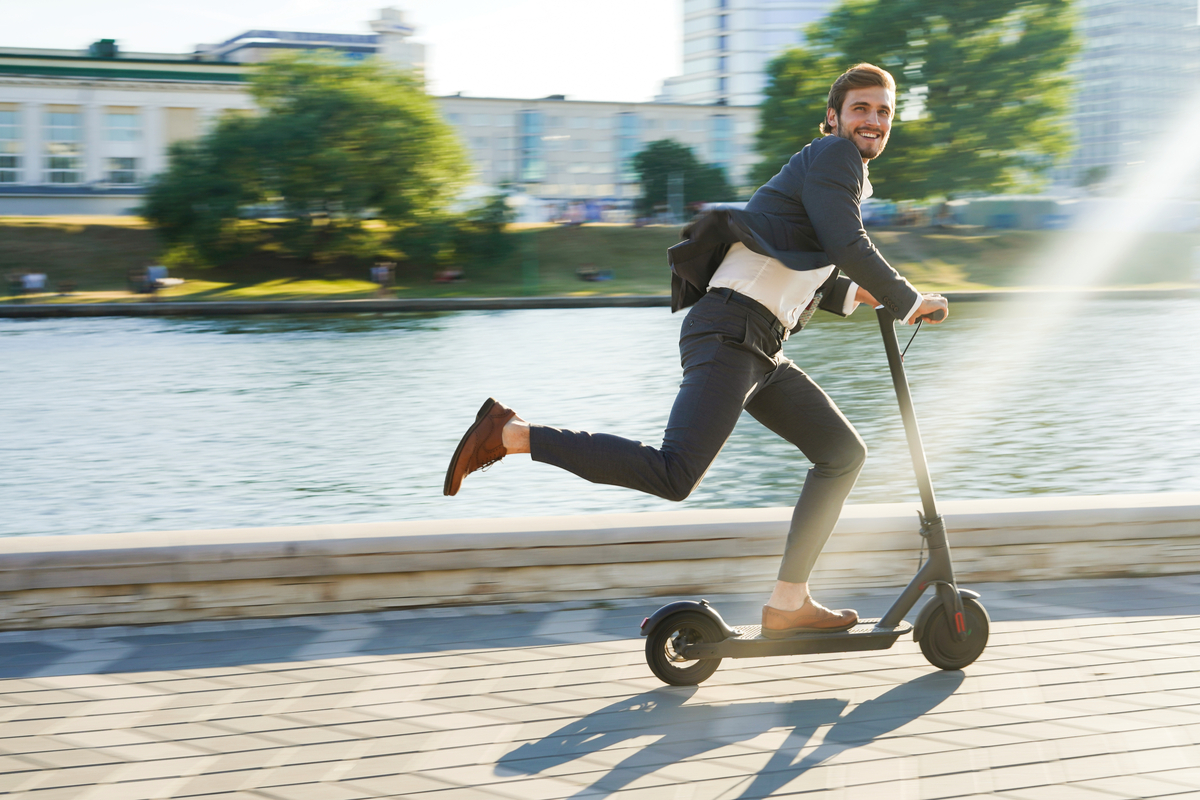
I’m 61 years old, and I’m in shape, if round is a shape. And I’m well past whatever athletic capacity I once had.
But I walk a lot. In cities, I try to walk anywhere I can. That’s partly because I hate taxis, and Uber often takes a long time to pick up. The real reason I want to walk is that I like to see the city, turn down some streets on a whim and stop and gape at nice buildings or lovely parks.
The problem with walking, given my roundness, is that I get all sweaty. That’s okay if I’m walking to exercise. But if I’m walking to get somewhere where I am going to give a talk or participate in a conference, I need something that has wheels.
Worried about injuring myself, I have until now avoided using those ubiquitous rent-a-scooters. I’m partly worried about ridicule, I’ll admit. After an ice storm in Raleigh, I once slipped in my driveway and tore the quadriceps muscle in my leg. I lay in the driveway, on the slippery ice, and stared at the planes flying overhead. Eventually I tried to open the car door to blow the horn, to get my wife to come help me into the house. But the car door was locked.
Eventually I crawled into the house and told my wife what had happened. She asked if I needed to go to the hospital, and I said I thought I could wait until the next day. She said, helpfully, “Well, at least you already iced it.” So, you see what I’m dealing with here. If I came home with a broken wrist from riding an Orange or a Trip scooter, I would have to face withering scorn.
But this weekend I found myself in Washington, DC, at my hotel about one and one half miles from the conference venue. And there were scooters outside. I know the area, and it was possible to take side streets and avoid the congested roads. So I downloaded the app, filled in my financial information, and scanned the code to unlock my little wheeled steed.
I had looked in advance; an Uber would have been $7.45, and was estimated to take eight minutes. That was the benchmark, then. Of course, in an Uber I wouldn’t have the same view of the sky and my surroundings, and it was a lovely October day in DC. I was wearing a dark suit, a tie, and heavy wingtip shoes. But what the heck: I pushed off on the scooter, and … nothing.
Turns out you have to push it to get to a pretty good speed to get the thing to work. I pushed off again, harder, and I was off. Another thing: turns out that having no springs and very hard, small wheels means that you have to be really careful about even small cracks and potholes. But you don’t have to go very fast to make progress if you are only going a mile and a half; even walking the thing on the major crosswalks with lights, I made it in about nine minutes. That’s about 10 miles per hour, and since I did spend several minutes walking at intersections I was probably doing more like 15 mph — the supposed top speed — some of the time.
I put down the kickstand (there is a designated scooter parking area at the venue) and parked the thing. Just pressed “end ride” on the app, and I was done. Cost $3.46, and I got to see the world a little. My right (back) leg was stiff from being in an uncomfortably flexed position, but I’m sure that with some practice I’d relax and learn to ride. The motor is certainly powerful (I weigh 240, and it had no problem on the gentle hills, though I bet a long steep hill would be a problem). An Uber might have been faster, but I’m not sure that’s true. And it would not have been as much fun.
Scooters: Help, or Hassle?
When electric rental scooters first appeared on city streets, in spring 2018, it was clear that the rental companies had decided that it was better to ask for forgiveness than for permission. The scooters simply appeared, in many U.S. cities, in their initial “roll-out” (sorry), though Bird had been in Santa Monica, California, since September 2017 as a trial. The result, predictably, was confusion and resentment; I’m afraid the companies were guilty of Pauline Kael syndrome, thinking that since everyone they knew loved the scooters, everyone would think that. They weren’t right about that, since now many people hate scooters. But there are a whole lot of them out there.
Of course, scooters are much older than the high-tech version I rode. The first scooter using the small wheels and the handlebars for turning appeared in 1817 in Germany. And who can forget what Michael J. Fox did in the first Back to the Future movie, knocking off the handlebar post so he could skateboard-tease Biff’s car into the manure pile? After its launch as a product, and quickly as a fad, in 2000 the “Razor” Scooter sold more than 5 million units within six months. They were sturdy, collapsible, and shiny. Both my sons had one, and they became quite adept.
Razor alone has sold more than 30 million scooters overall, and more than a third of those have been rechargeable electric units. But the new rental companies — Bird, Lime, Skip, and Spin are in most cities in the U.S. — have a different model. They put the scooters out, often just dumping them almost anywhere or so it appeared, and rely on their smartphone app and a wifi connection to mediate the rental process.
A few cities have regulated the use or availability of the scooters; Los Angeles, Chicago, and DC have started “pilot programs.” New York, on the other hand, does not allow scooters at all, at least in Manhattan. There have been complaints in the cities where scooters have been deployed, including scooters left blocking sidewalks and stairways, dangerous or careless driving by riders, and injuries to both riders and pedestrians.
A recent CBS segment on scooters (“Freewheeling”) tries to be fair, but it’s hard to sustain the argument against these things for long. Yes, there are problems with managing the scooters, and the formal rules and conventions of using scooters and deciding if they are vehicles on roads or sidewalks all must be worked out.
But if you travel in Asian countries, there are far (far!) fewer cars in central cities. Some European cities, likewise, are dominated by bicycles and other vehicles that are easier to park. The U.S. obsession with “free” parking, at least for our larger cities, is probably doomed, and the regulations that dictate parking as parts of any new construction are an enormous obstacle to building new affordable housing. Uber and other automobile services are likely partial solutions. But being able to walk out your hotel or apartment door, hop on a scooter, and travel two miles in 20 minutes or less, without worrying about traffic or parking, is a big step forward.
I admit, though, that there is an age element to all this. When I was scooting along in my suit and wingtips, I passed a young girl — maybe five years old — walking with her mother. Little girl, loudly as kids do, said, “Mommy, look, isn’t that man too old to ride a scooter?” Mom immediately, and surprisingly also loudly, agreed: “Well, yes, sweetie, he is too old. I hope he doesn’t hurt himself.”
You are likely to see a lot more old people, and people dressed in business attire, using scooters soon. The advantages of fast and nearly free mobility in center cities are just too great to pass up.
Share This Article

Post on Facebook

Post on X

Print Article

Email Article