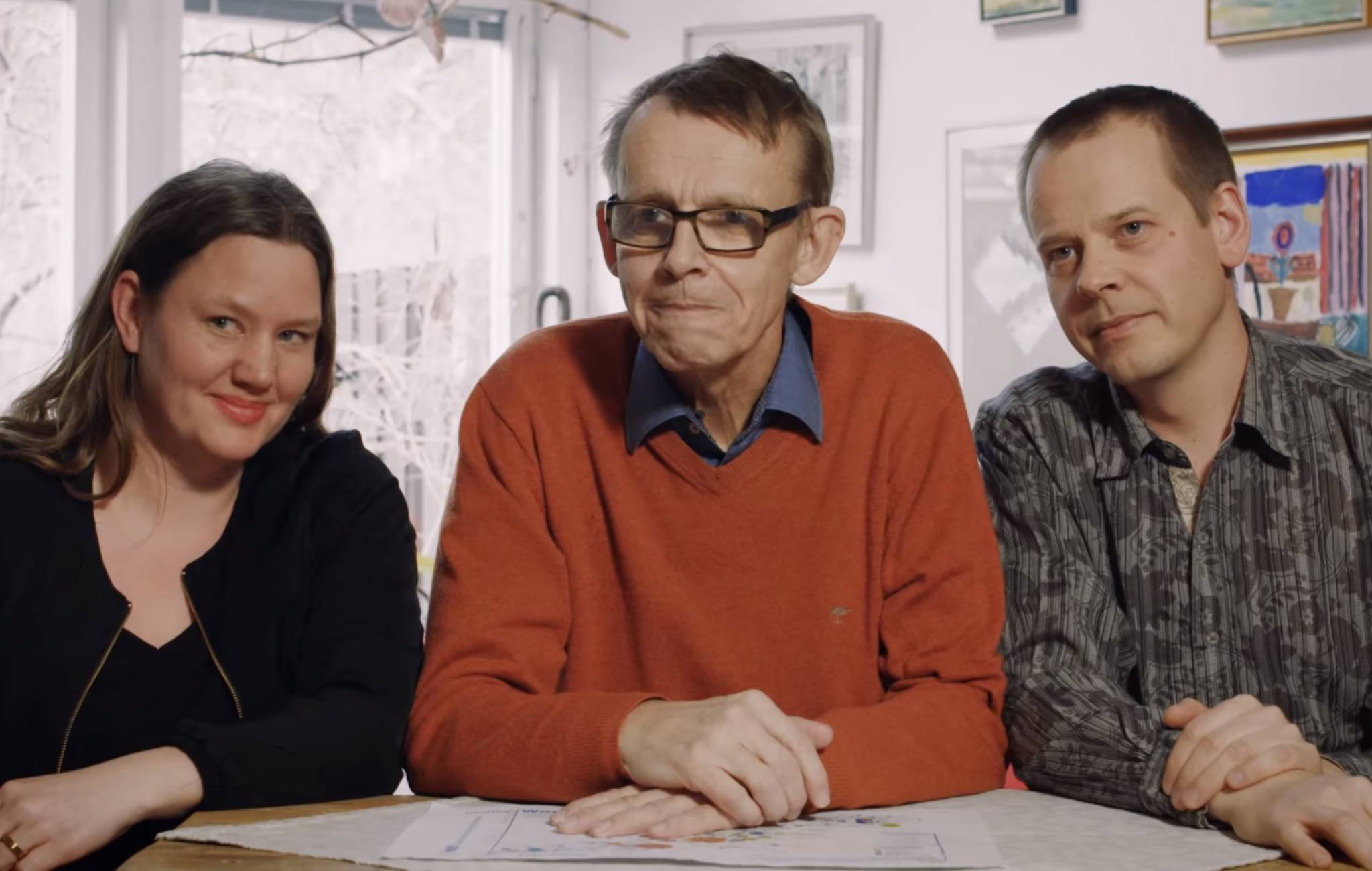

It’s unfortunate for humanity that, in February 2017, pancreatic cancer shortened the life of Hans Rosling. His insight and wisdom would possibly have tempered the mass hysteria over Covid-19.
A professor of international health at Karolinska Institute, and co-founder the Gapminder Foundation, Rosling earned international acclaim in the decade or so before his death by creating easy to understand data visualizations that help to correct major misconceptions about the state of the world.
My first exposure to Rosling was through this YouTube recording of a TED Talk he gave in 2007. His 2010 TED Talk celebrating washing machines is one that I still show to all of my Econ 101 students. Rosling was a masterful public speaker, and one with an important message.
Factfulness
Just before he died, Rosling wrote – assisted by his son Ola, and Ola’s wife, Anna – Factfulness, which was published posthumously in 2018. Why I waited until 2020 to read this book is a mystery. It is brilliant.
Factfulness testifies to the truth of the advice not to judge a book by its cover. It looks like those eye-catching volumes that are prominently displayed in airport bookstores. Boasting blurbs from Bill Gates, Melinda Gates, and Barack Obama – and sprinkled throughout with photographs and simple graphics – Factfulness doesn’t appear to be a book filled with deep wisdom and insight. This false appearance is reinforced by Rosling’s writing style: direct and utterly without academic pretension, Rosling’s prose is crystal clear. The reader never has to struggle to decipher his meaning.
Yet this meaning is vital, and never more relevant than today, nearly four years after Rosling’s death. The reader in 2020 of Factfulness gets the eerie sense that Rosling in 2016 had a premonition of what awaited humanity in 2020. Although no one can say for certain, my strong sense is that, were Rosling still alive, his would be among the most persistence voices counseling calm and moderation amidst the hysteria over Covid-19 and the deranged measures taken in response.
The Fear Instinct
Among the instincts that Rosling warns against is the fear instinct. Noting that “‘frightening’ and ‘dangerous’ are two different things,” Rosling writes that the fear instinct “makes us give our attention to the unlikely dangers that we are most afraid of, and neglect what is actually most risky.” Yes. And Rosling repeatedly advises his readers to understand that the news media naturally appeal to our fear instinct by exaggerating dangers, typically by failing to put them into proper context:
Here are a couple of headlines that won’t get past a newspaper editor, because they are unlikely to get past our own filters: “MALARIA CONTINUES TO GRADUALLY DECLINE.” “METEOROLOGISTS CORRECTLY PREDICTED YESTERDAY THAT THERE WOULD BE MILD WEATHER IN LONDON TODAY.” Here are some topics that easily get through our filters: earthquakes, wars, refugees, disease, fire, floods, shark attacks, terror attacks. These unusual events are more newsworthy than everyday ones. And the unusual stories we are constantly shown by the media paint pictures in our heads. If we are not extremely careful, we come to believe that the unusual is usual: that this is what the world looks like.
For the first time in world history, data exists for almost every aspect of global development. And yet, because of our dramatic instincts and the way the media must tap into them to grab our attention, we continue to have an overdramatic worldview. Of all our dramatic instincts, it seems to be the fear instinct that most strongly influences what information gets selected by news producers and presented us consumers.
Encountering most of today’s reports and commentary on Covid gives no sense that the median age of Covid victims in the U.S. is the late 70s or early 80s. Or that 79 percent of American Covid victims are 65 years or older. Or that 92 percent of these deaths are of people 55 and older. (The preceding figures are estimated from here.) Or that fully 41 percent of all Covid deaths in the U.S. are of residents of nursing homes. Or that, according to the CDC, the Covid infection fatality ratio for all Americans ages 50-69 is 0.005, while that for Americans ages 70 and older is 0.054.
Were the media to report these figures, Americans’ fear instinct would not be stimulated.
Rosling on the Media
Rosling correctly emphasizes that the media’s consistent misrepresentation of reality is not a result of a giant, conscious conspiracy. Each media outlet simply has it in its self-interest to report in a manner that sensationally misleads. By sparking the fear instinct, the media grab much more attention than if they simply report on reality with more accuracy. And by sparking the fear instinct, they expand their audiences.
Making matters worse is journalists’ general ignorance of much of what they report and opine on. Rosling tells of a test that he administered to several journalists and documentary filmmakers. This test explored their knowledge of basic facts of today’s world, such as the percentage of children worldwide who are vaccinated against some disease. The results are discouraging. No one should suppose that journalists are generally better informed than are the people they aim to make better informed.
Let’s let Rosling tell the story; the following comes from pages 211-212 of Factfulness:
It seems that these journalists and filmmakers [who were tested] know no more than the general public, i.e., less than chimpanzees [who, presumably, would answer Rosling’s questions randomly]
Journalists and documentarians are not lying – i.e., not deliberately misleading us – when they produce dramatic reports of a divided world, or of “nature striking back,” or of a population crisis, discussed in serious tones with wistful piano music in the background. They do not necessarily have bad intentions, and blaming them is pointless. Because most of the journalists and filmmakers who inform us about the world are themselves misled. Do not demonize journalists: they have the same mega misconceptions as everyone else.
Our press may be free, and professional, and truth-seeking, but independent is not the same as representative: even if every report is itself completely true, we can still get a misleading picture through the sum of true stories reporters choose to tell. The media is not and cannot be neutral, and we shouldn’t expect it to be.
[W]e have to seek to understand why journalists have a distorted worldview (answer: because they are human beings, with dramatic instincts) and what systematic factors encourage them to produce skewed and overdramatic news (at least part of the answer: they must compete for their consumers’ attention or lose their jobs).
Reflecting reality is not something the media can be expected to do. You should not expect the media to provide you with a fact-based worldview any more than you would think it reasonable to use a set of holiday snaps of Berlin as your GPS system to help you navigate around the city.
Indeed so. And yet people around the world, engulfed by the fear instinct, have allowed themselves to be stirred by the media – and by their political “leaders” – into an hysterical terror over Covid-19.
It’s too bad that that Hans Rosling is not alive in 2020 to help the forces of sanity fight Covid Derangement Syndrome.
Share This Article

Post on Facebook

Post on X

Print Article

Email Article