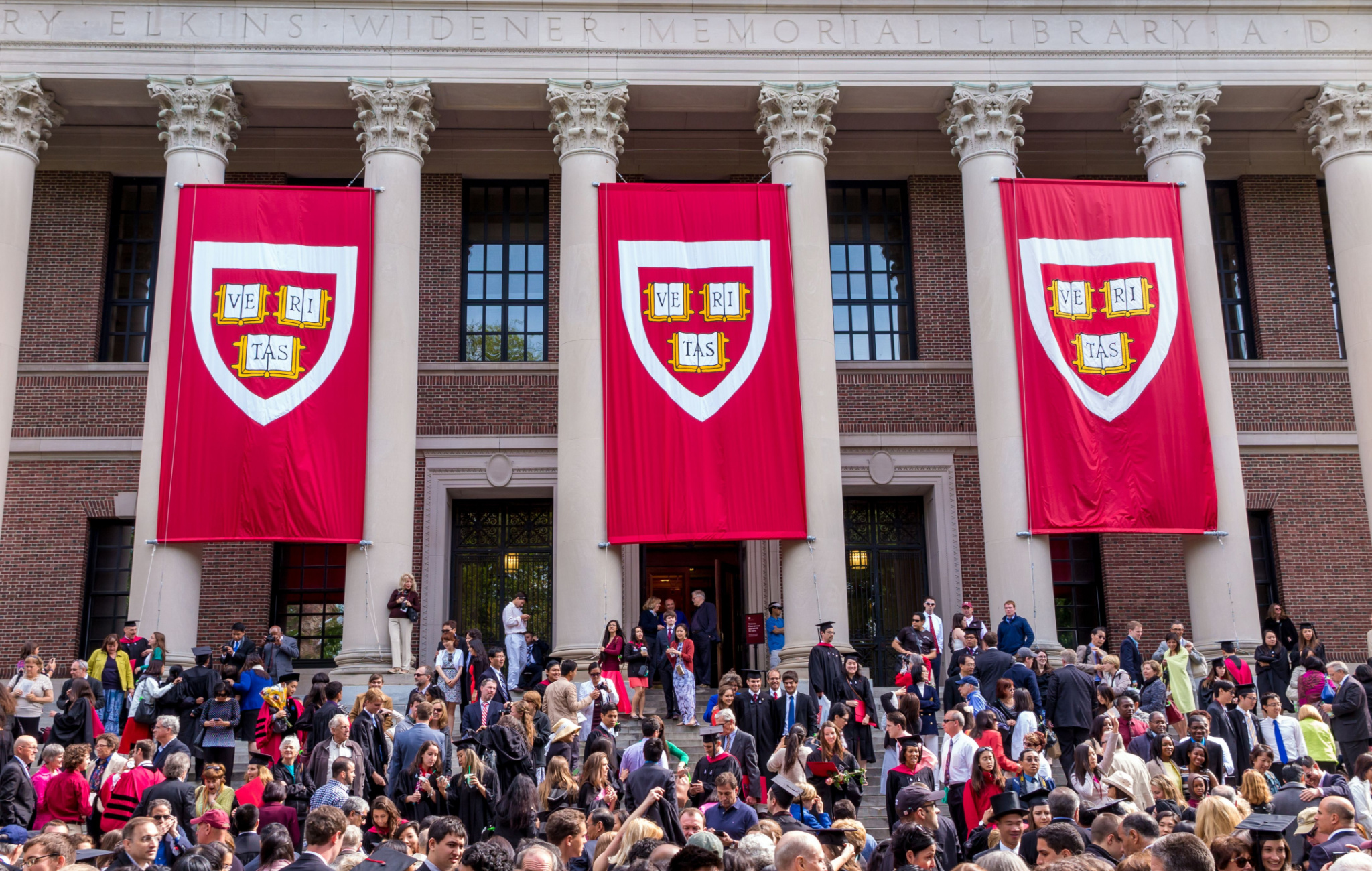

Higher ed is certainly facing its reckoning — “reaping the whirlwind” comes instantly to mind. As I watch Harvard squirm under the international spotlight, I find it difficult to be very sympathetic. According to an email I received from its new interim president, Harvard is being “subjected to an unrelenting focus,” a “persistent scrutiny” that has pushed the college into an “extraordinarily painful and disorienting time.” All I can honestly say is, I know how you feel…
I graduated from Harvard years ago and can’t pretend to have kept my finger perfectly on the pulse of campus politics there. Nevertheless, I am a newly minted PhD from a mainstream university and I can easily extrapolate. My experience on campus these past few years has, I do not doubt, mirrored exactly the kind of shenanigans that has gotten Harvard into such “painful” straits. And without wishing to sound too gleeful, I admit to feeling a certain sense of gratification at watching academia reap what it has sown.
I entered my doctoral program in history in a fit of innocence. I genuinely sought a community of the mind — a place where ideas could be freely exchanged and interesting knowledge gleaned. While the experience was not altogether miserable, I have to say my overarching sensation after getting the degree was one of relief. Yes, yes, everyone is relieved to finish a doctoral degree, but there was something else compounded on top: the sense of finally not having to watch what one says, the feeling I imagine one would feel on leaving a political reeducation camp. No more eyes, no more veiled threats, no more biting your tongue.
I had been ostracized, for instance, at the very outset by a clique of the exquisitely sensitive for my attempts at open conversation about gender politics. I wondered aloud if the au courant trans-movement might itself be a “social construct” and was told that my questions were “violent” and could not be tolerated on campus.
During my portfolio exam, when I was declaiming on the perennial ‘Man vs. Nature’ tension, I had a tenured professor stand up and order me to “STOP saying man” and to only use the word “human.” The incident was so embarrassingly egregious, it derailed my exam. It even caused a neutral member (a paleontologist, bless him) to submit a formal complaint to the dean. The complaint went nowhere of course.
After a few years, I didn’t even bother to apply for most of the choicest scholarship opportunities, since they overtly proclaimed that “preference will be given to historically disadvantaged students.” I didn’t presume that “historically disadvantaged” meant someone like me — rural, mid-life, veteran, and leftist-nonconforming…
Not that it is any kind of revelation, but the growing chorus of concern over out-of-control Diversity, Equity, Inclusion (DEI) thought-control is well earned. In none of my classes could students or faculty engage in anything like open inquiry about race or gender. A discussion about the history of enslaved Europeans alongside the history of enslaved Africans? Crickets. A contextualization of gender roles that defied the standard “oppression” narrative? No.
After years of reading my work with nothing but praise, my advisor suddenly required me at the eleventh hour to replace the word “Indian” with something more palatable (ludicrously, the Spanish “Indio” would suffice). Another member of my committee offered to take umbrage at my comparisons of documented ethnohistoric rituals on Native Americans’ behalf, a patently paternalistic and insensible thing to do.
Look, I’m not claiming to have been surprised. I knew what I was getting into and had harbored suspicions from the outset. Moreover, I am quite prepared to admit that some of the disaffections with my academic experience were self-induced. But to ignore the pervasive cloud of weird, semi-threatening tension which swirls around a modern faculty corridor does a disservice to a long and venerable academic tradition. Students like me have not been well supported or encouraged intellectually these last years. Academic activism has squandered the talents of an entire generation and appears hellbent on doing so again.
Yet, for all that, there is an optimistic silver lining. Now, for the first time in recent memory, the hyper-politicized woke orthodoxy is being successfully challenged. The cracks in the ivory tower have become fissures for the whole world to see. My warning to my college-aspiring children that I won’t spend a brass farthing on tuition seems to be an increasingly widely shared sentiment. Meanwhile, The Harvard Business Review, attempting to make sense of the precipitous collapse of DEI initiatives, now advises companies to “explore DEI actions that are identity-neutral but remove bias from the workplace. Examples include creating structured recruitment and promotion processes with clear, transparent, merit-based criteria…” In other words, “enough with the racism already.” Maybe the lunacy is coming to an end.
Harvard’s high dudgeon over outside scrutiny is indicative. And despite all the “painful and disorienting” turmoil at being held to account, the message seems to be getting through. The interim president tells us that “[r]ededicating ourselves to free inquiry and expression, in a climate of inclusion and a spirit of mutual respect, has never mattered more. Upholding a paramount commitment to academic excellence has never mattered more. Pursuing the truth has never mattered more.” Indeed. Maybe the reckoning higher ed faces will begin the long course-correction it so badly needs. Maybe it will even return to the sort of place I had hoped to go.
Share This Article

Post on Facebook

Post on X

Print Article

Email Article