When my eldest daughter, now 23, was five years old, she delivered her first “out of the mouths of babes” moment. When walking into our local supermarket shortly before Memorial Day, displays were predictably decked in red-white-and-blue bunting. She asked me why, and I replied, “It’s because Memorial Day is next weekend.” She then retorted, “Oh! Is that the day we celebrate the wars?!”
Her question stopped me in my tracks. Pausing to gather my best dad-on-the spot response, I explained, “No, sweetie. We don’t celebrate wars. It’s supposed to be a sad day. We need to remember how awful war is and to think about and pray for our friends and family that have been hurt or killed in wars.”
In an instant, my young daughter revealed the message delivered to American children: War is too far removed to lament. Rather, the full appreciation of the sacrifices associated with military conflicts is held at a great distance. Whether those sacrifices were made willingly or unwillingly, lamenting them is largely absent from this culture’s consciousness. Our children know it, and if we’re honest, so do the rest of us.
This essay isn’t intended to rail against Memorial Day sales, consumerism, barbecues, and furniture discounts that have come to define the extended weekend. Rather, it reflects on how this culture lost its ability to mourn the losses of war since the original “Decoration Day.”
The Origins of Memorial Day
The origin of the holiday revolves around the close of the Civil War, so the controversy over its origins comes as no surprise. The earliest grave decoration appeared in October 1864, when three women of Boalsburg, Pennsylvania, decorated the graves of the fallen. Whether Union soldiers’ graves were exclusively commemorated remains unclear. Another account from Charleston, South Carolina, explicitly honored northern casualties alone on May 1 of the same year.
Two springs later, the secretary of the Ladies Memorial Association of Columbus, Georgia, Mary Ann Williams wrote a letter to the editor calling for officials to “set apart a certain day to be observed…and be handed down through time as a religious custom of the country, to wreathe the graves of our martyred dead with flowers.”
Two weeks later, both Columbus, Georgia, and Columbus, Mississippi, held events one day apart, and the latter was immortalized in the Francis Miles Finch poem The Blue and the Gray.
With sectional rivalries still at a fever pitch during the Reconstruction era, General Orders No. 11 was issued by General John A. Logan. He was reportedly inspired by his wife, Mary, after she witnessed the practice of grave decoration in Virginia. She remarked to her husband that it was “not too late for the Union men of the nation to follow the example of the people of the South in perpetuating the memory of their friends.” In response, Logan ordered military personnel to set aside May 30, 1868, as a national day of Decoration. While not yet a national holiday, it served as an informal day of remembrance for the armed services and others who sought to honor the war dead. With the shadow of the Civil War still hanging over the country, the solemnity of the occasion would not have been lost.
In the decades following, greater emphasis was placed on the day. It wasn’t until May 11, 1950, that Congress passed a joint resolution, requesting that President Truman “issue a proclamation calling upon the people of the United States to observe each Memorial Day as a day of prayer for permanent peace and designating a period during each such day when the people of the United States might unite in such supplication.” Finally, the date was officially moved from May 30 to the last Monday of the month in 1971, while the nation was still in the throes of the Vietnam War.
War as an ‘Economic Good’
The call to prayer for “permanent peace” has given way to the post–World War II era of near-constant foreign conflict. The inescapable irony is that, during this age of frequent military engagement and deployment, the lived experience of war is more distant from American culture than at any point in recent memory. So much so that the costs of war are often described in terms of “pain” at the gas pump, rather than the bodies, hearts, and minds of Americans on extended deployment and in harm’s way. To be sure, supply shocks and higher living costs are real burdens felt by ordinary Americans in the midst of unnecessary conflict. But they pale in comparison to the losses borne by those in active war zones.
This distancing reflects a cultural transformation with deep and complex roots. Still, two plausible contributors are worth considering.
First, the economics of war finance since World War II has, at least temporarily, insulated the public from the costs of war. Military expenditures have been funded less through direct taxation or the mass sale of war bonds and more through deficit spending. The Federal Reserve and its commercial bank partners continue to absorb much of this debt. As a result, the costs are largely obscured from public view and are felt only later, when policymakers can deflect blame for the resulting loss of purchasing power onto familiar scapegoats.
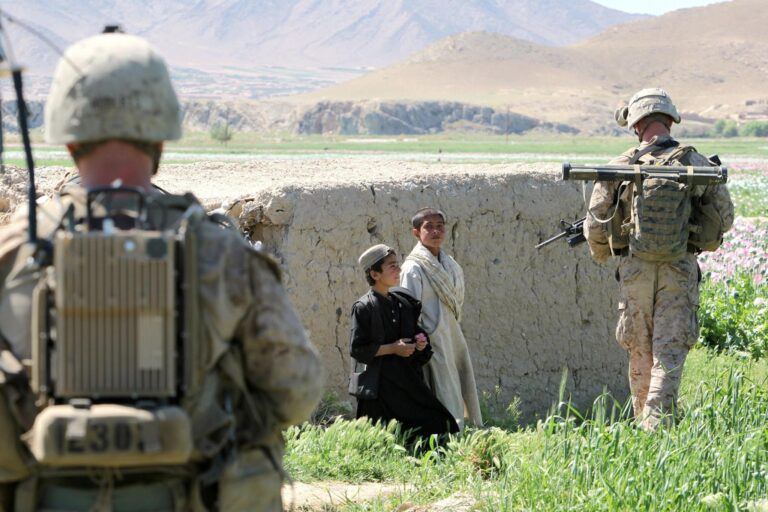
Second, many Americans still operate under the assumption that war is “good for the economy.” They point to the federal government as a demand-driver in the GDP calculation, and to new technologies and industries that emerge from the military-industrial complex. Military contractors have cleverly spread the benefits of their subcontractors throughout the fifty states. For instance, the F-35 fighter jet has significant employment attached to it in 45 states. Moreover, the “Camo Economy” involved vast economic benefits to subcontractors, rather than to the Pentagon directly. In 2019, contractors in Afghanistan outnumbered military personnel by more than 50 percent and “an estimated 8,000 US contractors died, in addition to around 7,000 US troops.” Some honest commenters who claim that war benefits the overall economy at least acknowledge that without massive military expenditures “taxes would have been lower, inflation would have been lower, there would have been higher consumption and investment and certainly lower budget deficits.”
Through these two channels, inflation-financed warmaking and government-driven excess expenditures, the costs of war appear to be far removed, and even, dare we say it, beneficial.
‘The Great Severance’
This cultural insulation brings me back to my daughter’s early impressions of Memorial Day. If the true costs of war are cast far from us in terms of economic pain, and even painted as economically beneficial, then it is no wonder that a child might think that in America, we celebrate war. This powerfully illustrates what Catherine Pakaluk has called, albeit in another context, “the great severance.”
Wherever we see economic policies that shield people from the social, cultural, and economic consequences of policymakers’ choices, the true human toll remains hidden from view, although only temporarily. But sometimes, even a child’s eyes can see straight through the ruse.
Share This Article

Post on Facebook

Post on X

Print Article

Email Article