On January 7, 1959 a chemist appeared on the popular TV program I’ve Got a Secret. He claimed to have a substance that could lift the show’s host, Gary Moore, off the ground on a wire with a single drop. The chemist noted that the substance was discovered by accident; Moore called it a “serendipity.” Not only did the glue lift the 150-pound host, it also lifted both the host and the guest, well over 300 pounds in total.
The chemist was Dr. Harry Coover, and the substance was to become known as Super Glue.
Some of our most important innovations have been discovered by accident. Penicillin, the microwave oven, the vulcanization of rubber, and Teflon immediately come to mind. To this pantheon of accidental discoveries, we can add Super Glue.
While Super Glue’s chemistry was discovered by accident, making it useful, affordable, and abundant was an exceedingly deliberate process.
A Sticky Discovery
Harry Coover earned his PhD in chemistry from Cornell University. During World War II, he worked for Eastman Kodak’s chemical division in Rochester, New York, where his team was searching for a transparent plastic suitable for precision gunsights.
In 1942 the team looked at cyanoacrylates, a group of polymers that showed promise, but had the fatal problem of sticking to everything they touched. Researchers moved on, not realizing that this was a billion-dollar discovery.
In the early 1950s, Coover looked at cyanoacrylates again while he was researching material for jet aircraft canopies. A member of his team observed that the stickiness could be an asset, not a liability. The substance bonded to plastic, metal, wood, and rubber. The chemical had not changed; what changed was Coover’s perspective.
The Chemistry of a Miracle
Super Glue is one of chemistry’s little miracles. Chemistry is the study of matter and its properties and interactions. The remarkable properties of Super Glue come from a process called polymerization. Cyanoacrylates consist of small molecules called monomers. They bond rapidly into long chains of super-strong polymers when exposed to the slightest amount of moisture.
Most conventional adhesives need prolonged drying, heating, or mixing with another component. Not so with Super Glue. The moisture in the air is enough to create the polymer. While this property is extremely useful, it also makes manufacturing, packaging, and storing cyanoacrylates a nightmare. How do you keep it from sticking to everything before customers can use it?
From Discovery to Innovation
It’s one thing to discover or invent a new product, it’s quite another to figure out how to make it profitable. Coover’s engineering team came up with many ingenious solutions to build the manufacturing equipment and packaging that could handle the sticky miracle.
In its December 9, 1957, issue, Chemical & Engineering News reported that Eastman Kodak was offering one-ounce samples of Eastman 910 Adhesive for $5 (almost $60 today). The announcement included a revealing explanation of the high price:
“Part of the reason for the price is the high attrition rate of the production equipment. The manufacture of this product can suddenly turn into the most awful mess you ever saw in your whole life. Nevertheless, the cost should decline some when the production volume rises.”
That final prediction would prove remarkably accurate.
Coover filed a patent application in June 1954 and received US Patent No. 2,768,109, covering alcohol-catalyzed cyanoacrylate adhesive compositions, on October 23, 1956. In 1958, Eastman Kodak began commercially marketing the adhesive as Eastman 910.
An urban legend suggests that the number “910” came from the product’s ability to form a bond in nine to ten seconds; others say it was the nine-hundredth formula Eastman tested. The name didn’t matter when the public realized the value of the product.
Time magazine introduced readers to the new product in its November 24, 1958 issue. The write-up noted that a single drop could hold up a 5,000-pound car under certain conditions. Super Glue was no longer an accident: it was becoming a household necessity. But more valuable applications were in the future.
From Household Repairs to Saving Lives
One day while building a model, Coover’s son accidentally cut his finger. Coover decided to try Super Glue to seal the wound. A new miracle was discovered. Cyanoacrylates could do more than repair broken household objects and hold up TV hosts; they might also help save lives. Military medical personnel in Vietnam began using cyanoacrylate adhesive to help control severe bleeding and temporarily seal wounds until surgery could be performed.
Recognizing its lifesaving potential, Coover applied to the US Food and Drug Administration for medical approval in 1964. Lack of FDA approval did not stop people from using it. Only after 34 years, in 1998, did the FDA approve Dermabond, a specially formulated 2-octyl cyanoacrylate adhesive, for closing certain types of skin wounds.
Researchers continued to discover new applications.
Police discovered that cyanoacrylate could reveal invisible fingerprints on glass, metal, and plastic. This technique became an important tool in identifying criminals.
Coover ultimately received more than 460 patents and contributed to advances in graft polymerization, organophosphorus chemistry, and olefin polymerization. On November 17, 2010, President Barack Obama presented him with the National Medal of Technology and Innovation.
Reflecting on his discovery, Coover remarked: “Serendipity gave me a second chance…It probably is the single material that has more uses than any other material.”
He also told his granddaughter that, of all his achievements, he was most proud of the medical applications of cyanoacrylates and the lives they continue to save.
Super Glue is just one example of a discovery that has uses far beyond what the original inventor imagined. We see this with many such technologies, from Thomas Edison’s phonograph to Steve Jobs’s iPhone.
Super Glue’s economic story is just as remarkable. According to HTF Market Intelligence, the global Super Glue market is currently valued at $2.31 billion and is expected to grow 5.8 percent a year.
The Economics of Super Glue Abundance
When Eastman Kodak offered one-ounce samples of Eastman 910 for $5 in late 1957, the material was very expensive and was only suited for industrial uses. The price reflected the tremendous challenges of manufacturing a product that seemed determined to stick to the very machines producing it.
In 1958, blue-collar manufacturing workers earned around $2.10 an hour. At $5 an ounce, the time price of Super Glue was approximately 2 hours and 23 minutes.
Coover’s original patent expired in 1973, opening the door to competition.
As production methods improved, many other companies learned how to manufacture, package, and distribute cyanoacrylate adhesives more efficiently. Today, you can buy a 1.76-ounce bottle of Super Glue for $9.99, or $5.68 per ounce. With blue-collar wages now averaging $32.60 an hour, the time price has fallen to approximately 10.5 minutes per ounce — a 92.7 percent decline. For the time it took blue-collar workers to earn enough to buy one ounce in 1958, they can buy 13.7 ounces today. Super Glue abundance has been compounding at an annual rate of 3.92 percent.
But most consumers don’t buy Super Glue in large bottles. They buy the little tubes. And their abundance story is equally impressive.
The Little Tubes
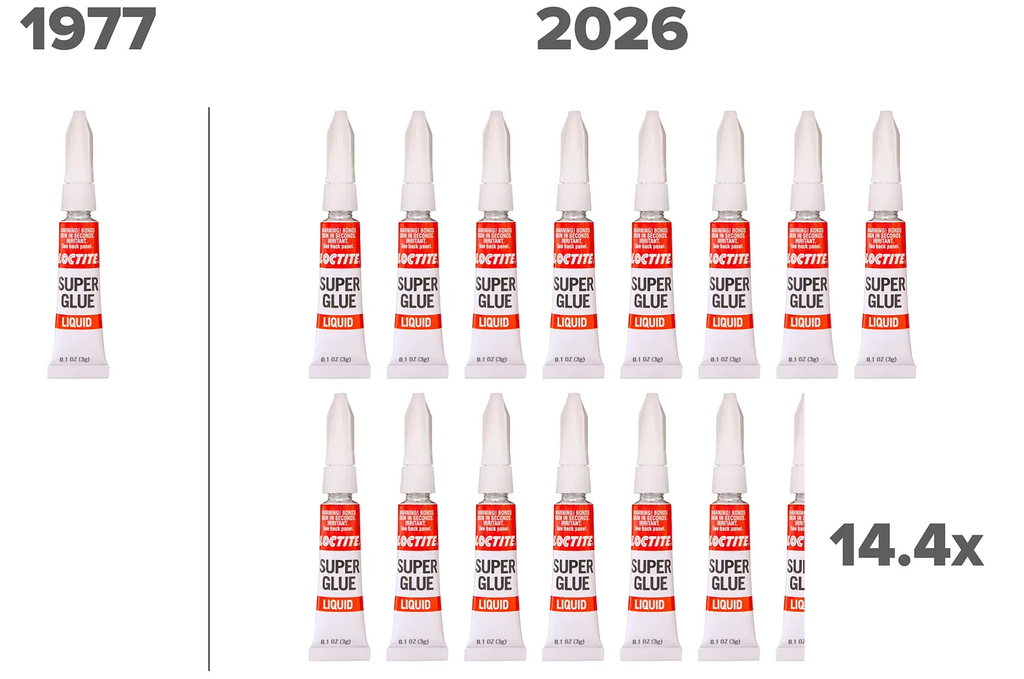
In 1977, Loctite sold a 0.1-ounce tube of Super Glue for $1.67, equivalent to $16.70 per ounce. Blue-collar manufacturing wages at the time averaged $5.51 an hour, putting the time price at approximately 182 minutes per ounce.
Today, Walmart sells a four-pack of tubes containing a total of 0.42 ounces for $2.88, or just $6.86 per ounce. At a blue-collar wage of $32.60 an hour, the time price has fallen to just 12.6 minutes per ounce — a 93.1 percent decline in time price. Since 1977, Super Glue abundance in small tubes has grown at a compound annual rate of 5.6 percent.
There’s another interesting lesson in the little tubes. Buying Super Glue in larger bottles can offer substantial savings per ounce, but there’s a catch. Once opened, moisture can enter the container and gradually cause the adhesive to cure and harden, potentially long before you use it all. For occasional household repairs, a multipack of tiny tubes may be the better bargain. Although the price per ounce is higher, each tube remains sealed until needed, reducing the amount that goes to waste between projects. Sometimes abundance isn’t about buying more for less — it’s about getting more value from what you buy.
The original manufacturers struggled to keep Super Glue from sticking to their equipment. Today, competition and innovation have made it easier than ever for the rest of us to get our fingers on it.
The Chemistry of Abundance
The story of Super Glue reveals a deeper principle about wealth, resources, and human ingenuity. The number of atoms on Earth is finite. What matters economically, however, is the extraordinary number of useful ways we can discover to combine and recombine those atoms.
Nobel Prize–winning economist Paul Romer describes this potential in terms of recipes. With roughly a hundred naturally occurring elements in the periodic table, the number of possible combinations grows exponentially. Romer explains: “For recipes that can have four elements, there are 100 × 99 × 98 × 97 recipes, which is more than 94 million. With up to five elements, more than nine billion.” With ten elements, the number of possible recipes exceeds the number of seconds since the Big Bang. These calculations don’t even account for different proportions, structures, and arrangements. Humanity has explored only a minuscule fraction of the possibilities.
Harry Coover’s discovery brought one of those previously unexplored possibilities into existence. The atoms that make up cyanoacrylates have always existed. What was new was the knowledge of how to transform them into a remarkably useful, commercially viable adhesive.
But discovery was only the beginning. Engineers had to learn how to manufacture Super Glue without ruining their equipment. Packaging specialists had to develop containers that prevented premature hardening. Entrepreneurs and competing manufacturers discovered ways to lower costs and expand distribution. Consumers found applications the original researchers had never imagined.
Each new discovery expanded the product’s usefulness. Continued innovation, investment, and competition made it increasingly affordable.
Resources cannot be understood simply as fixed quantities of physical matter. Their true value emerges when human beings discover how to transform matter into something valuable. Petroleum becomes fuel, sand becomes computer chips, and troublesome laboratory chemicals become powerful adhesives. The atoms were already here: what changed was our knowledge of what we could do with them.
Share This Article

Post on Facebook

Post on X

Print Article

Email Article