
Economic Theory
-

•
When Government Fails, Communities Take Care of Themselves
In the early- and mid-20th century, systemic racism often meant that African American communities were excluded from government welfare programs. In the face of this injustice, we see numerous examples of communities stepping up to take care of each other when government officials turned the other way.
-

•
Universal Basic Income Is Little More Than Smoke and Mirrors
The prospect of a safety net devoid of loopholes and bureaucracy is tantalizing. Unfortunately, fiscal reality reveals UBI to be little more than clever arithmetic and a distraction from more modest changes to welfare policy and the tax code that would directly help those most in need.
-

•
The U.S. Welfare System’s Paternalistic History
History will always remember President Lyndon Johnson for his escalation of the war in Vietnam, which turned into an unwinnable and tragic entanglement against a foe he did not understand. Sadly, with over fifty years of hindsight, one must judge Johnson’s War on Poverty in much the same way.
-

•
How Top-Down Government Fails America’s Poor
Our debate about safety nets and responses to poverty hinges on a fundamental fallacy — that services are either provided by the government or not at all.
-

•
Climate Activism: An Ideology in Search of a Justification
Environmental activists cling to the same stale policy prescriptions, no matter the situation. Only their rationale changes.
-

•
Why You Have to Bus Your Own Table
Soft skills are being priced out of the labor market by minimum wages. At $8 an hour, it might be worthwhile to hire someone to bus tables. At $11 an hour, Massachusetts’ minimum, it probably isn’t.
-

•
A Bona Fide Tax Revolt in France
Politicians and activists who blithely maintain that public support for lofty climate change projects is both bottomless and selfless are either obtuse or tacitly agitating for tyranny.
-

•
Your First Job: Real Costs of the Minimum Wage
The minimum wage is only the most visible portion of what quickly amounts to a vast array of considerable, often unseen costs.
-
•
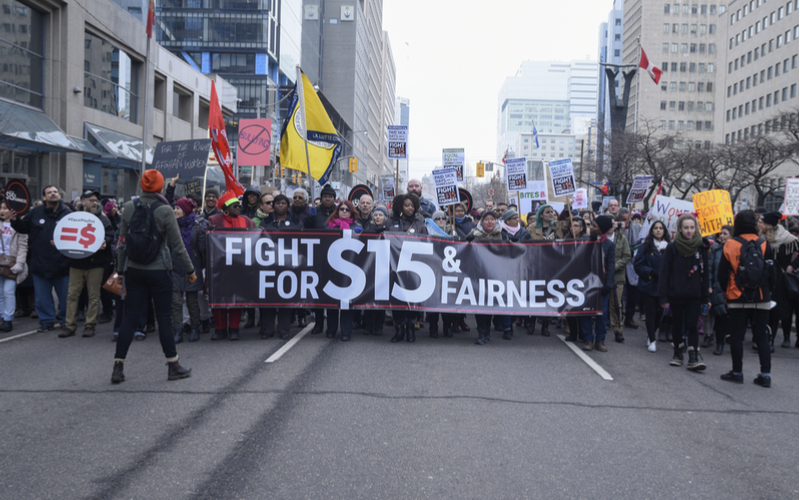
The Empirical Reality of the Minimum Wage
But even after excluding all shoddily done studies of minimum wages, we’re still left with conflict in the conclusions. Fortunately, economic theory itself supplies clues as to why.
-

•
Proposed Federal Jobs Guarantee Is Too Big to Exist
The federal jobs guarantee, as spelled out in Democratic policy circles, would arguably be the largest public intervention in the economy in American history.
-
•
When Government Fails, Communities Take Care of Themselves
In the early- and mid-20th century, systemic racism often meant that African American communities were excluded from government welfare programs. In the face of this injustice, we see numerous examples of communities stepping up to take care of each other when government officials turned the other way.
-
•
Universal Basic Income Is Little More Than Smoke and Mirrors
The prospect of a safety net devoid of loopholes and bureaucracy is tantalizing. Unfortunately, fiscal reality reveals UBI to be little more than clever arithmetic and a distraction from more modest changes to welfare policy and the tax code that would directly help those most in need.
-
•
The U.S. Welfare System’s Paternalistic History
History will always remember President Lyndon Johnson for his escalation of the war in Vietnam, which turned into an unwinnable and tragic entanglement against a foe he did not understand. Sadly, with over fifty years of hindsight, one must judge Johnson’s War on Poverty in much the same way.
-
•
How Top-Down Government Fails America’s Poor
Our debate about safety nets and responses to poverty hinges on a fundamental fallacy — that services are either provided by the government or not at all.
-
•
Climate Activism: An Ideology in Search of a Justification
Environmental activists cling to the same stale policy prescriptions, no matter the situation. Only their rationale changes.
-
•
Why You Have to Bus Your Own Table
Soft skills are being priced out of the labor market by minimum wages. At $8 an hour, it might be worthwhile to hire someone to bus tables. At $11 an hour, Massachusetts’ minimum, it probably isn’t.
-
•
A Bona Fide Tax Revolt in France
Politicians and activists who blithely maintain that public support for lofty climate change projects is both bottomless and selfless are either obtuse or tacitly agitating for tyranny.
-
•
Your First Job: Real Costs of the Minimum Wage
The minimum wage is only the most visible portion of what quickly amounts to a vast array of considerable, often unseen costs.
-
•
The Empirical Reality of the Minimum Wage
But even after excluding all shoddily done studies of minimum wages, we’re still left with conflict in the conclusions. Fortunately, economic theory itself supplies clues as to why.
-
•
Proposed Federal Jobs Guarantee Is Too Big to Exist
The federal jobs guarantee, as spelled out in Democratic policy circles, would arguably be the largest public intervention in the economy in American history.