Guess who’s coming home for Christmas? Many college graduates are getting fired just five or six months into their first “real world” jobs. Sixty percent of the 1,000 employers surveyed by Intelligent.com last October said they’d already dismissed graduates hired in May or June of 2024.
Seventy-five percent of companies reported that some or all of the recent college graduates they hired were unsatisfactory. According to the same survey, over half of businesses hiring Gen-Z employees believed these young professionals lacked motivation, communication skills, and readiness for the workforce. Many who hadn’t already fired recent graduates they hired this summer said they’d seen enough to avoid hiring from next year’s cohort.
Such reports invite skepticism; older generations have always criticized the younger for perceived shortcomings. It’s not uncommon for aging generations to despair of those who follow them. Poor work ethic and reliance on technology are the usual culprits. In Ancient Greece, teachers at Aristotle’s Lyceum supposedly complained of the slowest and dullest students resorting to writing things down on parchments (taking notes) because they couldn’t be bothered to use their brains.
But the modern culture clash is likely to be acute: corporate norms bear little resemblance to the post-pandemic campus culture from which young people are emerging. But this isn’t just a story of generational tension. It’s a direct reflection of the US university system — and its failure.
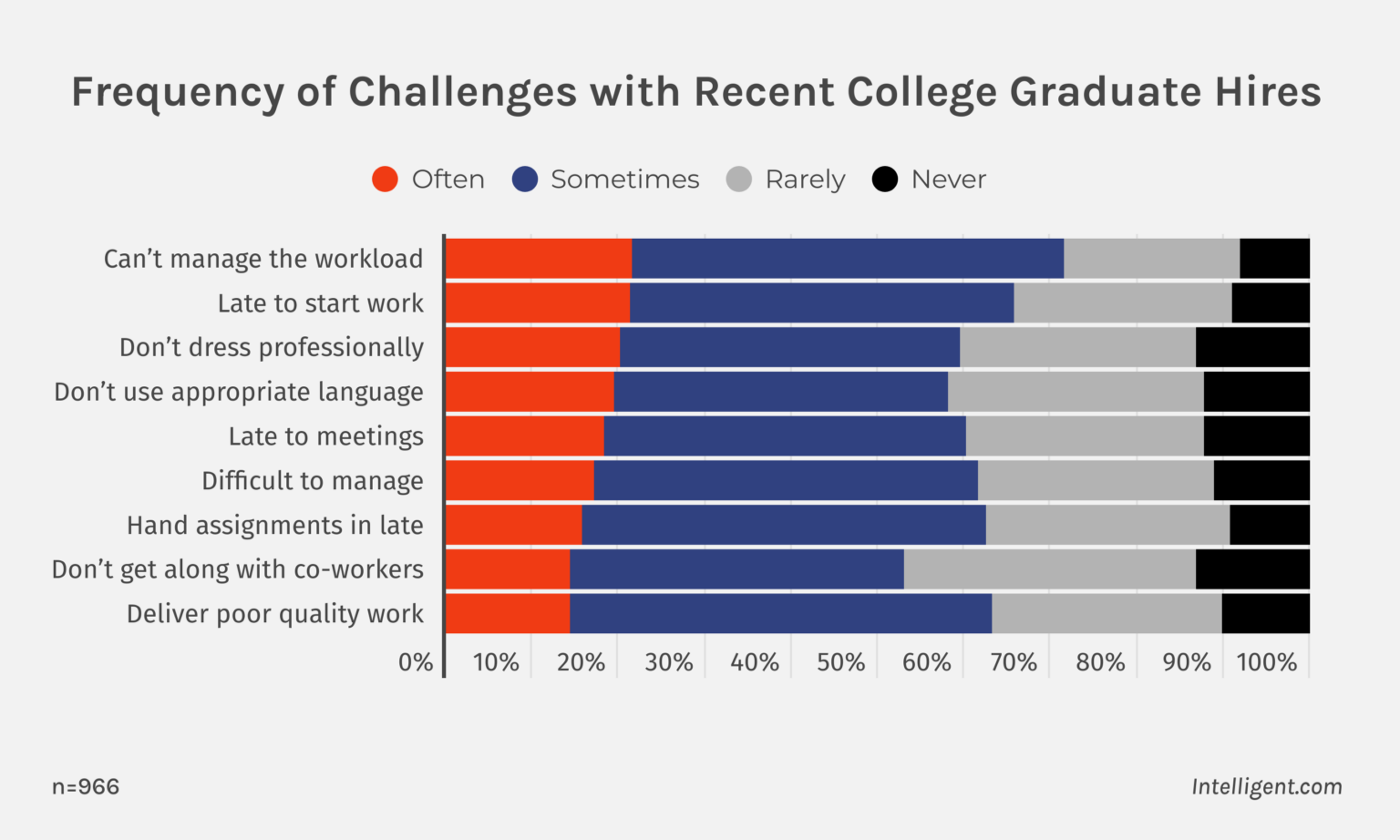
Business leaders complain that recent graduates are unable to work independently, lack motivation and problem-solving abilities, and are easily offended.
“Many recent college graduates may struggle with entering the workforce for the first time as it can be a huge contrast from what they are used to throughout their education journey,” Intelligent’s chief education and career development adviser Huy Nguyen said in the report.
Universities are pouring resources into defining welcoming layouts, lowering barriers, policing microaggressions, and establishing safe spaces. But recent products of that pipeline are paying the price. And lest we forget, most will keep paying it. University graduates owe an average of $28,244 one year after they leave school.
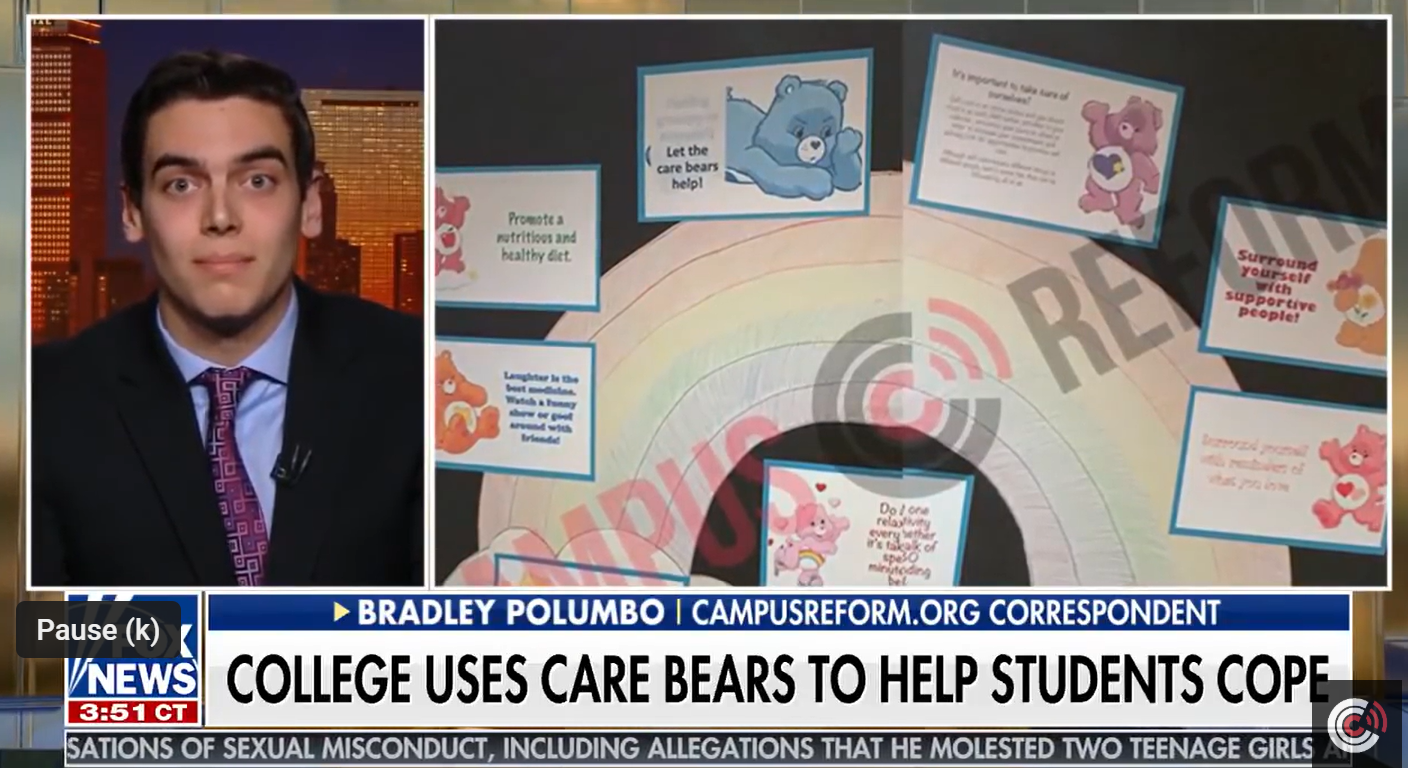
Columnist and podcaster Brad Polumbo was still in college at Amherst when he told Fox News his dorm’s university staff had tried to soothe stressed-out students using “Carebears to Cope” during finals week. He found it condescending, and he’s excelled in a competitive, skills-based career since. Many of the kids who’ve been fired from their first jobs, though, are emerging from a world that coddles them and prioritizes protecting their emotional vulnerability and intellectual comfort. But your comfort zone is a terrible place to build any intellectual muscle.
Campus Culture Could Be Limiting Kids’ Earning Potential
What college kids are trained to believe change looks like (campus protests, broad collective action, sit-ins and occupations) tends to be unsuccessful and frustrating. The heated, hyperbolic tone of politics — including on campus but more broadly among young people online — would lead many well-intentioned souls to believe their moral duty is to disrupt and complain and point out wrongthink.
Intellectual statements of conformity were required for university hiring and promotion. Whole departments emerged to attack any hint of grievance or prejudice. In a tense political moment and a tough market, colleges couldn’t be seen failing to invest in anti-racist guest lecturers and Offices of LGBTQ Inclusion. All the campus-wide initiatives competed to make kids feel safer — not stronger.
The requirement that an employee create more value than he costs, and save his superiors more trouble than he creates, comes as a surprise to people educated to conform and demand others comply, rather than innovate and improve. We’ve taught them to fear being wrong: don’t offend, don’t take risks, don’t try anything new. In short, try not to learn.
Even the censorship and chill on speech in elite colleges is a symptom, not the sickness. College freshmen escape the force-fed requirements of high school to find college is more of the same, but with higher stakes, more stress, and the ticking clock of mounting debt.
Kids who work hard and excel in a university environment will learn little that’s valued by private sector businesses among young employees: self-regulation, initiative, the ability to get along with people, and independent problem-solving. Those are the very muscles the Deanlets prevented them from strengthening by protecting them from any intellectual heavy lifting.
How Deanlets Broke the Pipeline
Administrative bloat — the phenomenon of nonteaching administrative positions outpacing the growth of faculty for face-to-face instruction — largely exists to generate evidence of compliance with federal dictates about education fairness and access, but has not been concerned with the quality of education offered. Bureaucratic growth not only diverts attention from core skills but also erodes overall workforce readiness.
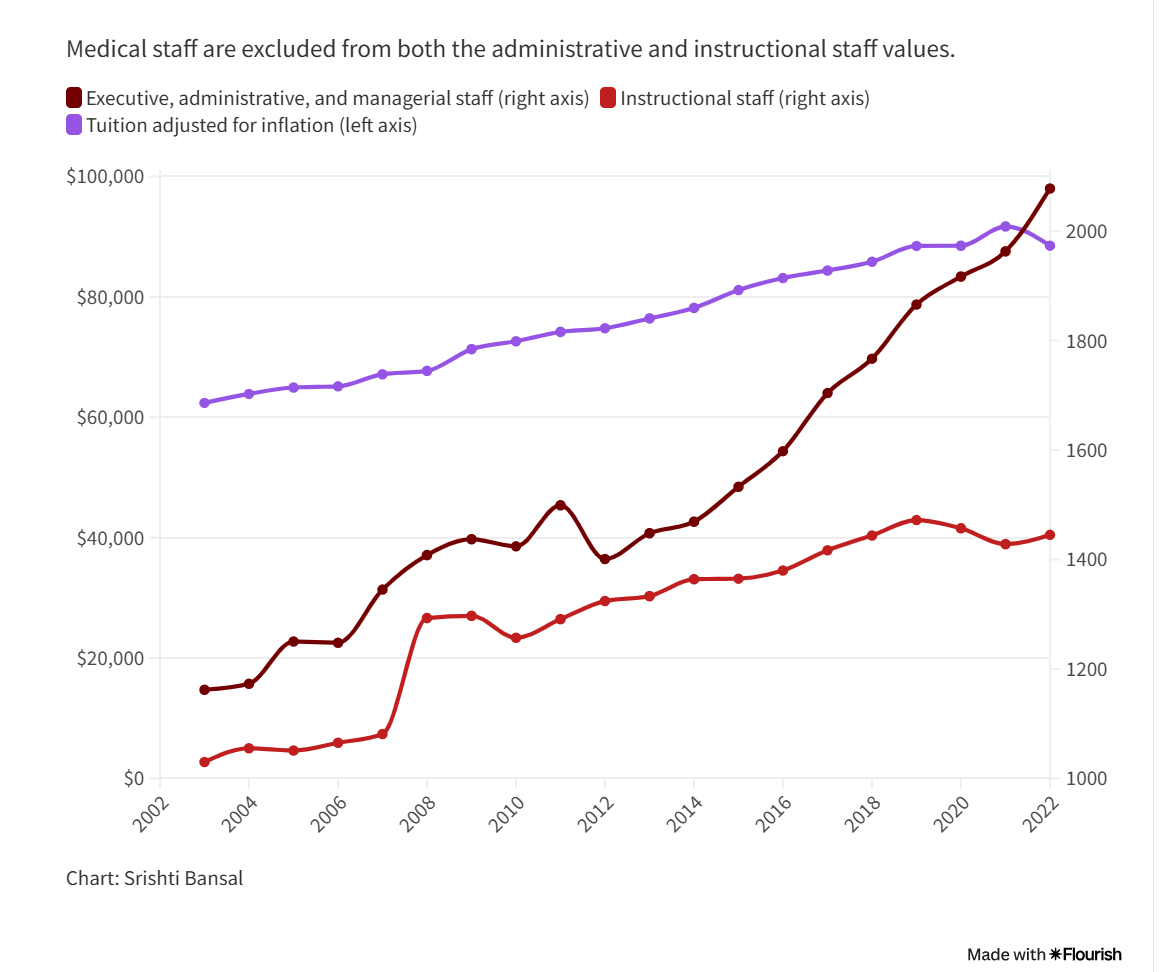
Benjamin Ginsberg, who published Fall of the Faculty: The Rise of the All-Administrative University and Why it Matters in 2013 (and too late to keep me out of a PhD program,) called these well-intentioned bureaucrats “Deanlets.” They have multiplied to far outnumber teaching or research faculty (and in a few cases, including Harvard and Yale, actually outnumber students). Their roles are focused on how to keep students engaged on campus and moving swiftly through the program.
“Retention” of students became the watchword in education. Efforts to keep students enrolled (and taking on loans) focused initially on those whose parents hadn’t attended college, and increasingly on immigrant, gender-queer, and other minority identity students. “Cultivating community” became the measure of institutional success. While such efforts may be laudable, considerably less emphasis, and certainly far less federal scrutiny and institutional funding, was placed on the actual curricula and skills students were “retained” on campus to learn.
Administrators are tasked with keeping young people happy and enrolled, all to keep the gravy train of parent investment and federally guaranteed loans flowing. Administrators don’t answer to employers for the quality of education and long-term value to the student. They answer to university leadership, and in turn, federal regulators.
The Opportunity Cost of Ineffective Schools
Unfortunately, the problems precede university education.
From kindergarten on, the 30-to-a-classroom ZIP code government school model has rewarded conformity and compliance, fragility, and intellectual dependence. Schools focus on standardized testing, rigid curricula, and a bureaucratic obsession with credentials over skills. Independent problem-solving, initiative, and resilience — the traits employers prize — are stifled. By the time kids arrive at the cusp of adulthood, with a fraction of the literacy and other skills that more rigorous programs offered decades ago, college can’t possibly provide what it promises.
Precious few in the current K-12 and higher education system have incentives to prepare students to thrive in today’s workplace. Public schools and universities are modeled on a top-down, industrial-era approach to employment that prepares people for jobs now done by machine.
For 13–17 years, we give students little ability, capacity, scope, or reward for planning their own time, pursuing independently a curiosity or problem they take an interest in. Colleges have become a linear, adult-driven, box-checking exercise more than a flourishing place of ideas, factories of knowledge driven by a search for the truth. Even many kids who are great at getting good grades may never connect meaning or passion to what they have learned. And they won’t have much experience testing their findings on people who disagree.
While it might be in the best interests of colleges to open departments of Student Affirmation, those who fund schools and centrally planned curricula have no strong incentive to provide an education that’s empowering for the individual.
Campus Activism and Conformity Clash With Workplace Realities
John Taylor Gatto’s The Seven-Lesson Schoolteacher explained decades ago how the educational system produces conformity, not competence. Now, under expanded federal control since the Department of Education was established, every measurable educational outcome has declined — literacy, numeracy, critical thinking. Federal intervention promised equity but delivered calamity; mediocrity, not meritocracy; compliance and recall, but no initiative or imagination.
Critics like President Trump have called for abolishing the Department of Education, but the problem isn’t limited to federal overreach. States, too, have prioritized a one-size-fits-all approach over local innovation. The stagnation and decay of education isn’t just a failure of policy — it’s a failure of imagination.
Young people are emerging from this environment ill-equipped for workplaces that demand adaptability and collaboration. College campuses, often detached from real-world stakes, amplify this misalignment with “safe spaces” and ideological homogeneity in both faculty and classrooms. Graduates are unready to face the workplace, a diverse, high-stakes learning environment — one where they have to figure things out and get along without oversight — because they haven’t yet been exposed to one.
Share This Article

Post on Facebook

Post on X

Print Article

Email Article