Since August 2020, the Federal Reserve has operated under a monetary policy framework that has come to be known as flexible average inflation targeting (or FAIT). After years of below-target inflation and ultra-low interest rates, central bankers across the globe were trying to figure out how to pack back in some monetary policy punch when interest rates hit their zero lower bound.
Enter FAIT. Unlike the Fed’s previous monetary framework — a symmetric inflation target around 2 percent — the “average” in FAIT allowed for monetary policy to overshoot its target in order to make up for past policy misses. In essence, higher inflation is okay today if inflation was too low before. Based on what was known at the time, or what we had gotten used to, it seemed to a lot of economists and policymakers like a good update to the framework.
But the theory was immediately put to the test.
The policy was implemented in August 2020, as the world was facing massive challenges. We were in the midst of a pandemic with full-fledged lockdowns across the globe. By its implementation date the Fed had already taken aggressive monetary action to backfill the economy — as did Congress. The FAIT framework supported these actions. And economists across the spectrum did too.
Since recovery got underway, however, opinions have been anything but aligned. In June 2022, inflation hit 9 percent — a 40-year high — in sharp contrast to the below-target trend before the pandemic. It wasn’t transitory, as policymakers had hoped. And it’s taken years to get it under control, and the American public is still none too happy about it.
Whether the new FAIT framework led to the best policy outcomes or begs a genuine reexamination is a matter of considerable debate — and worthy of exploration.
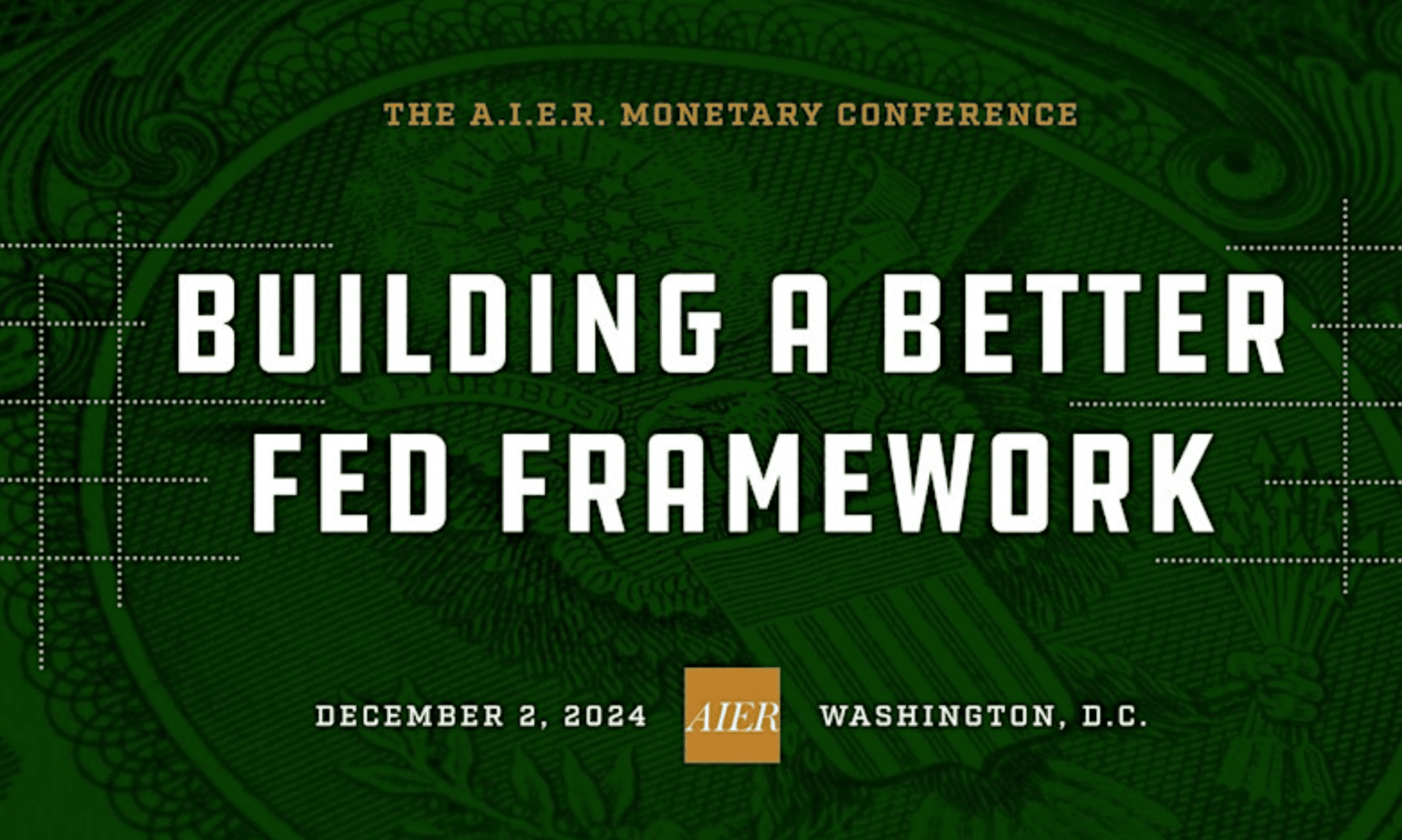
Luckily, AIER is poised to do just that. On December 2 we are convening at George Washington University in Washington, DC, for our inaugural monetary conference: “Building a Better Fed Framework.”
Our organization is bringing together leading monetary scholars to examine the Fed’s monetary policy, past and present, and sharing ideas for improving its framework going forward.
We will kick off the conference with some history: “How Did We Get Here?”
- What’s the role of inflation in the US economy?
- Why has it mattered so much to policymakers, both at the Fed and in Congress, and especially the American people?
- When have we had monetary policy missteps before and what can we learn from those episodes?
- How did inflation actually get so out of hand after the pandemic?
- Was it just supply shocks subsiding or did monetary policy choices play the bigger role?
Then we will go a little deeper into today’s framework and the monetary tools used to implement it in the session “What Have We Learned?”
- How successful or unsuccessful has FAIT been?
- How have the Fed’s various policy tools helped or hindered implementation, including the tool of forward guidance?
- How have changes to the Fed’s operating framework from a corridor system to what’s been called a floor system affected its monetary framework?
Finally, after we explore the history and go through the present-day minutiae — as wonks are wont to do — we give you what you actually came to hear: “How Can the Fed Do Better?” On this last panel we’ll ask:
- What alternative frameworks could the Fed consider?
- Could monetary rules support a more robust Fed framework?
- Which rules might work well and which not so well?
- And what of proposals for a higher inflation target?
I hope you’ll agree these are worthy questions. I have no answers for you, yet. You’ll have to show up to learn for yourself. Or wait for the unexciting AI-generated summary. (I know which I prefer.)
But in all seriousness, by understanding our past, evaluating our present, and contending with novel ideas for the future, we just may build a better Fed framework — and ultimately a better monetary future.
So don’t miss it. See you in DC on December 2!
And since you’ve read this far you get the discount code reward. Register today with MONCON24.
Share This Article

Post on Facebook

Post on X

Print Article

Email Article