Following the Republican rout last week, political leaders and party faithful attempted to make sense of what went wrong.
The president of the United States blamed Fox News for the GOP’s sweeping defeat, while Vice President JD Vance laid out a more nuanced explanation on X.
“The reason we lost is the war,” Vance said. “If you’d like to argue it was worth it, that losing the Senate for the next 6 years was worth it, then do so. Argue it was a worthwhile cost to pay. Agree or disagree, that’s at least honest.”
The Iran conflict no doubt contributed to the GOP’s defeat. After all, on election night 2024, the president had bragged about keeping the country out of war and pledged to do so in the future.
Instead, the country found itself at war with Iran on a pretext that sounded strikingly familiar to past incursions in the Middle East. With a crucial global energy chokepoint closed, average gasoline prices surged from $2.98 per gallon in late February to $4.50 in early May. And as these prices went up, the president’s approval ratings went down.
So Vance is not wrong that the Iran war was unpopular and contributed to the GOP’s defeat. But an abundance of data show the second item on his tweeted list — “focus on the cost of living/inflation” — is the reason, as he said “Our voters showed up. And…many of them voted for Democrats.”
Voters clearly despised the impact of this administration’s tariffs. In a nationwide ABC News poll, about one in three voters said the war in Iran was “crucial” to their vote, while fully half said the same about the cost of living — and government corruption.
Voters Want Affordability, and Tariffs Hurt It
Despite Trump’s populist rhetoric around their launch, tariffs were unpopular with voters. Writing at the Cato Institute prior to the election, Alfredo Carrillo Obregon explained that tariffs had become bad politics, as well as bad economics. The bipartisan conventional wisdom in Washington that protectionist policies win electoral votes was turned on its head as voters linked tariffs to affordability.
“Concerns about affordability sit at the top of most voters’ minds these midterms, and thus, high and sweeping tariffs promoted by the White House have understandably become a culprit behind increases in Americans’ cost of living,” Obregon wrote. Polls, and likely the final vote tally, proved him correct.
While Vance framed the disconnect as a messaging failure, voters were right to identify tariffs as a threat to an affordable American life. Last month, economists at the Federal Reserve Bank of New York published a paper finding that tariffs had raised the cost of goods in 67 categories in 2025. The typical American household is paying at least $1,000, and perhaps several times that, more to maintain the same standard of living under the new tariff regime.
Economists have always understood that, contrary to the President’s promises, taxes on imported goods are paid by American consumers, not by foreign governments or overseas manufacturers. Rising prices on imported varieties of a good account for about 64 percent of the tariff’s bite, according to the Fed paper, but another 36 percent comes from higher-priced domestic producers, who are either paying more for the imported inputs to their products, or were able to raise prices when foreign competitors were penalized.
Making goods more expensive, some have argued, is exactly the point of a successful tariff. Americans now pay 75 percent more for aluminum and 64 percent more for steel than the rest of the world. The trade deficit indeed seems to be contracting. And manufacturing jobs are rising again, but only after cratering during the first year of Trumpian tariff theatrics. As our colleague Dave Hebert pointed out recently, the administration is now claiming a job-creation victory for partially filling the hole it dug. Tariffs have done little to nothing to return manufacturing to the US.
So, do voters feel that tariffs are helping the economy, despite raising costs? According to NBC News exit polls, when asked about Trump’s tariff policies, just 21 percent of voters said tariff policy had helped the national economy, compared to 66 percent who said they’d hurt it. (Twelve percent said they had made no difference.)
When asked about the situation closer to home — whether tariffs had helped or hurt the economy of their own area — Americans were even more sure. Just 14 percent said the tariffs had helped, compared to 64 percent who said they had hurt.*
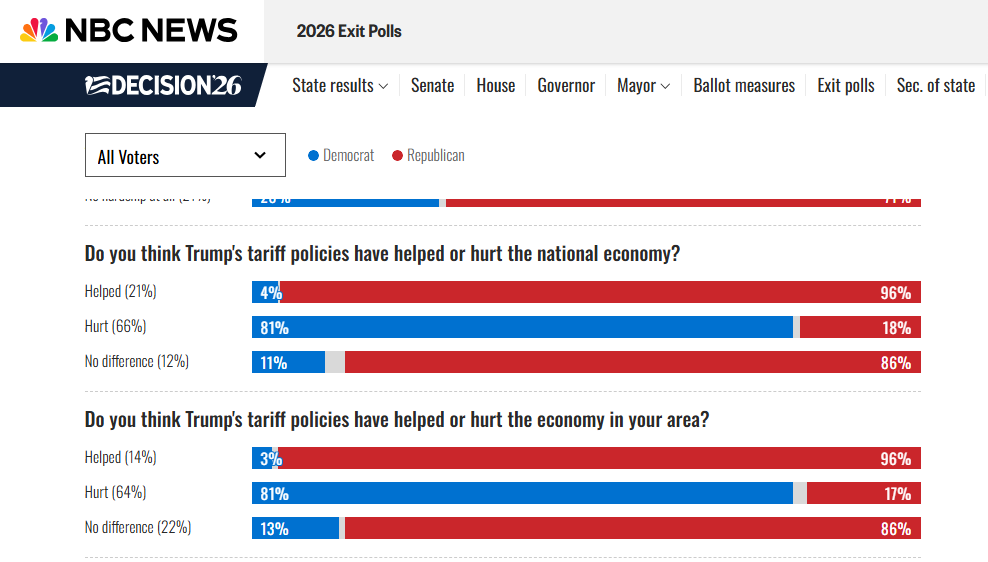
Wherever one looks, the voter surveys tell the same story: voters felt the sting of tariffs in their own pockets and punished the GOP. That should’ve been clear to Republican strategists well before November, as poll results said most voters, including 75 percent of Republicans, had noticed tariffs raising prices and intended to vote with that in mind.
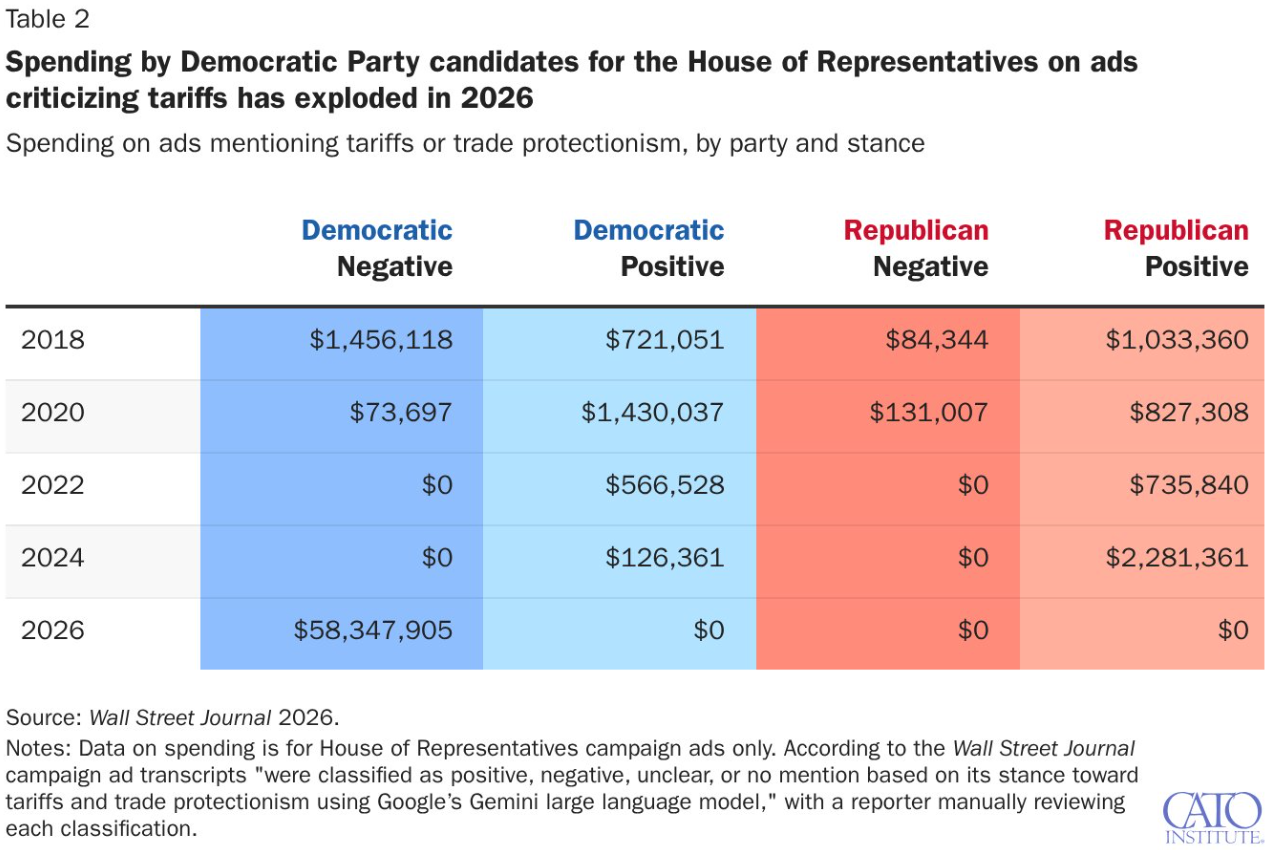
And perhaps strategists did notice. According to data from The Wall Street Journal and the Cato Institute, Democratic candidates for US House spent more than $58 million on advertising mentioning tariffs. Republican House candidates spent nothing promoting tariffs.
In other words, a year and a half after the president’s “Liberation Day” tariffs, any mention of that liberation was conspicuously absent from GOP political messaging.
Many small business owners and American “makers” are reporting thinner margins, and many have been forced to raise prices for goods with imported components, even as inflation otherwise stabilized. The small-government, pro-business, just-leave-me-alone base of the Republican Party liked what Candidate Trump promised, but are angry about what President Trump has done.
Perhaps that’s why Republicans running for the House didn’t want voters reminded. In fact, just a penny out of each dollar they spent on campaign advertising went to a spot that mentioned the word “Trump.”
Tariffs Create Winners, Losers, and Lobbyists
Government corruption was another top-ranked reason that 2024 Republican voters backed Democrats in 2026, and tariffs create plenty of corruption.
Trump’s tariffs generated plenty of opportunities for political favoritism and rent-seeking. When a tariff is set, something new is created for government actors to give away: the valuable exemption from a tax competitors must continue paying. Businesses, especially large ones, have a powerful incentive to invest in lobbying for exemptions, exceptions, and special access, rather than productive activity.
High-quality data has been collected on these activities in both Trump terms, though most voters were probably only peripherally aware of it. Tariff-related lobbying surged to record levels, according to LegiStorm. More than 1,000 discretionary exemptions to the April 2025 tariffs were granted through an opaque and unequal process, many as the result of close ties to the White House.
President Trump had multiple opportunities to reduce tariffs after their damaging effects on small businesses became evident, particularly when the Supreme Court overturned several of the administration’s justifications for imposing them.
For small businesses without extensive lobbying teams, complex customs classifications and rapidly changing rules impose a substantial compliance cost burden. Even after SCOTUS struck down the emergency tariffs, the complexity of obtaining refunds set up new opportunities for well-capitalized investors, and new stresses on those operating at the margins. Large Wall Street firms began purchasing businesses’ rights to a tariff refund for as little as five to twenty cents on the dollar. For small importers unable to wait for government repayment or navigate the administrative paperwork, it was another demonstration of an administration that claimed to support small businesses while transferring power and capital to larger ones.
2024 Rhetoric Met 2026 Reality
Neither the Iran War nor the administration’s tariffs are solely to blame for the GOP’s historic defeat on Tuesday, but both contributed mightily. In 2024, voters turned out to return someone to the White House who’d promised them no more wars and cheaper groceries. In 2026, they showed up to punish the breaking of those promises.
Vice President Vance prefers to cite the war as the sole cause of the GOP’s defeat, perhaps because he’s been one of tariffs’ key supporters in the White House. He has repeatedly accused trading partners of “taking advantage” of the US, and argued that tariffs were the way to respond.
“Unless you’re willing to use American power to fight back against what those countries have been doing for a generation, you are never going to rebuild American manufacturing and you’re never going to support the American worker,” Vance told Maria Bartiromo.
The populist rhetoric of “fighting back” against foreign producers, “rebuilding American manufacturing” and “supporting the American worker” has political appeal. Politicians have employed such arguments for centuries, supported by a combination of myth and misunderstanding.
Concentrated benefits to special interest groups have helped to sustain tariffs and other protections from competition, while distributing their costs across millions of consumers and businesses poorly placed to organize against them. President Trump has made many campaign stops at the handful of steel mills and other factories that are benefiting from higher prices, highlighting the concentrated benefits.
But tariffs became broader and harder to avoid, and businesses were relatively transparent about having to pass those costs on to American buyers. Amid an affordability crisis driven by dollar debasement and falling real income, Americans reacted. Fed research showed Americans cut their consumption of tariffed goods proportionally more than the price rose, suggesting a behavioral backlash.
The 2026 election suggests Americans are no longer willing to pay the price of protectionism.
The “Blue Wave,” Tariffs, and the Future of US Economic Policy: A Roundtable Discussion on AIER’s podcast Qualified Opinions.
*This paragraph initially included data from a separate exit poll.
Share This Article

Post on Facebook

Post on X

Print Article

Email Article