Recently, writing in these pages, Joakim Book argued that progress has stalled.
If you were born in the United States any time after the Second World War, you likely have a skewed view of history. Your individual life probably had its slings and arrows, but the backdrop seemed to be one of almost steady progress. It was easy to be optimistic that life would get better.
Conflating prosperity with the natural order of things may leave us psychologically and spiritually unprepared for what comes next.
World War II had just begun when, in 1939, C.S. Lewis addressed anxious students at Oxford. In his sermon “Learning in War-Time,” Lewis explained that a fragile state of existence has always been humanity’s plight. We have always lived on the “edge of a precipice,” he argued, and the war “simply aggravates the permanent human situation so that we can no longer ignore it.” (Emphasis added.)
“Life has never been normal,” Lewis argued; it is usually “full of crises, alarms, difficulties, emergencies.”
So here we are in 2026, facing another “normal” crisis: unsustainable budget deficits, illiberal mobs on both extremes, and diminishing respect for the principles by which humanity flourishes.
How do we become people who can endure the loss of things we cherish without losing our moral compass or our hope for continued human progress?
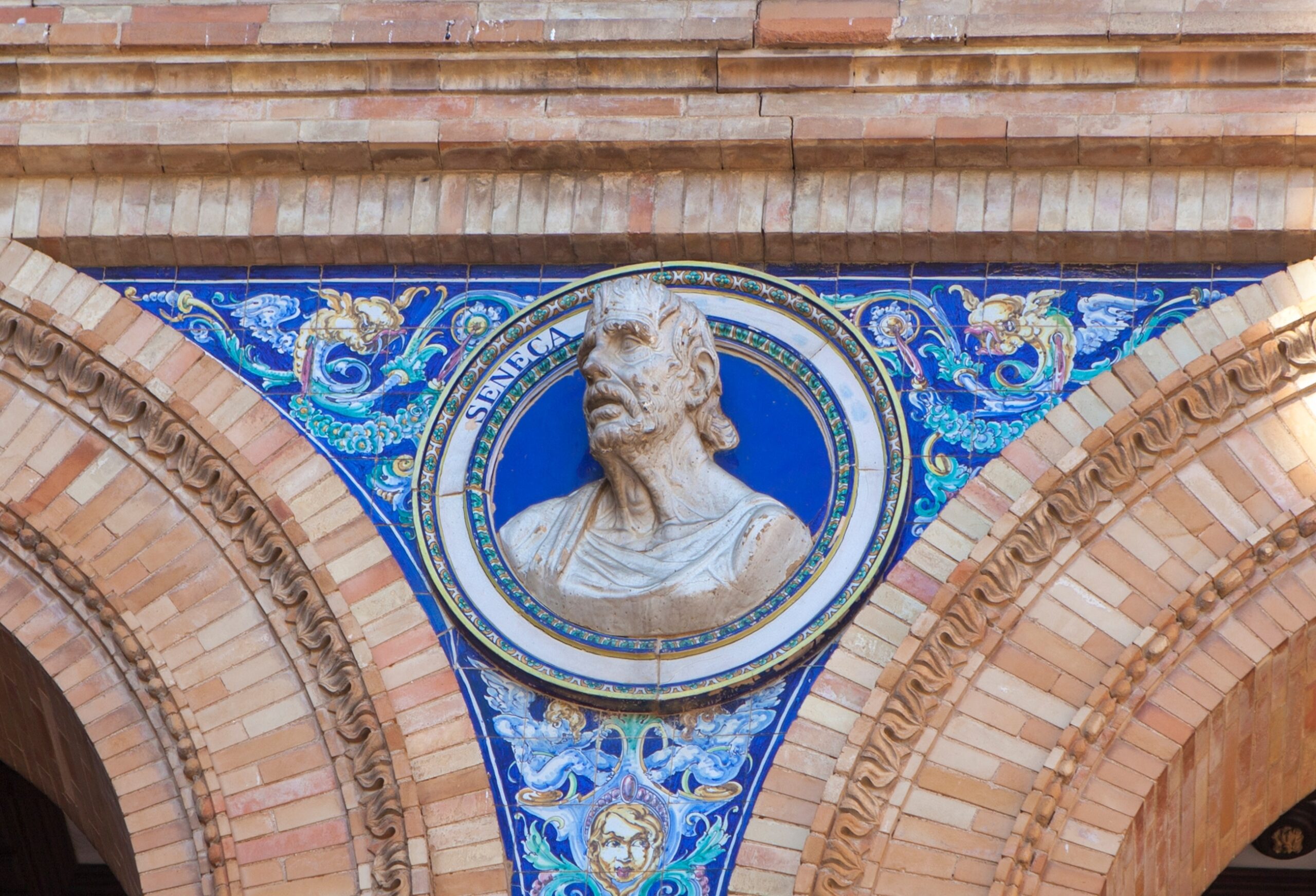
Let’s not assume we have more moral ability than we actually do. The Stoic philosopher Seneca advised, “One can never be sure of one’s strength until numerous difficulties have appeared on every side, or indeed until the moment when they have come quite close.”
Suffering Through Catastrophes That Haven’t Happened
In Moral Letter 13, Seneca taught, “More things frighten us… than really affect us, and we are more often afflicted in thought than in fact.” Indeed, “many unexpected things” come to pass, while much of what we expect “never happens at all.” By letting the unknown torment us, we lose the ability to act effectively in the present.
Seneca was not telling us that terrible things cannot happen, but that our imagination can make us suffer over imaginary things that have not arrived and may never arrive.
My YouTube feed, trained on my past preferences, offers a stream of political and financial punditry. How often is that punditry correct or actionable?
Do we bring our gadgets into the bedroom? We may go to bed anxious and sleep poorly. Upon awakening, do we rinse and repeat by checking the news, reading more frightening predictions, and mentally rehearsing the worst?
Fear is not necessary to take needed action. I put on my seat belt without fearing a car crash. I exercise every day without fear motivating me. I can take reasonable steps to keep my family comfortable during a power outage without making preparation the focus of my day.
We can prepare for adversity and yet refuse to make fear of adversity the organizing principle of our lives.
The point of Stoic practice is not to escape disturbing emotions and hardships, but to keep them from governing our choices. To the Stoics, simply toughing it out would waste an opportunity to learn and train for real adversity.
In his essay “On Providence,” Seneca observed, “Calamity is an opportunity for virtue.” He argued that we can “grow numb from excessive good fortune… held in a lazy tranquility as if on a motionless sea.”
“Harsh things,” Seneca warned, “come as a greater shock to those who lack experience.”
If you can’t control your mind when someone cuts you off on the highway, don’t expect to handle major events without practice. Everyday frustrations are grist for our moral agency.
Circumstances Are Not the Ultimate Source of Freedom
In perhaps the most famous idea in all of Stoicism, Epictetus opens the Enchiridion (Manual for Living) with this truth: “Some things are within our power, while others are not.”
Progress, our health, our finances, the stability of civic order, the adoption of classical liberal principles, and peace may be influenced by our actions, but they are not under our control.
Suppose the broad stock market indexes lose 50 percent and stay depressed for a decade. Our material loss in wealth has consequences, but it doesn’t reduce our moral agency. We can respond with generosity instead of bitterness and love instead of fear. The quality of our character does not have to experience a bear market.
We cannot guarantee economic prosperity, but we can remain trustworthy and decent, which helps sustain the conditions that will make prosperity possible again.
Epictetus’s distinction is not an argument for passivity. He was born a slave; he knew the difference between external and internal freedom and how we enslave ourselves.
He argued that we should direct our efforts toward our own choices and character, knowing that externals cannot destroy our moral agency.
Resist the Moral Temptations of Fear
In Volume Two of The Gulag Archipelago, Aleksandr Solzhenitsyn wrote, “The line separating good and evil passes not through states, nor between classes, nor between political parties either — but right through every human heart — and through all human hearts.”
Economic distress can encourage resentment. Political uncertainty can create a desire for strong leaders who promise security. Fear can make scapegoating attractive and sacrificing principles for safety seem reasonable.
The danger is not confined to any particular political faction. When frightened enough, anyone may be tempted to surrender independent judgment. If today’s animosities deepen, will we fracture further into tribes fighting over what they perceive as a win-lose pie?
The future of liberty depends on our ability to remain morally responsible even when totalitarians and the chatterbox in our heads give us reasons not to.
Viktor Frankl would urge us to attend to what gives our lives meaning before adversity tests us. The Holocaust survivor observed that even in the most extreme circumstances, some starving prisoners retained their humanity and shared their bread with others.
Frankl, like the Stoics, recognized that the ultimate human freedom is “to choose one’s attitude in any given set of circumstances, to choose one’s own way.”
Is it our way to love our family and even our enemies, as Jesus advised in the Sermon on the Mount? Is being faithful to our responsibilities while retaining our highest values our way?
Suppose our sense of who we are depends on career success, income, vacations, our house, and retirement accounts. If those things are threatened, we may experience it as an assault on our very being, making us vulnerable to the siren call of illiberal forces.
Frankl learned in the most extreme circumstances that “it did not really matter what we expected from life, but rather what life expected from us.” He continued, “We needed to… think of ourselves as those who were being questioned by life — daily and hourly. Our answer must consist, not in talk and meditation, but in right action and in right conduct.” Frankl believed our “will to meaning” is a key to human flourishing.
Hope Without Guarantees
Václav Havel, a leader in overthrowing communism in Czechoslovakia, separated hope from optimism. Hope, he explained, “is not the conviction that something will turn out well, but the certainty that something makes sense, regardless of how it turns out.”
Havel and Frankl would say our actions have meaning without a guarantee of progress.
In his 1939 talk, Lewis advised the students to continue their quest for “knowledge and beauty” and “not wait for the suitable moment that never comes.”
We could ask what today’s students are doing. But Lewis would ask, Are you seeking “knowledge and beauty”?
We need not assume that progress is inevitable to keep doing what makes progress possible.
Share This Article

Post on Facebook

Post on X

Print Article

Email Article