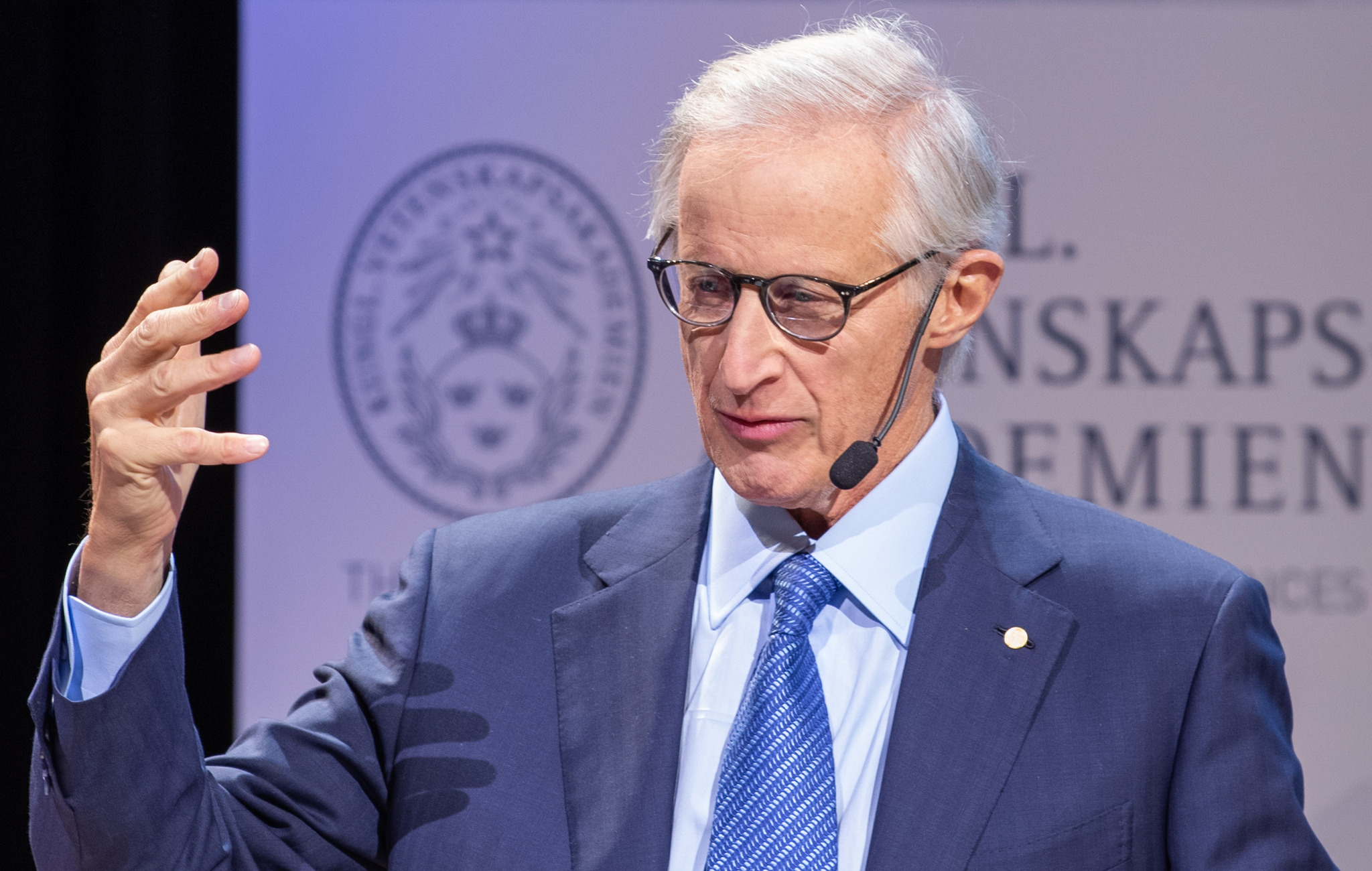
William Nordhaus, who was co-winner of the 2018 Nobel Prize in Economic Sciences, died on October 30, 2026. Nordhaus contributed much to our economic understanding. While he won his share of the prize for his work on global warming, the Nobel committee failed to mention that he also made other contributions to our understanding of economic growth and of who gets the gains from innovation.
Sometimes, though, he lashed out at people who disagreed with him about global warming, calling them “climate deniers” and claiming, without evidence, that they held their views because they were paid off by energy companies.
Global Warming and Taxes on Carbon
Nordhaus was probably the first modern economist to write extensively about global warming. He worried that the increase in carbon dioxide added to the atmosphere would warm the atmosphere and would, by the end of the twenty-first century, make world economic output lower than otherwise. He created the Dynamic Integrated Model of Climate and the Economy (DICE) to do what the name suggests: merge economic growth theory with global warming theory.
Nordhaus pointed to climate models that concluded that if we, meaning, the world, did nothing to rein in carbon usage, the global average temperature by the end of the 21st century would be 3 to 5 degrees Celsius higher. Although he didn’t specify the baseline, it appears that he was using the pre-Industrial Revolution temperature. The world temperature has risen about 1 degree Celsius since then. Nordhaus advocated that all national governments impose stiff taxes on carbon usage.
Nordhaus’s contribution was threefold. First, he took projections of carbon usage and temperature increases from climate models, plugged them into his DICE model, and estimated the reduction in Gross Domestic Product decades down the road if nothing were done to restrain carbon usage. Second, he used his model to estimate the taxes on carbon that would maximize the net benefits of carbon usage. On the one hand, carbon usage, by making the Earth warmer, would hurt real output; on the other hand, usage of fossil fuels, which, of course, contain carbon, drives economic growth. As in all economics, there are tradeoffs. In 2017, Nordhaus used a model to estimate the optimal carbon tax to be $31 per ton of carbon dioxide. To put that $31 in perspective, it would have increased the price of gasoline by about 28 cents per gallon. That’s a substantial number, but, as anyone who has noticed the effects of the Iran war can attest, it is small compared to the effects of other government actions.
Why did Nordhaus advocate carbon taxes rather than, say, detailed government regulation of various uses of carbon? Because he was a bona fide economist. He understood in this context the Hayekian insight that governments don’t have nearly enough information to set limits on uses of carbon. A government official couldn’t know whether or how much to mandate fuel economy, for example. The great advantage of a tax on carbon, as long as it is uniform, is that it causes every user of carbon to face a price that, ideally, includes the cost that that carbon use imposes on the society at large. Each user would restrict carbon emissions where their marginal benefit is lower than the tax-inclusive price of carbon. Using a tax rather than specific mandates allows society to cut back on emissions in precisely those areas where it is cheapest to do so. We may not know what that exact tax rate should be, but we do know that carbon taxes are superior to detailed regulation.
Of course, to say that there is an optimal tax rate is to say also that a tax that exceeds the optimal level is too high. That brings us to Nordhaus’s third contribution in climate economics. He used his model, and basic economic reasoning, to point out problems with the strong claims made by other economists who advocated much higher carbon taxes. In 2006, the British government published the Stern Review. Led by economist Nicholas Stern, the report gave more weight to future climate damages than Nordhaus did and called for earlier, deeper cuts in greenhouse gas emissions, estimating that each additional metric ton of carbon dioxide emitted would cause about $85 in damage. Compare that to Nordhaus’s 2017 estimate of $31 per ton. The Nordhaus tax, in 2006 dollars, would have been $25.50 in 2006. Stern’s proposed tax was several times the tax that Nordhaus proposed.
Why such a big difference? There were multiple reasons, but a primary one is that Stern used a 0.1 percent annual discount rate to bring future losses back to the present. Compare that to real interest rates of 2 or 3 percent that we see in financial markets. Using such a low rate puts a much bigger weight on losses of people 100 years from now. Some economists have argued for such a large weight. But Nordhaus had a good answer. In a 2006 critique of the Stern Report, which was published by the National Bureau of Economic Research, Nordhaus noted the Stern Review estimated that per capita consumption would grow at 1.3 percent per year for two centuries. While that number might sound small, over many decades it is huge. He noted that the high-damage case was “associated with a 13.8 percent decline in consumption in 2200.” This would mean, he wrote, that per capita consumption would grow from $7,800 in 2006 to “only” $81,000 in 2200. He concluded:
Hence, the Review advocates reducing current consumption to prevent the decline in consumption of future generations that it projects to be much richer than today. While this might be worth contemplating, it hardly seems ethically compelling.
In November 2018, only weeks after the Nobel Prize announcement, energy economist Robert Murphy noted that Nordhaus’s own model showed that the United Nations goal of keeping the world temperature from increasing by more than 1.5 degrees Celsius was ludicrously expensive. When asked about that goal in an interview with the New York Times, Nordhaus said that that goal was impossible to achieve. What he didn’t say was that, according to his own model, the cost of achieving that goal would have been many trillions of dollars greater than the benefits. He had estimated that the optimal increase in temperature was 3.5 degrees Celsius.
The Value of Lighting
Nordhaus made two other major contributions to our economic understanding, neither of which the Nobel committee mentioned.
One was the value of lighting. Except in times of power outages, which people in my part of America experience about once every year, we Americans take electric lighting for granted. It was not always so.
In 1800, people used candles, which were enormously expensive. Now, of course, we use light bulbs. Nordhaus showed that the cost of lighting in 1992 was well under 0.1 percent of the cost in 1800. He used his estimates to re-estimate real wage growth. Standard estimates, he wrote, were that between 1800 and 1992, real wages had grown by 13 times. But his re-estimates, using the reduction in the cost of lighting, showed that real wages have actually grown by between 58 times and 980 times!
Gains from Innovation
Another Nordhaus contribution, unheralded by the Nobel committee, was his estimate of the gains from innovation. In a data-heavy analysis published in 2004, Nordhaus concluded that only 2.2 percent of the gains from innovation went to the innovator and the remaining 97.8 percent went to consumers.
In a recent article, I did a calculation showing how plausible his estimate was.
Nordhaus’s Unfortunate Ad Hominems
Unfortunately, William Nordhaus sometimes engaged in ad hominem when confronting critics of his and others’ views on global warming. I, who am not a climate scientist, think that he is probably right that global warming will continue and be destructive. But that doesn’t mean that it will be nearly as destructive as Nordhaus thought. One skeptic is David Friedman, who has written that we don’t even know whether the net effects of global warming will be negative or positive. Take agricultural output, for example. On the one hand, areas closer to the equator will be more inhospitable to growing crops. On the other hand, areas far from the equator, such as my native Canada, will become more agriculture friendly. The net effect is hard to know. Yet Nordhaus claimed that skeptics are incentivized to be so. A company that is “making a hefty profit by fouling the atmosphere,” he wrote in his 2021 book, The Spirit of Green, “may round up far-out ideas or hire hungry scholars to back its activities.”
That may well be so, but it hardly accounts for all skeptics.
A Nobel-Worthy Legacy
William Nordhaus had his blind spots, but his research allows us to better understand how living standards improve and who shares in the gains. Conventional price measures can miss improvements in what a dollar buys, as in the case of the cost of light. In a separate study, he traced how the benefits of innovation are dispersed among consumers, rather than concentrated with the business that innovated. And by putting the economy and carbon emissions on the same model, he encouraged us to weigh the cost of emission reductions in the future against the costs to real people now.
Nordhaus himself was a divisive figure at times. But his work gives us a better sense of how disparate goals can be united, and how innovation — even at a price — can benefit the majority of humans in statistically perceptible ways.
Share This Article

Post on Facebook

Post on X

Print Article

Email Article