In F. Scott Fitzgerald’s short story, “The Ice Palace,” Northerner Harry meets Southern belle Sally and the two agree to marry. Sally’s small Georgia hometown is hot, sultry, and decadent, a place where she and her friends live lazy, dreamy lives. Harry’s hometown, on the other hand, arguably based on St. Paul, Minnesota, is brutally cold but filled with robust, rosy-cheeked Scandinavians full of industry and purpose.
Though dazzled by Northern men, Sally becomes trapped on a visit to meet Harry’s family, and nearly freezes in a three-story ice palace constructed as the centerpiece of a winter carnival. Traumatized, she breaks the engagement and returns home to a life of idleness, where “over the trees and shacks and muddy rivers, flowed the heat, never hostile, only comforting, like a great warm nourishing bosom for the infant earth.”
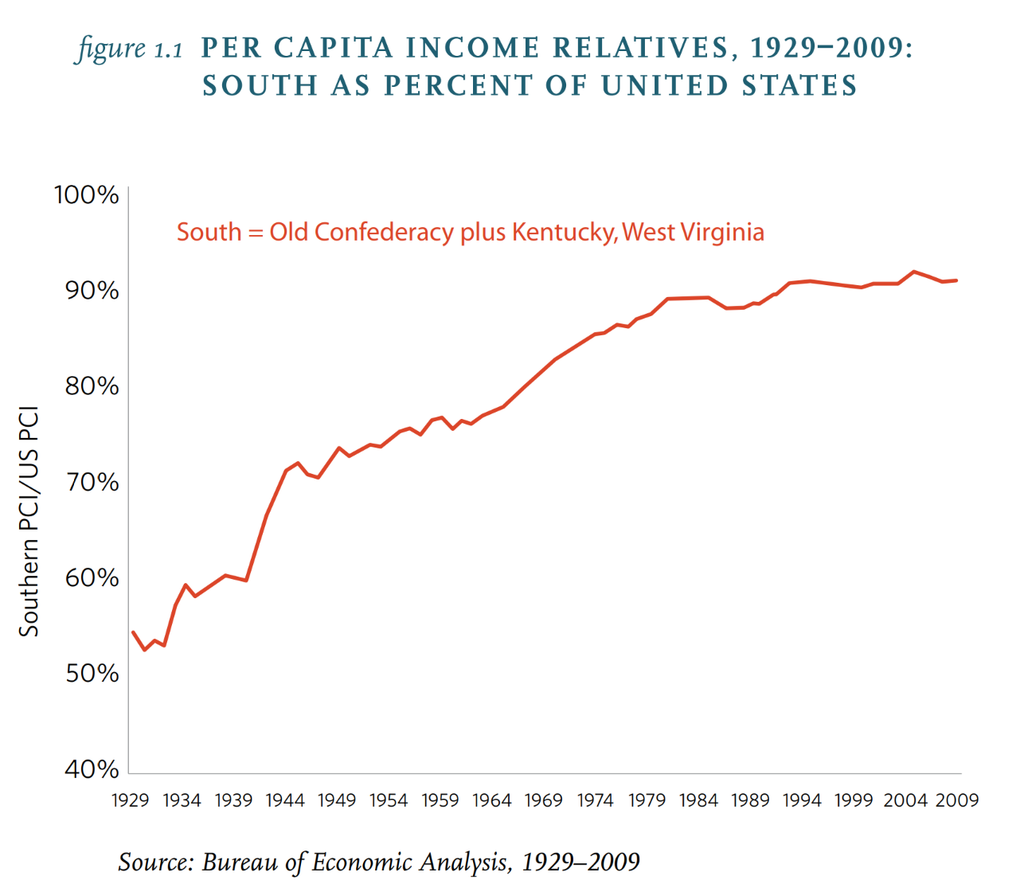
In 1920, when Fitzgerald published these words, there was some truth to the stereotypes he employed. The American South was the poorest region of the United States, with a per capita income half that of the nation overall. President Roosevelt even called the region “the nation’s number one economic problem” in a 1938 speech.
But that changed in the second half of the twentieth century, when a “New South” emerged. Fitzgerald’s land of trees and shacks and muddy rivers became a “Sunbelt” of bustling cities, economic dynamism, and population growth. It’s a case study in the transformative power of business-friendly policies.
From Cotton Fields to Corporate Headquarters
In the summer of 1976, I moved from the Old South to the New. I had just finished third grade in Waldo, Arkansas, a rural town in the southwest corner of the state. That fall, I started fourth grade in Houston, Texas. Local television commonly referred to the city as “Boomtown.” It was an epicenter, along with places like Atlanta, Georgia, and Charlotte, North Carolina, of an ongoing Southern transformation.
In the Old South, what had mattered was blood and land. It was a quasi-feudal society where it was difficult to rise above the station you inherited, nearly impossible if you were black. And when the tension created by slavery in a nation founded on freedom became untenable, the Civil War broke out, and the South was crushed. The Union’s victory owed at least as much to economic superiority as military proficiency.
Though it took roughly a century, transforming the Southern economy required replacing its agrarian, slave-based order with a more modern, freer, more diversified system. In Houston, the transformation was spurred by the oil industry. In Charlotte, it was banking. And in northwest Arkansas, it was retail, with Walmart founder Sam Walton becoming the richest person in the United States in 1982.
These and other parts of the New South had common denominators, such as pro-business environments of low taxes, light regulation, and a focus on individual initiative. Right-to-work laws created flexibility for businesses and less adversarial relationships between labor and management. This was crucial at a time when American firms were increasingly competing in a global market.
Among other factors, this century of growth and net in-migration was also reliant on widespread air conditioning and the eradication of malaria and hookworm from rural areas.
Politically, the South shifted from Democratic to Republican. When Bill Clements became governor of Texas in 1979, he was the first Republican to win the office in more than a century.
Growing Up in Boomtown
After living in a part of Houston known as Spring Branch, my family moved out to the new suburb of Alief in 1980. Much of it looked like it had just been unwrapped. Less than a mile from our house was the sparkling 50-acre campus of the global engineering firm Brown & Root, with its landscaped grounds and an imposing security fence with a guarded entrance gate. Even at such a young age, I had a sense of living near the center of some kind of powerful dynamism.
My first close friend at Alief Middle School was John, a Rust Belt refugee from Michigan. A remarkable number of these folks were showing up in Houston as the American auto industry contracted in the face of vigorous competition from imports. On the school bus, I heard conversations between kids who had grown up in neighboring towns up north and were meeting for the first time in suburban Texas.
In the subdivision where we lived, roughly half the families were Asian American. At school, one guy wore a turban, something I’d previously only seen on television shows like the Jonny Quest cartoons. In an increasingly capitalist and economically mobile society, people in the New South were valued for what they could contribute, and judged rather less based on their skin color or parentage than in previous generations and in the places from which they’d come.
People Follow Policy
Corporations seized the opportunity. In 1979, American Airlines relocated from New York City to Fort Worth, Texas. Personal care products giant Kimberly-Clark moved from Wisconsin to Dallas in 1985. Mobil Oil left New York City for Fairfax, Virginia in 1987.
While such corporate relocations still happen today — the South now hosts the highest number of Fortune 500 headquarters of any US region — the concept of a New South has waned in the twenty-first century. According to a Google Ngram view, use of the term in books decreased by more than half between 2000 and 2022. Today, the national divide is rural versus urban, with the latter having become one-party strongholds of high taxes, big regulation, and bloated government policies that often fail the people they aim to serve.
Downtown St. Paul, Minnesota, for instance, the likely inspiration for Harry’s bustling hometown in Fitzgerald’s story, now struggles with epidemic levels of drug overdose, crime, poverty, and homelessness.
Leaders in such places might want to look around and consider whether their progressive political path — high taxes, expansive welfare programs, price controls, heavy regulation, and government intervention in housing and business — is really the road to future prosperity.
The story of the twentieth-century New South offers a lesson in transformation through free enterprise, individual opportunity, and market-led economic growth.
Share This Article

Post on Facebook

Post on X

Print Article

Email Article