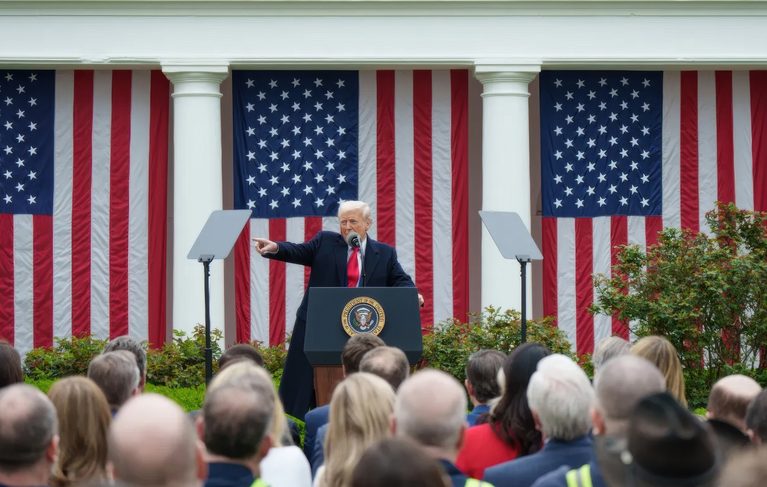
To put “America First” has been something that the U.S. president has promised from the first day in office. In his inauguration speech a little more than two years ago, he made clear that “from this day forward, a new vision will govern … it’s going to be only America first, America first.”
Disregarding the dark history of the term “America First,” which the Left almost solely focused on when the president put it in his mouth, there is, in principle, little wrong with the idea itself. That an elected head of state — or any politician for that matter — should look at his own electorate, which elevated him into office, rather than some foreign population seems common sense. After all, it is these people — in Donald Trump’s case, Americans — that he is representing; it is them he should care for, at least in theory. It would be rather strange if he accounted for the worries of Canadians, French, or South Africans in his decision-making processes.
The most glaring example of this — and the clearest and most often used — is foreign policy. While heads of state around the world find the “my country first” approach rather outdated — in our multilateral world order, they say, we are all in this together — it is hard to see from where the U.S. president, who supposedly holds this position to further the interests of Americans, would have the power to use the U.S. military to simply intervene in others’ affairs if his own country was not being attacked.
“America First” does become more complicated, however, when it comes to other issues. After all, Donald Trump’s promise was, for instance, that he would also put Americans first on economics and trade. In some regards, like his tax cuts and deregulations, which have spurred economic growth and created new jobs, he has done that. But when it comes to his trade policy, there is little doubt at this point that he has dramatically failed in the endeavor to make his country great again.
The Trade Problem
New studies in the last weeks have shown the immensely negative effects the protectionism of the president has had on both American consumers and companies. A new study by AIER’s Max Gulker and Peter Earle comes to the conclusion that Trump making good on his protectionist campaign promises has “harmed virtually all Americans while failing to positively impact the industries supposedly being protected.” Indeed, write Gulker and Earle, “anyone who maintains that a $75 billion income tax cut helps the economy must also agree that a tariff hike of $45 billion or more must harm the economy.”
Another new study, by the Federal Reserve Bank of New York, Princeton University, and Columbia University, finds that tariffs imposed last year “were costing U.S. companies and consumers $3 billion a month in additional tax costs and companies a further $1.4 billion in deadweight losses.”
Meanwhile, those who would supposedly profit most from these tariffs are, in fact, often those that are hurt the most. As Gulker and Earle note, not much has changed in the steel industry since the start of the tariff wars — things have changed for those people working there, though. Indeed, Erica York from the Tax Foundation has shown that Trump’s “tariffs are regressive, placing a higher burden on lower-income households.” While she is estimating that after-tax income has decreased by 0.30 percent on average for Americans, the tariff effect has been a reduction of 0.33 percent for middle- and low-quintile households.
The poorest in society are not only hurt income-wise, though, but also as consumers. News, for instance, of Dollar Tree announcing that it will close 390 stores in the U.S. due to the difficulty of the new trade barriers will certainly not hurt “the rich,” who are unlikely to visit chain stores selling $1 products. If there is anyone who has profited from the trade wars, it is if anything the U.S. government, which has seen an increase in revenue.
All of this lines up with what has been known for a while: in 2016, for example, the Economist wrote that “protectionism hurts consumers and does little for workers. The worst-off benefit far more from trade than the rich.”
Thus, while Donald Trump’s plan was to put Americans first on trade, the results show quite a different picture. As CapX’s Oliver Wiseman wrote in response to the studies, “The gap between the President’s trade war rhetoric and the consequences of his actions makes George W. Bush’s declaration of ‘mission accomplished’ in Iraq look understated.”
Now, Trumpian conservatives might respond that this is not the entire story, that, as Tucker Carlson said in his now-infamous Fox News monologue from early this year, Americans “are drowning in stuff,” “that the health of nation” should and cannot be “summed up in GDP”— that is, material well-being — that the goal should not merely be prosperity, but happiness in general.
All of this might be true. It is quite difficult, however, to measure the total happiness of Americans and whether it has changed since the new tariff regime commenced — if anything, it probably made things worse, not only because people have less money in their paychecks, but because the issue has been so divisive and conflict-stimulating that it is hard to believe that anyone has enjoyed the fights over this coerced protection.
The only thing we do know for sure is, as Wiseman notes, “the essential truth about trade: the more of it, and the freer, the better for all those involved,” at the very least economically. A tiny majority of Americans have surely profited from the trade wars — protectionism always has some winners on the backs of everyone else. But even if those winners were American workers, those “left behind” in rural areas, which Trump promised to help out — which is, as we have seen above, not the case at all — it would not be “America First.”
Today’s “America First” vision does not include all Americans, perhaps not even a majority of them. By protecting certain industries, certain job areas, or specific products, Donald Trump tries to put some Americans first, but hurts all other Americans along the way. Of course, the president will still say this is him putting “America First” — but probably only because “My Favorite American Industries and Workers First on the Back of All Other Americans” would not win many votes at the ballot box.
Freedom First
As Trump will surely realize as well, following a truly “America First” approach by trying to make all 325 million Americans happy — without anyone losing out, without anyone coerced into some scheme — is an impossibility. But here could lie the solution: to stop granting special treatment to a privileged minority and instead just leave Americans striving for their own happiness.
The real “America First” approach would be to just do the most American thing of all: to implement an agenda on individual liberty, personal responsibility, and a (very) limited government; to let those freely trade with anyone in the world as they want and let those that want to trade locally do the same; to let those that find all their happiness in their own individual GDP — their paycheck — look for possibilities to improve that metric and let those that would rather live in a strong local community, even if it means to forgo money to do that, do the same; and to let those elements of society that we find abhorrent be called out in the private sector, through a strong civil society, not be abolished by government.
Richard Ebeling wrote a few days ago on this site that “what the world needs is more personal freedom and economic liberty so we each may be the voluntary means to each other’s ends through the marketplace of ideas, employments, and products.” It seems as though starting this approach in the U.S. would be a first step on the path to a genuine “America First.”
Share This Article

Post on Facebook

Post on X

Print Article

Email Article