Frederick Douglass, the runaway slave who later became a model among abolitionists of gritty authenticity, eloquence, and persuasion, described the United States Constitution as a “glorious liberty document.” That was long before the 13th Amendment was ratified, or even proposed.
The original Constitution was part of a larger political drama, the American Founding, which was the greatest anti-slavery movement in history.
Discovering the Wrongness of Slavery
The sad story of human beings enslaving each other stretches across millennia and cultures. Few human practices are older or more common than slavery, which is why, in the course of thousands of years, few questioned the moral legitimacy of it.
At the time of the American Founding, slavery existed around the globe. Africans, in particular, were kidnapping and selling fellow Africans, over 12 million total, as part of an international slave trade, the “middle passage” of which was a nightmarish Hell on Earth aboard slave ships sailing across the Atlantic Ocean.
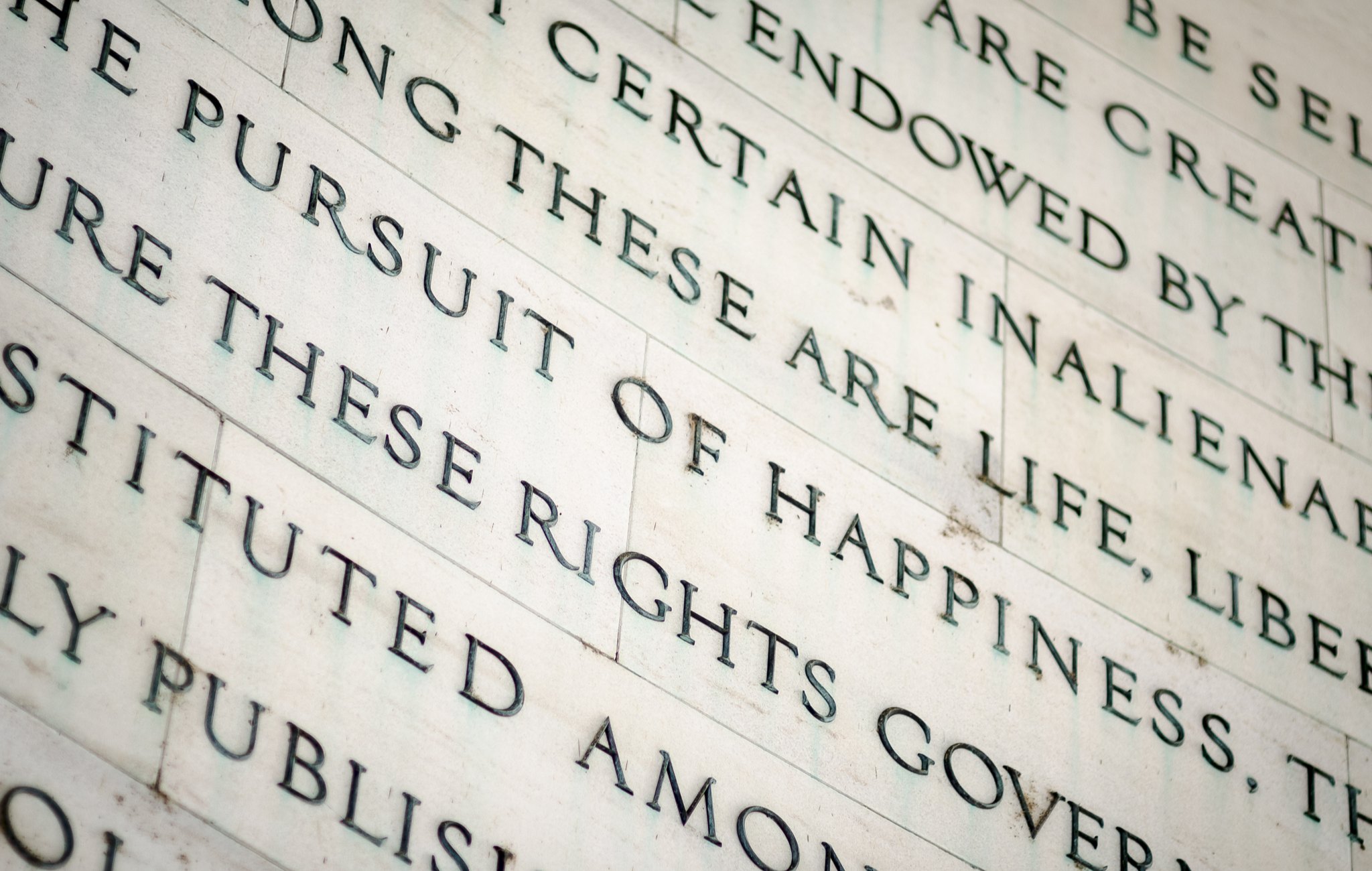
Then, something amazing happened. The American Founders discovered a timeless, universal moral truth: all human beings, everywhere, are “created equal” and possesses “certain unalienable rights” including “life, liberty, and the pursuit of happiness.” They declared this truth with the world watching, like a beacon of justice.
Before the ink dried on the Declaration of Independence, American revolutionaries launched a political and cultural movement, the moral logic of which required the abolition of slavery. After their high-profile separation from the British Empire, and because of their own revolutionary principles, growing numbers of Americans were opening their eyes to the injustice of slavery and demanding its swift end.
Within slightly more than four score and seven years, to use Abraham Lincoln’s famous dating at Gettysburg, and after a terrible Civil War, the Americans formally abolished slavery by way of Constitutional Amendment. The free United States we know today is the result of the movement started by the Founders, finished by Lincoln.
Glorious Liberty Document
Frederick Douglass recognized that even though the Constitution was adopted at a time when slavery was omnipresent and deeply entrenched, it was designed for a future without slavery. “Read its preamble,” Douglass implored Americans, “and consider its purposes. Is slavery among them? Is it at the gateway? Is it in the temple? It is neither.”
“Take the Constitution according to its plain reading and I defy the presentation of a single pro-slavery clause in it,” Douglass observed. Rather, the Constitution contains “principles and purposes entirely hostile to the existence of slavery.”
Perhaps nothing reveals more clearly the liberty-oriented, antislavery end for which the Constitution was designed than its three slavery-related clauses: the Three-Fifths Clause (Art. I, Sec. 2), Importation Clause (Art. I, Sec. 9), and the Fugitive Slave Clause (Art. IV, Sec. 2).
During the Constitutional Convention in Philadelphia, while debating the proportional numbers from each state within the House of Representatives, not one delegate argued for counting livestock as part of a state’s population. But there was a big debate over whether to count slaves, because everyone knew slaves are people.
The rub was that slave states were treating slaves like farm animals. Yet, those same slave states wanted to count their slaves as part of their population, because a larger state population would mean more Representatives, and more power, in Congress.
Delegates opposed to slavery proposed that slave states should not count slaves at all. If they wanted to count slaves, some countered, first free them, offer citizenship, recognize their voting and other civil rights, and then count them.
This disagreement resulted in the Three-Fifths compromise: slave states could add to the total number of “free persons” three-fifths of “all other persons,” i.e. slaves. In states without slavery there were only “free persons,” all of whom would be counted.
The Importation Clause said the importation of African slaves couldn’t be banned until 1808 (twenty years after the Constitution was ratified). President Thomas Jefferson signed the Act Prohibiting Importation of Slaves in 1807, which went into effect January 1, 1808.
The Fugitive Slave Clause was another compromise made under threats of secession from slave states. They wanted Constitutional protection to reclaim runaway slaves who escaped to free states. The Fugitive Slave Clause provided that protection.
If and when all of the states abolished slavery, and America became truly a land of liberty, not one of the Constitution’s slavery compromises needed to be repealed or amended because each would become inapplicable and irrelevant.
Constitution Day
On this Constitution Day 2022, it’s good to remember the Constitutional insights offered by Frederick Douglass. The Constitution was made for a nation that was born with slavery and would later, in its maturity, rejoice in the abolition of slavery. He was right.
Share This Article

Post on Facebook

Post on X

Print Article

Email Article