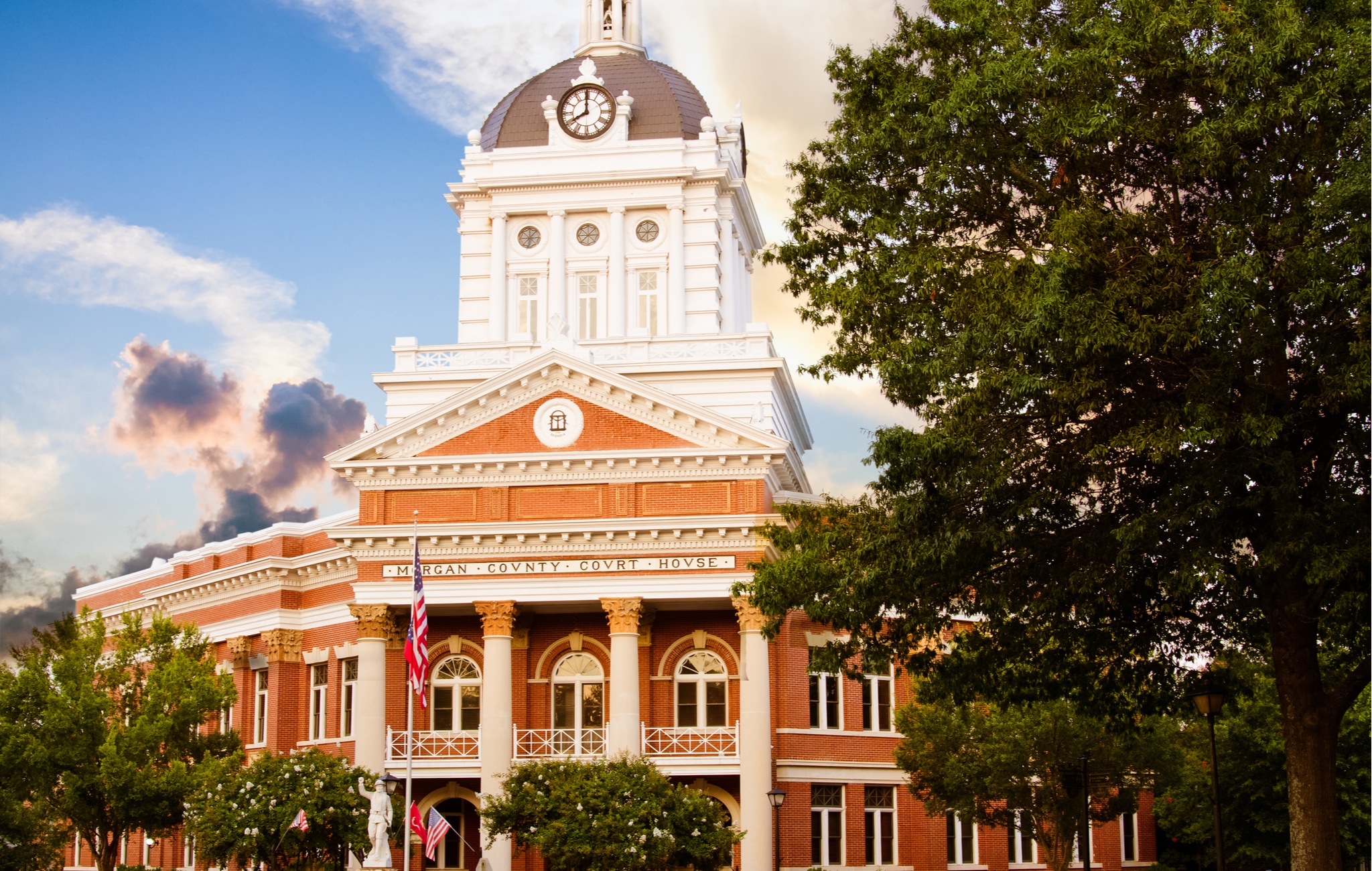
I passed through Madison, Georgia several times on business late last year and thought it a fine town of about 4,000 in the pine forest upland region east of Hotlanta. Unbeknownst to me at the time, Madison was long considered the widow’s capital of Georgia because of the relatively high concentration of young widows living there. And it was all due to a widower who died childless in 1817.
That man, Benjamin Braswell, moved to Morgan County, Georgia with his wife in the early nineteenth century, when it was still considered part of the frontier. He owned a farmers’ dozen slaves but grew no cotton, just corn, wheat, cattle, and hogs. His business thrived nevertheless. In his will, he stipulated that his slaves could pick their new owners themselves, provided their new masters offered his estate at least half of each slave’s market value. (For additional details, see E. Merton Coulter, “Benjamin Braswell, Georgia Pioneer Philanthropist,” Georgia Historical Quarterly 65, 2 [Summer 1981]: 67-81.)
In that same document, Braswell also unwittingly made Madison, the county seat of Morgan County, a magnet for widows by creating an indigent orphans’ school fund from the proceeds of the sale of his slaves and land, which totalled about $11,000, a tidy sum at the time. A local court soon came to control the fund and did a remarkably good job of investing it, even during the Civil War when it made only token investments in soon-to-be-worthless Confederate securities. It also helped that Yankee troops didn’t torch the town during Sherman’s March to the Sea, ostensibly because some politically-connected Unionists, perhaps the very people in charge of the fund, lived there.
The Braswell Fund also waxed ever larger because its expenditures rarely exceeded its investment revenues. Private elementary schooling in the nineteenth century South was pretty cheap, just pennies per student per day. Surpluses were rolled into more investments in railroad and bank stocks, creating yet more income. The fund was soon even paying the college tuition of indigent orphans and other donors also began to leave money to the fund in their wills.
When word of the Fund’s prosperity and generosity got out, poor widows with school-aged children began to flock to Madison to avail themselves of Braswell’s beneficence. Madison soon became “Widow’s Heaven” because the Fund paid for their children’s books, fees, and even clothes when necessary.
Although Morgan County courts invested the money, the fund was essentially a private charity. In fact, most antebellum Americans interested in aiding orphans or other worthies usually created a nonprofit corporation, or donated to an existing one, instead of entrusting the endeavor to executors or courts. Thousands of such nonprofit corporations sprang up nationwide before the Civil War and thousands more after it.
Charities also helped the widows of Madison, and the rest of America, to reduce the risk of being buried in a Potter’s field, an unmarked pauper’s grave in an unkempt municipal lot. That might seem like a trivial concern today, when over half of Americans choose cremation over interment, but in the nineteenth century a great stigma, and possible eternal damnation, attached to any family unable to afford a “proper Christian burial.”
In fact, many Americans purchased industrial life insurance policies (small premiums paid weekly) for the sole purpose of being able to afford a modest ceremony, plot, and headstone when they passed into the Great Beyond. Many others joined benevolent societies that promised proper burials for deceased members. Former slaves formed such voluntary societies soon after achieving freedom. Some used accumulated dues to pay for plots in church cemeteries when a member died, but others bought and ran their own burial grounds. [For details see C. A. Spencer, “Black Benevolent Societies and the Development of Black Insurance Companies in Nineteenth Century Alabama,” Phylon 46, 3 (1985): 251-61.]
Notice that the government was not absent from these tales of the crypt but that its role was minor, even incidental. Nothing like a cradle-to-grave social welfare system existed because it was unnecessary and even counterproductive. And it still is. To achieve a goal, like educating poor orphans or burying the dead with dignity, Americans did not have to elect certain politicians and pray that they fulfilled their campaign promises, they simply got ‘er done directly, in ways that naturally took local conditions into account.
Best of all, nobody was forced to subsidize others. They gave to charity, joined with like-minded people, or sought profit. The system wasn’t perfect — nothing is — but it was a far cry better than taxing people to support inefficient, uniform government educational and welfare programs.
We can’t go back to the good old days, but why can’t we go back to the good old ways?
Share This Article

Post on Facebook

Post on X

Print Article

Email Article