“Fascism entirely agrees with Mr. Maynard Keynes, despite the latter’s prominent position as a Liberal.”
So wrote the British fascist James Strachey Barnes in his 1928 book Universal Aspects of Fascism, which included a glowing preface written by Mussolini himself. “In fact,” Barnes continued, “Mr. Keynes’s excellent little book, The End of Laissez-Faire…might, so far as it goes, serve as a useful introduction to fascist economics.”
Even today, crackpots apply Keynes’s name to economic nonsense, hoping that some of his credibility will rub off; what might be called “Keyneswashing.” Was Barnes “Keyneswashing” fascist economics, or is there a genuine similarity with the Keynesian variety?
Laissez-Faire
Keynes defined “laissez-faire” as the “idea of a divine harmony between private advantage and the public good.” Adam Smith’s legacy, he summarized was, “in the main, to allow the public good to rest on the natural effort of every individual to better his own condition.”
The balance rested on two pillars, Keynes reasoned. First was ideology: if economic theory was followed to its conclusion, laissez-fire would be found at the end. He argued that this was not so, that the great economists — Adam Smith, David Ricardo, John Stuart Mill — had said no such thing, that this was only “what the popularizers and the vulgarizers said.” It was they, not the economists, who “fixed laissez-faire in the popular mind as the practical conclusion of orthodox political economy.”
Second, an accident of historical circumstance meant that “the corruption and incompetence of eighteenth-century government, many legacies of which survived into the nineteenth” coincided with “material progress between 1750 and 1850 [which] came from individual initiative, and owed almost nothing to the directive influence of organised society as a whole.” This practical experience, it was said, confirmed the “a priori reasonings” of the economists.
By the time Keynes published The End of Laissez-Faire in July 1926, these no longer held.
Keynes rejected the a priori reasonings. “It is not a correct deduction from the principles of economics that enlightened self-interest always operates in the public interest,” he wrote. “Nor is it true that self-interest generally is enlightened; more often individuals acting separately to promote their own ends are too ignorant or too weak to attain even these.” Keynes argued that experience showed that individuals, acting collectively, through government, actually could make better decisions than they did acting individually.
The experience of World War I was what Keynes had in mind. “War socialism unquestionably achieved a production of wealth on a scale far greater than we ever knew in peace, for though the goods and services delivered were destined for immediate and fruitless extinction, none the less they were wealth,” he wrote. If “the dissipation of effort was…prodigious, and the atmosphere of waste and not counting the cost…disgusting to any thrifty or provident spirit,” that merely reflected “socialism” in wartime; in peacetime, it could be different.
Corporatism
“[P]rogress lies in the growth and the recognition of semi-autonomous bodies within the State.”
— John Maynard Keynes, The End of Laissez-Faire
Such was Keynes’s proposed model for these bodies were corporations. “Bodies whose criterion of action within their own field is solely the public good as they understand it, and from whose deliberations motives of private advantage are excluded,” he wrote, giving the examples of universities, the Bank of England, the Port of London Authority, the railway companies, and “joint stock institutions,” which, “when they have reached a certain age and size, [tend] to approximate to the status of public corporations rather than that of individualistic private enterprise.”
This is corporatism, as Merriam-Webster tells us: “the organization of a society into industrial and professional corporations serving as organs of political representation and exercising control over persons and activities within their jurisdiction.”
And it was corporatism with a wide scope. Keynes argued for government direction of savings, foreign investment and income distribution. “I do not think that these matters should be left entirely to the chances of private judgement and private profits, as they are at present,” he wrote.
This was “Keynes’s Middle Way” between capitalism and socialism, as his biographer, Robert Skidelsky explained; “Today we might call it a Third Way.”
Fascism
“The fascist state is corporative or it is nothing.”
— Benito Mussolini
Political scientist Andrew Heywood wrote that the distinguishing feature of fascist economic thought is the idea of corporatism. Mussolini, architect of the first fascist state, explained that “the fascist state is corporative or it is nothing” and called the corporations “the fascist institution par excellence.”
Corporatism was the thin end of the authoritarian wedge. In 1926, Mussolini created a special ministry of corporations, explaining that a new cooperative machinery, as well as fixing wages and conditions of work, would eventually regulate the whole economy and that, eventually, the corporations would affect what would amount to compulsory recruitment of all Italian citizens for civilian work. In 1927, twenty-two corporations were established representing employers, workers, and government, charged with overseeing the development of all the major industries in Italy. In 1930, a National Council of Corporations was set up, comprising seven large worker and employer organizations; it had no legislative power, but could issue binding orders in matters concerning wages and conditions. By 1934, this had been expanded to include twenty-two sectors of the economy and social life.
Finally, in 1939, a chamber of Fasces and corporations was created to replace parliament. Mussolini saw this, Heywood writes, as a “‘third way’ between capitalism and socialism.”
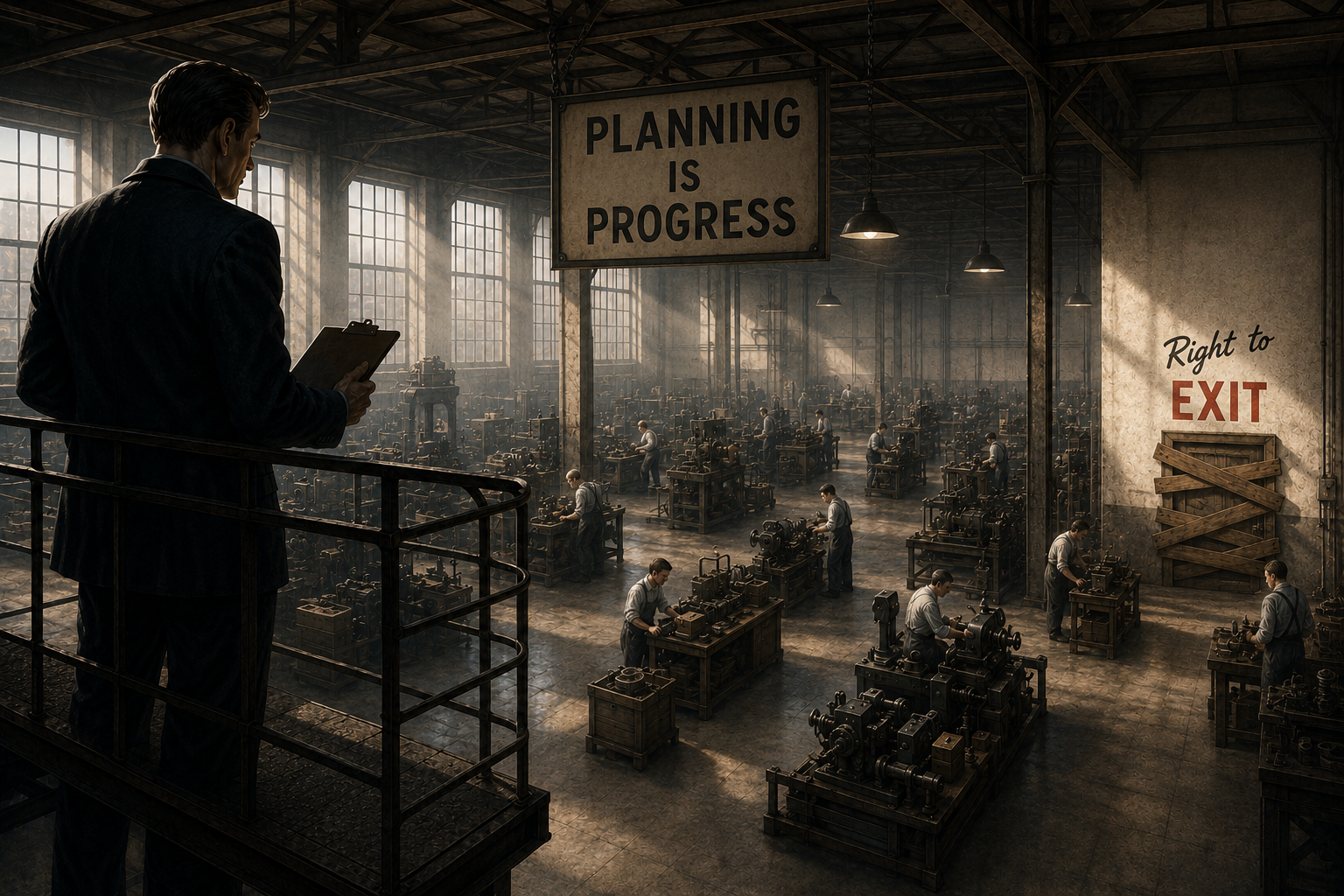
Can Economic Planning Remain Politically Neutral?
Much of this lay in the future as Keynes wrote, and perhaps we should not condemn him for lack of foresight.
Keynes believed, according to his biographer, the economist Roy Harrod, that “the government of Britain was and would continue to be in the hands of an intellectual aristocracy,” of which he was part. He supported economic central planning, via corporatism, because he assumed that enlightened experts like himself, a leading member of the Bloomsbury group, not a goon like Mussolini, would be doing the planning. He underestimated the political dangers of replacing decentralized decision-making with central planning, assuming that economic freedom could be curtailed without curtailing other freedoms.
But if we can excuse such a belief held in 1926 as naivety, how can we excuse it still held ten years later when fascism’s true nature was becoming apparent? In September 1936, Keynes wrote in the preface to the German edition of his masterpiece, The General Theory of Employment, Interest and Money, that “the theory of output as a whole, which is what the following book purports to provide, is much more easily adapted to the conditions of a totalitarian state, than is the theory of the production and distribution of a given output produced under conditions of free competition and a large measure of laissez-faire.”
If a totalitarian state is the price we must pay for the Keynesian “theory of output” to be put into practice, it is not a price worth paying. Likewise, if laissez-faire was the economic manifestation of political liberalism, then its death was to be mourned, not celebrated. If economic freedom is surrendered, other freedoms follow. “The economy” is just people acting, and one can only control “the economy” by controlling people.
Fortunately, and not for the last time, Keynes would be proven wrong. Laissez-faire was, like the Norwegian Blue parrot, not dead, but merely resting. Given the alternative, it is a good thing for humanity that this was so.
Share This Article

Post on Facebook

Post on X

Print Article

Email Article