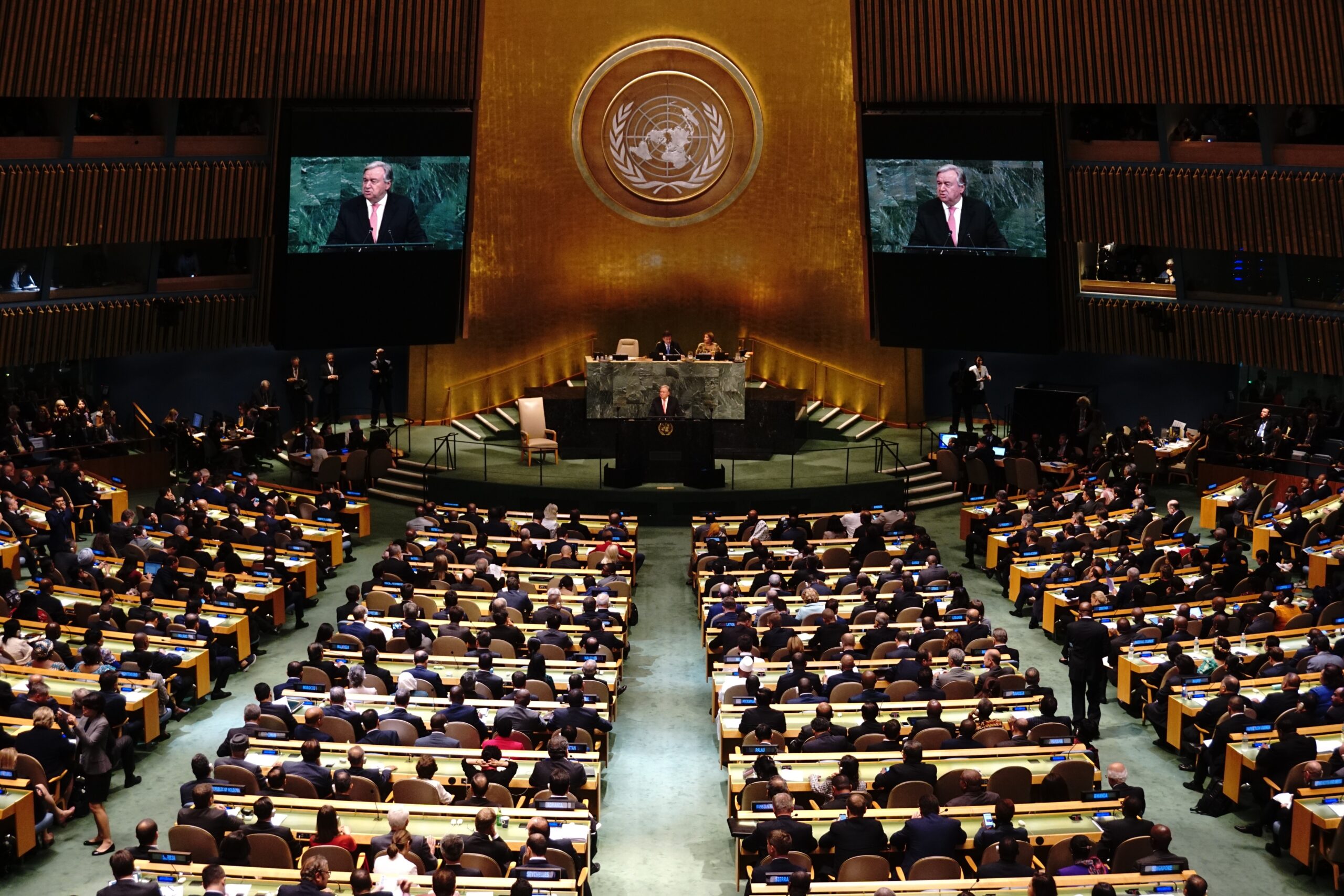
Many Americans now view the United Nations unfavorably, with only 52 percent expressing a positive opinion—a five-point decline since 2023. Public belief that the United States benefits from its membership in the UN is also waning.
Reflecting this growing dissatisfaction, Sen. Mike Lee (R-UT) has reintroduced 2023 bill, the Disengaging Entirely from the United Nations Debacle (DEFUND) Act, at the first session of the 119th Congress. The bill calls for the termination of US membership “in the United Nations, and in any organ, specialized agency, commission, or other formally affiliated body of the United Nations.” Rep. Chip Roy (R-TX) has reintroduced the House version of the DEFUND Act.
International organizations like the United Nations are neither sacrosanct nor immune from criticism. However, the proposals by Sen. Lee and Rep. Roy would, if enacted, unintentionally harm America’s national security interests.
Proponents of the DEFUND Act cite a range of concerns, including claims that the UN undermines US sovereignty and that the US’s outsized funding of the UN wastes taxpayers’ money. There are many valid criticisms of the UN, both from member states and from UN staff within the organization past and present.
Regarding sovereignty, Sen. Lee argues that the US has “ceded incrementally greater sovereignty to the United Nations under … illusory ‘customary international law.’” Yet the US Constitution provides a check: while the president may sign treaties, only the Senate can ratify them, ultimately determining whether the US is legally bound.
Indeed, the United States refused to join the League of Nations after World War I because the Senate declined to ratify the treaty. The US has a long history of withholding ratification from major international treaties. Notable examples include the Convention on the Rights of the Child (CRC), Convention on the Elimination of All Forms of Discrimination Against Women (CEDAW), Kyoto Protocol (1997), Convention on the Rights of Persons with Disabilities (CRPD), Comprehensive Nuclear-Test-Ban Treaty (CTBT), and the Rome Statute of the International Criminal Court (ICC).
On the ICC specifically, the US has taken vigorous steps to defend its sovereignty. Not only did it decline to ratify the Rome Statute, but in 2002, Congress passed the American Service Members’ Protection Act, often referred to as the Hague Invasion Act. This law authorizes the president to use “all means necessary and appropriate” to secure the release of American or allied personnel detained by, or at the request of, the ICC. More recently, the US has moved to impose sanctions on the ICC.
Rep. Roy also argues that the billions of dollars the US contributes to the UN annually are squandered. Sen. Lee echoes this view, stating that “Americans’ hard-earned dollars have been funneled into initiatives that fly in the face of our values—enabling tyrants, betraying allies, and spreading bigotry.” He also emphasizes that most US contributions are voluntary and that Congress, holding the power of the purse, should decide how these funds are allocated—or not.
As with any collaborative enterprise or governance by committee, some initiatives will inevitably be less efficient than unilateral efforts. Still, a Government Accountability Office study of a UN peacekeeping mission in the Central African Republic found that if the US had acted alone, the mission would have cost $5.7 billion—compared to the UN’s $2.4 billion price tag. The US share of that mission’s cost was only $700 million.
The most compelling reason for the US to remain in the UN is the value of its permanent seat on the United Nations Security Council (UNSC)—a position that comes with veto power. The strategic importance of this role cannot be overstated.
Consider the Soviet boycott of the Security Council in 1950. In protest of the UN’s refusal to recognize the People’s Republic of China, the Soviet Union vacated its seat. During this boycott, North Korea invaded South Korea. With the Soviet Union absent, the Security Council passed resolutions condemning the invasion and authorized the first UN multinational military intervention. Recognizing the scale of its miscalculation, the Soviet Union never again boycotted the UNSC.
A similar situation could arise if the United States withdrew. Without our presence, we could not rely on allies to represent US interests in future crises. Abandoning international discourse would mean forfeiting influence when it matters most.
While Sen. Lee and Rep. Roy may be acting out of conviction, their push to withdraw the US from the UN would risk repeating Cold War-era missteps—and could undermine our national security at a time when global stability is anything but guaranteed.
Share This Article

Post on Facebook

Post on X

Print Article

Email Article