Just-released numbers from two federal agencies, the Bureau of Labor Statistics and the Bureau of Economic Analysis, show that in the first quarter of 2024, Idaho was the number one state for both payroll growth and GDP growth. While these numbers jump around a lot, Idaho’s growth has strong foundations. A comparison of Idaho and California illustrates this fact and the economic principles that explain it.
People are moving to Idaho. From April 1, 2020 to July 1, 2022, Idaho had the highest net migration rate in the country.
Idaho has also historically had high fertility rates. In 2002, it was #5 for fertility, in 1997 it was #8, and in 2005 it was #3, to take some random years. Many of those children have now entered the workforce.
There’s a saying in economics: “supply creates its own demand” (Say’s Law). This is as true of labor as of commodities. Idaho’s population growth has fueled growth in employment and GDP.
You can see this by comparing Idaho to a slow-growth state, California (also the main origin state for movers to Idaho). The following figure shows the ratio of Idaho employment to California employment.
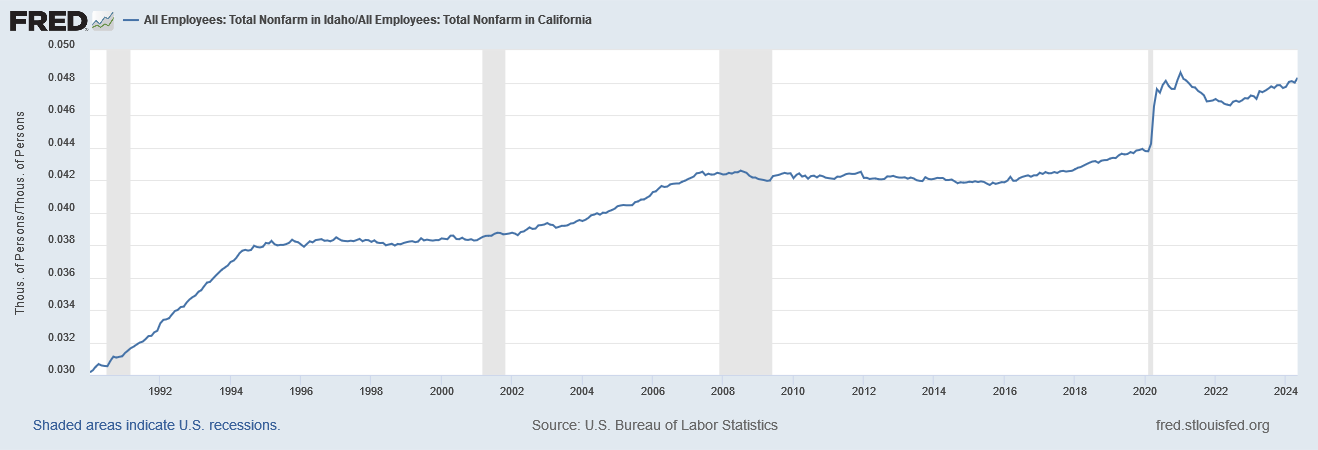
In 1990 Idaho had just 3 percent of the employment of California. Today, it has 4.5 percent, a 50 percent increase. All those people moving to Idaho have quickly found jobs. As a result, Idaho’s GDP has also increased faster than California’s, as the next figure demonstrates.
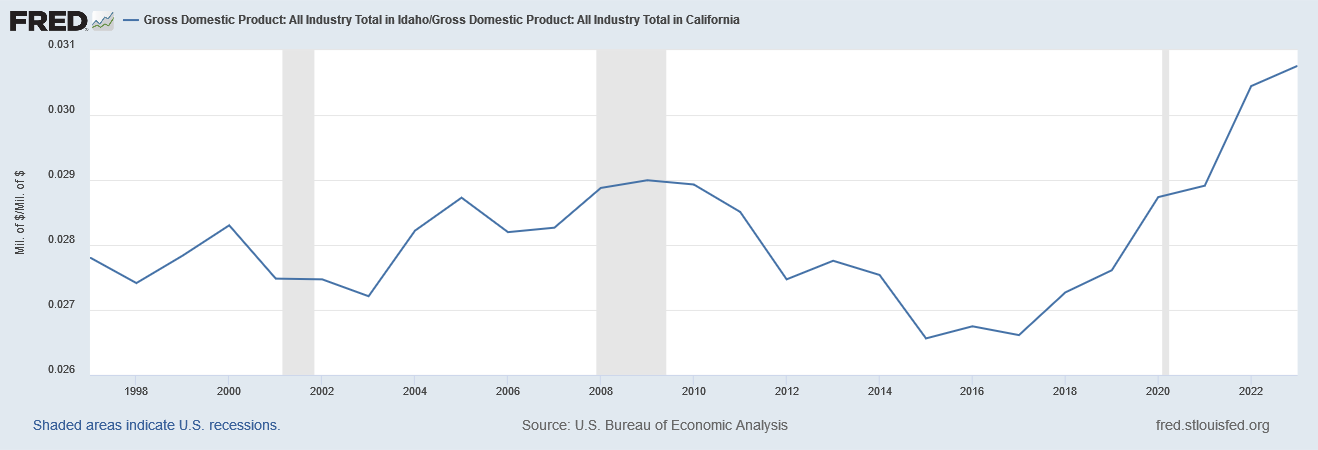
California went through a tech-fueled boom in GDP from 2009 to 2017, and AI developments may help California again. But even so, Idaho’s GDP has grown much faster, rising from less than 2.7 percent of California’s in 2017 to more than 3 percent of California’s by this year.
The trends are even starker when we look at personal income. A lot of that 2010s tech growth went to the profits of companies based in California, not people living in California.
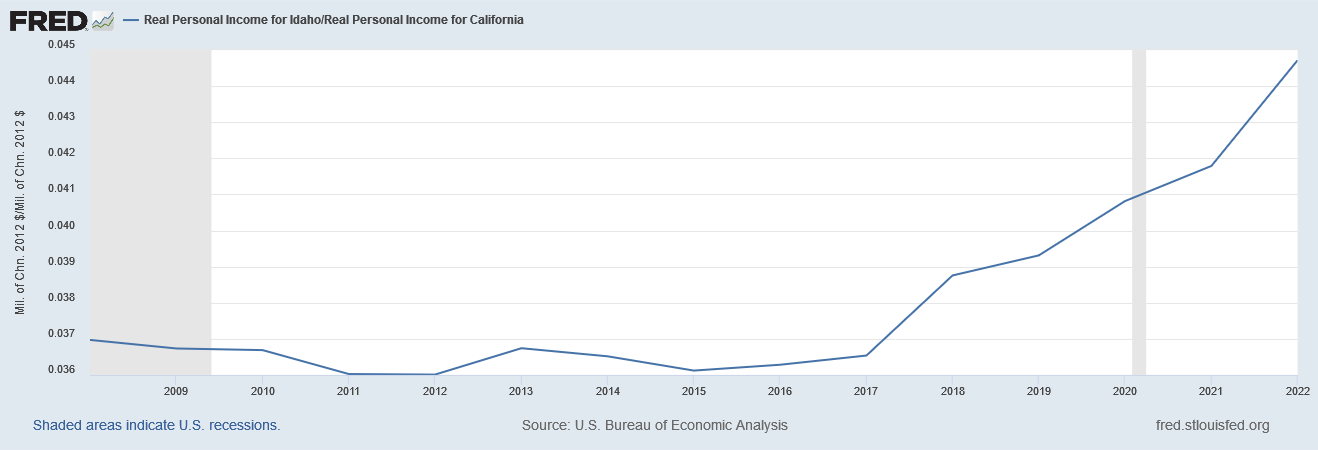
This figure shows real, inflation-adjusted personal income growth in Idaho relative to California. Idaho’s real personal income rose from under 3.7 percent of California’s in 2017 to just under 4.5 percent of California’s by 2022, the latest available year. Per capita income isn’t an appropriate measure for comparing states because the U.S. is an internally open economy: workers move to where they can get higher wages, adjusting for the price level. But Idaho’s growth has boosted the U.S. standard of living. We know this because of the fact that people are choosing to move there and are getting jobs.
One of the reasons Idaho has grown a lot faster than California is that it is easier to build houses there. The next figure shows Idaho’s per capita building permits relative to California’s.
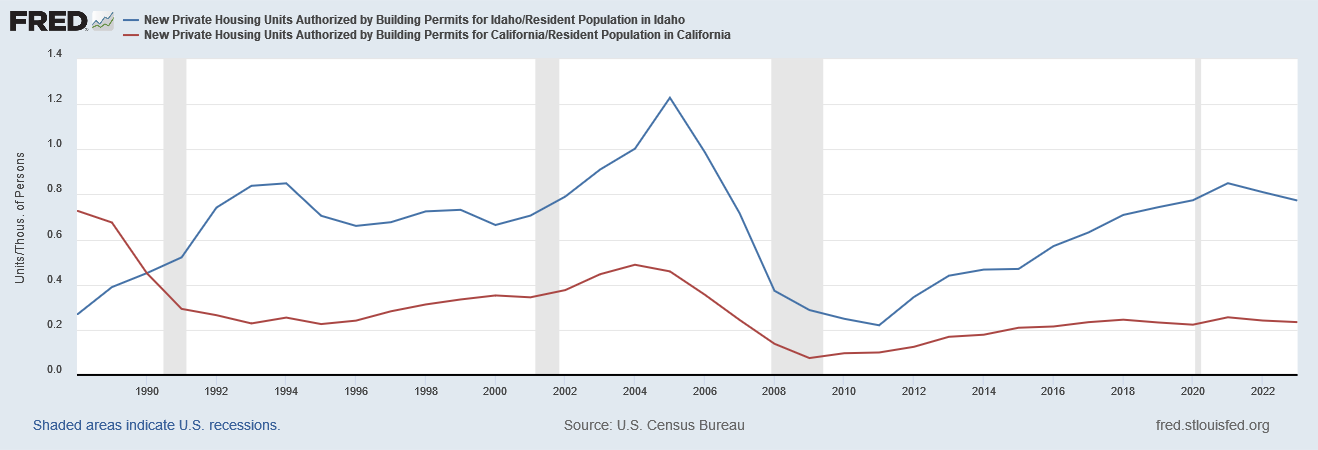
As you can see, Idaho has allowed a lot more building than California, relative to its population, ever since 1990. Now, some of this growth in building permits could reflect demand. Idaho might be becoming more attractive to Americans than California is, perhaps because of its higher degree of freedom.
Looking at house prices is a way to assess how much of Idaho’s growth relative to California’s has to do with supply of housing versus demand for it. The next figure compares Idaho’s and California’s house prices.
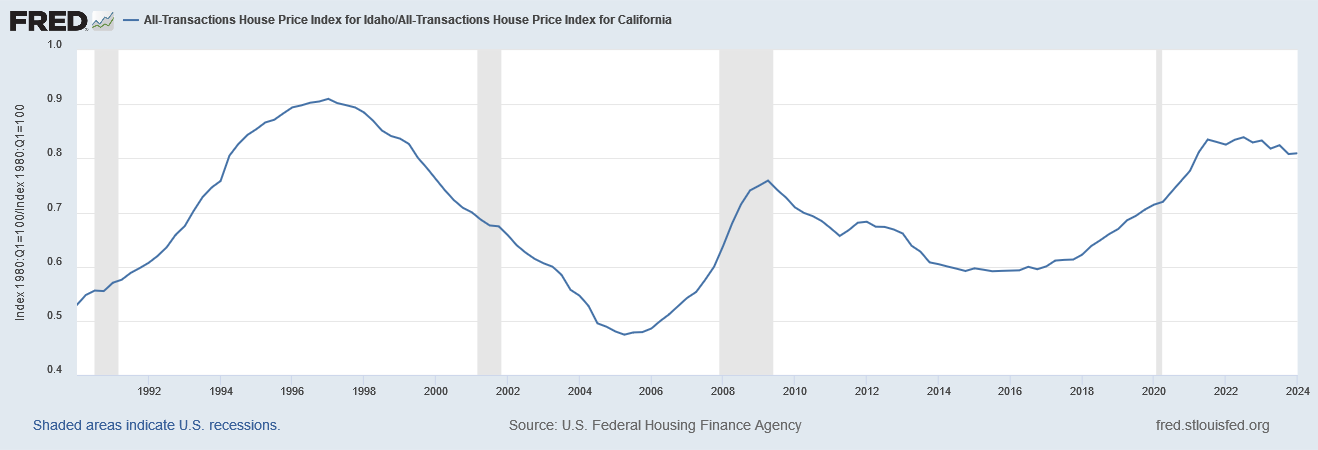
Since 2017, Idaho’s house prices have indeed increased faster than California’s, but before that, Idaho’s house prices fell relative to California’s even as its permit growth was faster. So for years, one of the main attractions of Idaho versus California was likely its more affordable and abundant housing. Since 2017, people have continued to move away from California and to Idaho, but the main drivers have probably been less the affordability of housing and more the higher quality of life and better economic opportunities in general.
Idaho’s growth is a lesson for the whole country. Low taxes and regulations and freedom to build, combined with a high quality of life, have made it an attractive destination. Population growth has created job growth, personal income growth, and GDP growth. Idaho should plan its infrastructure to accommodate growth without generating a reaction against it. I’m willing to bet that there are still a lot of Californians who want out.
Share This Article

Post on Facebook

Post on X

Print Article

Email Article