
Robert Hughes

Senior Research Faculty
Robert Hughes joined AIER in 2013 following more than 25 years in economic and financial markets research on Wall Street. Bob was formerly the head of Global Equity Strategy for Brown Brothers Harriman, where he developed equity investment strategy combining top-down macro analysis with bottom-up fundamentals. Prior to BBH, Bob was a Senior Equity Strategist for State Street Global Markets, Senior Economic Strategist with Prudential Equity Group and Senior Economist and Financial Markets Analyst for Citicorp Investment Services. Bob has a MA in economics from Fordham University and a BS in business from Lehigh University.
-

•
As 2016 Ends, Big Economic News Awaits
The Thanksgiving holiday is over and the final month of 2016 is approaching. The coming week brings a crowded list of important economic events, and beyond it, some big economic news to watch in December.
-

•
Existing Home Sales Keep Rising
We received more data this morning that show the housing market with continued upward momentum.
-

•
Jobs Report Shows a Continuing Economic Expansion
A moderately upbeat October jobs report suggests the economic expansion continues to grind ahead and the labor market continues to tighten. The October gains in jobs and wages suggest the economy is maintaining positive momentum in the early part of the fourth quarter.
-
•
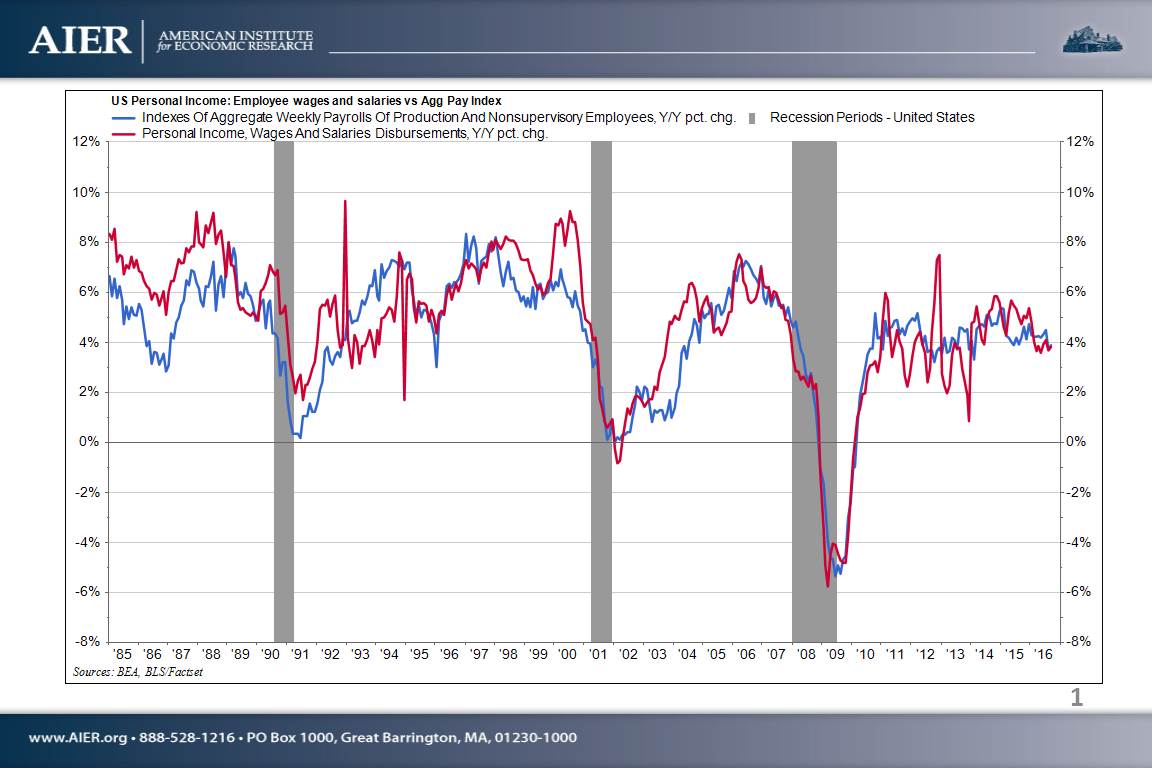
Rising Wages a Positive Sign Heading into Holidays
The preliminary estimate for personal income for the third quarter shows a 3.9 percent increase, the same pace as in the second quarter, according to new data released by the Bureau of Economic Analysis this morning. These are solid though not spectacular gains.
-

•
Mixed Signals from Today’s Durable Goods Report
Today’s report from the Department of Commerce on new orders and shipments of durable goods sent mixed signals on the state of the economy and outlook for third quarter GDP.
-
•
As 2016 Ends, Big Economic News Awaits
The Thanksgiving holiday is over and the final month of 2016 is approaching. The coming week brings a crowded list of important economic events, and beyond it, some big economic news to watch in December.
-
•
Existing Home Sales Keep Rising
We received more data this morning that show the housing market with continued upward momentum.
-
•
Jobs Report Shows a Continuing Economic Expansion
A moderately upbeat October jobs report suggests the economic expansion continues to grind ahead and the labor market continues to tighten. The October gains in jobs and wages suggest the economy is maintaining positive momentum in the early part of the fourth quarter.
-
•
Rising Wages a Positive Sign Heading into Holidays
The preliminary estimate for personal income for the third quarter shows a 3.9 percent increase, the same pace as in the second quarter, according to new data released by the Bureau of Economic Analysis this morning. These are solid though not spectacular gains.
-
•
Mixed Signals from Today’s Durable Goods Report
Today’s report from the Department of Commerce on new orders and shipments of durable goods sent mixed signals on the state of the economy and outlook for third quarter GDP.