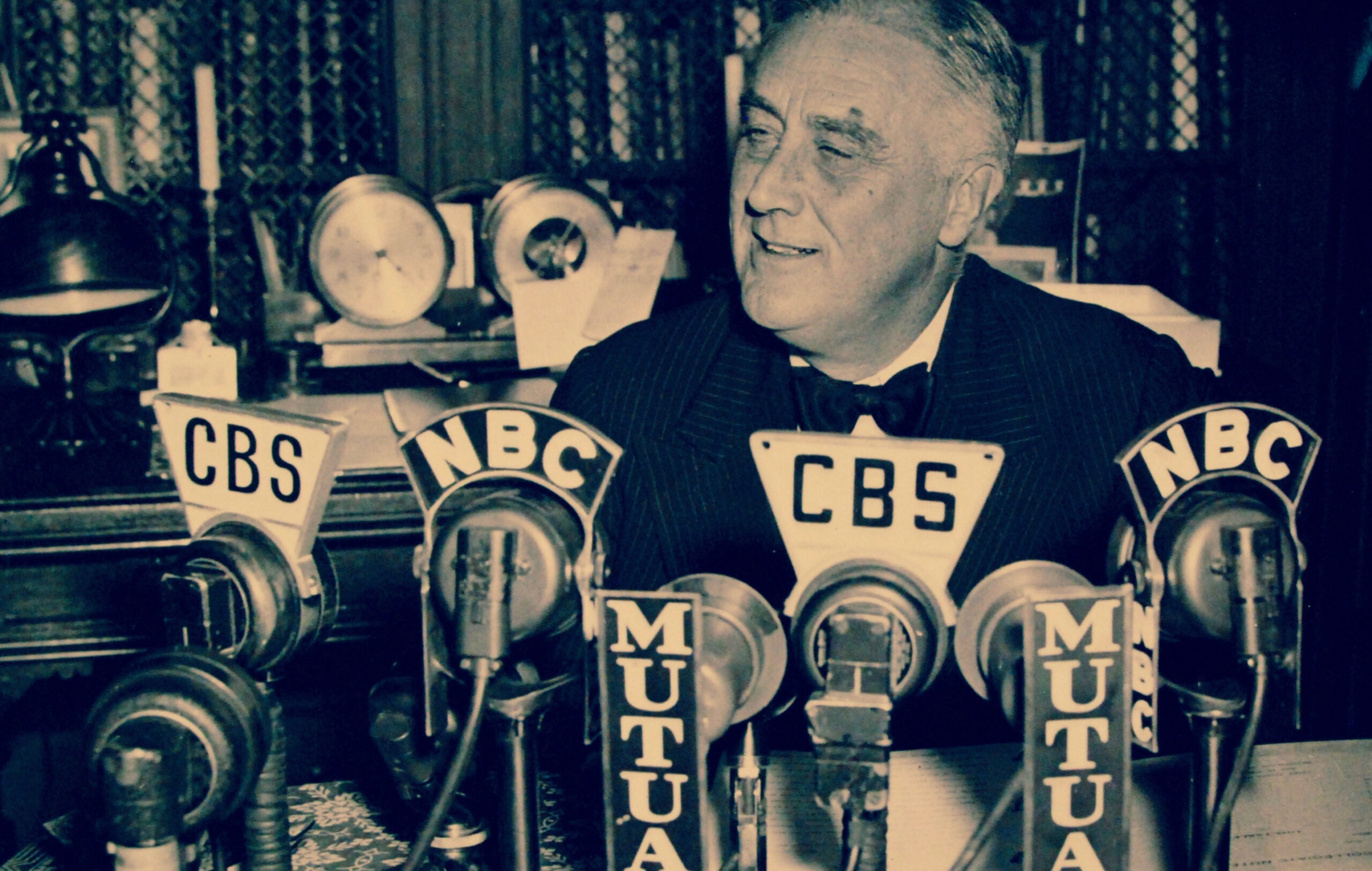
No president in American history had greater skill in the political uses of radio than Franklin Delano Roosevelt. His warm voice was called “sincere . . . and good natured even in attack,” and gained easy access to millions of living rooms. But just as importantly, and far more lastingly, Roosevelt finished the regulatory edifice begun by Calvin Coolidge and Herbert Hoover, changing American consumption of radio content forever.
Prior to the 1927 creation of the Federal Radio Commission (the predecessor of the Federal Communications Commission, or FCC), radio was arguably freer than the printing press. Short-range audio broadcasts not only gave listeners mass entertainment but also provided a way to share and access diverse opinions: socialists, labor unions, religious evangelists, and political populists. Well-publicized problems of interference between frequencies were often engineered politically to bolster calls for regulation, but court rulings were sorting through confusion. Affirming the doctrine of prior use, courts were able to determine de facto ownership in the electromagnetic spectrum.
Roosevelt was determined to silence dissenting voices on the radio. He adeptly manipulated the revolving door of regulators and industry executives and executed behind-the-scenes intrigue using intermediaries to conceal the appearance of censorship while embracing its effects.
By 1933, big broadcasters eagerly aligned themselves with the new administration, and in many cases became regulators themselves. Former FRC commissioner — CBS vice president — Henry A. Bellows was a Democrat and Harvard classmate of FDR’s. In his official role, he promised to reject any broadcast “that in any way was critical of any policy of the Administration,” and announced that all stations were “at the disposal of President Roosevelt and his administration.” Bellows specified that CBS had a duty to support the president, right or wrong, and privately assured presidential press secretary Stephen Early that “the close contact between you and the broadcasters has tremendous possibilities of value to the administration, and as a life-long Democrat, I want to pledge my best efforts in making this cooperation successful.”
The day after Roosevelt took office, the networks and the National Association of Broadcasters (NAB) jointly announced that all broadcasting facilities could be put to the service of the administration on “an instant’s notice.” They adopted a “right of way” policy requiring affiliates to break into regular broadcasts for the president’s speeches. In the first year alone, the networks carried 51 of Roosevelt’s speeches, far more than they had for his Republican predecessor Hoover in a similar period. This near carte blanche access to the airwaves extended to the president’s political allies and family members. At NBC’s invitation, key presidential advisor Louis Howe hosted a weekly series that often floated “useful trial balloons” for the president.
Both Roosevelt and the networks prioritized the president’s fireside chats, an ideal format to personally pitch to the voters and bypass often-critical newspapers. According to Betty Houchin Winfield, these cast FDR (much like social media posts did for President Donald J. Trump) as “the newsgatherer, the reporter, as well as the editor…without any intermediate journalistic filter to interpret or change his words.” When Roosevelt later proposed a weekly newspaper to publisher J. David Stern to refute the “poisonous propaganda of the conservative press,” Stern quipped that he did not need “such a vehicle. You did it alone on the radio.”
Radio proved indispensable for the promotion of the National Recovery Administration, the lynchpin of the First New Deal. In August 1933, FRC Commissioner Harold A. Lafount warned that stations had a “patriotic…and legal duty,” to reject advertisements from those “disposed to defy, ignore or modify the codes established by the N.R.A.” Lest the consequences were insufficiently plain, he elaborated that “radio stations, using valuable facilities loaned to them temporarily by the government,” must “not unwittingly be placed in an embarrassing position because of greed or lack of patriotism on the part of a few unscrupulous advertisers.” In her study of radio censorship in 1937, Not to Be Broadcast, Ruth Brindze pointed out that “any similar effort to control the [print] press would have created a sensation.”
The administration secured aid from the Federal Communications Commission in another realm as well. As most of the print press lined up against the president in the 1936 campaign, radio remained securely in his corner. Because of FCC pressure, including the tense waiting for that six-month license renewal, broadcasters often erred on the side of favoring the administration when in doubt. Republicans complained in vain.
The major networks had a standard policy of carrying Roosevelt’s speeches gratis as news or “civic affairs,” thus skirting the FCC’s provisions to give other candidates equal time. That category encompassed such highly politicized utterances as the bare-knuckle State of the Union Address on January 6, blasting the “economic autocracy” who “engage in vast propaganda to spread fear and discord among the people.” When Henry P. Fletcher, the head of the Republican National Committee, tried to respond through a series of anti-New Deal skits, NBC president Lennox Lohr turned him down under the pretext that “such dramatic programs as you have offered would place the discussion of vital political and national issues on the basis of dramatic license rather than upon a basis of responsibly stated fact or opinion.” Fletcher also met a rebuff from CBS President William S. Paley, who, overlooking the partisan tenor of some of Roosevelt’s own speeches, explained that “appeals to the electorate should be intellectual and not based on emotion, passion or prejudice.” In the end WGN (an independent station owned by the anti-Roosevelt Chicago Daily Tribune, carried the skits.
A rare remaining dissident voice on radio, and thus a prime target for Roosevelt’s animus, was the widely listened-to CBS commentator Boake Carter. On behalf of the president, White House Press Secretary Stephen Early made an appeal in November 1937 to his friend, Marjorie Merriweather Post, a director of General Foods, and a veteran of Democratic causes, to restrain Carter’s critical commentary of FDR. According to Harold Ickes’s diary in February 1938, the “President told Miss Perkins [Secretary of Labor Frances Perkins] that he would be happy if she could discover that Boake Carter, the columnist and radio commentator, who has been so unfair and pestiferous, was not entitled to be in this country. It appears that an investigation of his record is being made.”
It was, indeed. The Department of the Treasury was scrutinizing Carter’s background and his tax forms, while the State Department searched (unsuccessfully) for a pretext to deport him back to the United Kingdom. When a noticeably rattled Carter got wind of these efforts, he asked: “Who said that I should be Deported? Beware! Libel me at your peril.”
Roosevelt revealed his true intentions during a dinner conversation with Jerre Mangione, then working for the Federal Writers’ Project of the WPA. Mangione recalled that as the evening wore on, the president volunteered that he was having Carter “thoroughly investigated” and that the results, when revealed, “would put an end to his career.” Mangione was crestfallen: “That Roosevelt, the statesman I had admired, should admit to such vindictiveness came as the greatest jolt of all.”
As pressures bore down from the administration, Carter’s commentary became distinctly more tepid. “I pulled my punches,” he later admitted, and because of this and other contributing reasons, “my radio rating, which had been at the top, began to drop.” In August 1938, CBS discontinued the program. In a subsequent lecture tour, Carter accused the “Great White Father in Washington” (Roosevelt) of bullying station owners worried about six-month license renewals and for intimidating CBS into firing him. Freedom of speech, to the extent it was genuine, he reported regretfully, applied only to the print press. At the end of 1938, not a single anti-New Deal radio commentator remained on the major networks.
Meanwhile, the Roosevelt administration was launching a similar pressure campaign against the smaller stations and regional networks. A leading illustration was a radio voice, Father Charles E. Coughlin, whom FDR had initially encouraged. Coughlin had begun broadcasting his sermons in 1928 and rapidly gained listenership. He purchased time on dozens of hookups of independent stations and reached millions of listeners (including presidential candidate Roosevelt) who tuned in for his populist jeremiads against the “international bankers.” Alan Brinkley observes that “Once Roosevelt had decided that Coughlin would be useful to his political strategy, he showered the priest with attention and compliments and soon won him over completely.” Reciprocating, Coughlin was fulsome in his praise, proclaiming “Roosevelt or Ruin!” and “The New Deal is Christ’s Deal” but he was also a loose cannon. After months of tension, he broke completely with Roosevelt in 1936. The administration responded with a quiet, but determined, search for ways to silence the radio priest.
When Coughlin’s broadcasts began to feature antisemitic content in late 1938, the size of the constituency to take him off the air increased throughout the political spectrum. Frank R. McNinch, the FCC chairman, was the most prominent example. With Coughlin clear in mind, he pledged to “employ every resource” to stop radio from becoming “an instrument of racial or religious persecution.”
Similarly, FDR’s press secretary, Stephen Early, admonished broadcasters not to “permit the individual or group with the greatest financial resources to utilize radio to peddle their own particular brand of social or economic philosophy.” More ominously, Early subsequently announced that in the event of war, radio must prove itself a “good child” or the government might have to teach it “manners.”
The perceived futility of trying to read FCC or administration tea leaves prompted the National Association of Broadcasters (NAB) to adopt a landmark “voluntary code” in July 1939. While the most obvious goal was to align with the real or perceived FCC goal of forcing Coughlin off the air, it also served as an entering wedge for more comprehensive censorship. For example, the code imposed permanent “voluntary” bans on the sale of commercial time for discussing “controversial issues” (except for party electoral broadcasts), editorializing by either newscasters or commentators, and “attacks upon another’s race or religion.” The Code Compliance Committee showed the two-faced double standard by stating that it had no intention to bar anyone “from using radio. It simply denies the right to buy time.” Rigid compliance was the safest response for normally cautious broadcasters. “By citing its ban on self-sponsorship of controversial views,” historian Richard W. Steele observes, “broadcasters could more comfortably rid themselves of a long-standing nuisance [Coughlin] while demonstrating the industry’s oft-expressed commitment to neutral programming.”
The American Civil Liberties Union gave no encouragement to efforts to apply the First Amendment to radio. That organization subscribed to the general view that the electromagnetic spectrum was uniquely scarce and, hence, that it was impossible to apply to radio the comparatively “laissez faire” approach used toward the print press. In 1935, for example, ACLU publicity director Clifton Reed, matter-of-factly described the “doubtful social validity” of applying free speech to radio, because stations had a “lucrative monopoly” and that their “single obligation is to present programs in ‘the public interest, convenience, and necessity.’”
David Lawrence, the publisher of US News, was almost alone in standing up for free speech in the new medium. Radio, he argued, was “no more ‘affected with the public interest’ than is the newspaper business.” Regarding claims of scarcity, Lawrence observed that the “vast majority” of communities had only one newspaper, and ongoing technical improvements promised a rapid increase in the number of stations that could be accommodated by existing wavelengths. He predicted that the future offered even more potential for competition, including innovations such as “‘wired radio’ [which] will make possible millions of outlets in the homes of America and an unlimited number of transmitters can be built for this purpose.”
But Lawrence was fighting a losing battle. Citing the NAB Code as justification, the Yankee and Colonial networks dropped Coughlin and other stations in key local markets soon followed suit. In September 1940, Coughlin, venting his frustration, left the air.
The Code brought other significant changes to radio content. As discussed in an earlier article, it helped to undermine the “American Family Robinson,” a popular anti-New Deal soap opera. It was also instrumental in shaping, or more accurately stifling, the great debate over U.S. intervention before World War II. Writing in November 1941 to his ally in the anti-war America First Committee, John T. Flynn, Socialist Party leader and civil libertarian Norman Thomas reported that a New York station had reneged (on advice of the NAB) on a contract for a series of speeches against US intervention. Thomas had raised the money himself to pay for the speeches. (Coughlin had done the same, of course!)
Thomas agreed that “the speeches are controversial and do violate a strict interpretation of the Code, but they are neither more nor less in violation of the Code than the continual [pro-administration] remarks of Walter Winchell and Eleanor Roosevelt on sponsored programs.” Ironically, Thomas had vigorously supported the original creation of the Code. Its actual enforcement had hoisted him by his own petard and he probably knew it. He complained to Flynn “that we are dealing with a situation on the radio in which practically all commentators are on one side, in which people who talk on public affairs on sponsored programs are almost, without exception, interventionists.”
The NAB code was also a precursor to the much better-known Mayflower Doctrine of 1941, under which the FCC mandated “full and equal opportunity for the presentation to the public all sides of public issues.” Radio, to be truly free, the statement continued, must never “be used to advocate the causes of the licensee….The public interest—not the private—is paramount.” The effect of the doctrine was often to discourage station managers to avoid all controversial issues, rather than take any chances.
In retrospect, the Mayflower Doctrine exemplified continuity with FDR’s earlier policies toward radio than a break from the past. It also reflected longstanding practice both by the FCC and the subsequent NAB broadcasting code. While the effort to restrict free speech sometimes took the form of formal regulation, FDR more commonly relied on indirect methods. By World War II, the freewheeling radio discourse that had prevailed before the establishment of the Federal Radio Commission was becoming a distant memory. In its place came the emergence of a sanitized medium which left little room for dissident voices, especially those challenging the administration in power.
The author explores these and similar themes in his soon-to-be released book, FDR: A New Political Life.
Share This Article

Post on Facebook

Post on X

Print Article

Email Article