The cascading events of the 2008 global recession, and a bipartisan $700 billion bailout of US banks, sparked a cultural backlash known as the Tea Party movement. This grassroots affiliation then swelled in opposition to more large‑scale government intervention, most notably the Patient Protection and Affordable Care Act, better known as Obamacare.
Two years later, the 2010 midterm elections proved a turning point: Republicans, branded as Tea Party supporters, won back 63 House seats and six Senate seats, the largest shift in Congress since 1948. By 2016, then‑presidential candidate Donald Trump was praising the movement: “The tea party people are incredible people. These are people who work hard and love the country.”
Roughly a decade later, the Republican Party no longer champions small government or a laissez‑faire economy. Once the self‑proclaimed guardians of limited government, today’s GOP embraces state control across multiple fronts: steering corporate investment, micromanaging trade, spending without restraint, and ignoring entitlement insolvency. It is no isolated drift — it is a wholesale realignment toward big‑government nationalism. As Star Wars warned: “So this is how liberty dies…with thunderous applause.”
Nowhere is the GOP’s break with small‑government ideals more visible than in its willingness to dictate where and how America’s largest companies invest. Apple announced plans to invest $500 billion to expand manufacturing and AI server production across the United States. The firm originally desired to expand its footprint in India, avoiding the geopolitical squeeze of US–China tensions. The President responded to this news: “I had a little problem with Tim Cook yesterday. ‘You’re coming here with $500 billion, but now I hear you’re building all over India. I don’t want you building in India.’”
Apple isn’t alone; Google and Nvidia are making similar US‑focused investments. Alongside these investments came the AI Action Plan, declaring, “Winning the AI race will demand a new spirit of patriotism and national loyalty in Silicon Valley and long beyond Silicon Valley.” But does AI truly need a patriotism push?
As high‑tech firms show they can be corralled into government‑approved investment, the same heavy hand is now reaching into America’s old‑line industries. Last year, the proposed US Steel–Nippon Steel merger became a political flashpoint not because it threatened consumers or competition, but because the buyer was foreign. Instead of letting the merger proceed, the government prohibited the action and only let Nippon invest in US Steel. Nippon also granted the US government a “golden share” in the firm. As the Cato Institute’s Scott Lincicome argues, “The Trump administration’s ‘golden share’ control of a wide array of US Steel’s domestic business activities should be seen as a de facto nationalization of the company, given what we know about the new relationship and the very standards pushed by the US government in related contexts.” The loser in acquiring US Steel, Cleveland Cliffs, applauded Donald Trump’s June 4 decision to raise steel tariffs from 25 percent to 50 percent, as their stock rose 33 percent that same day.
Rather than trust markets to allocate capital, Washington now treats investment and ownership as matters for political control. It is one more example of the right abandoning free‑market principles in favor of economic nationalism.
The same instinct to manage markets from Washington now drives US trade policy, with results just as costly and counter‑productive. The US government slapped a sweeping 50-percent tariff on semi‑finished copper items, such as pipes, wires, rods, sheets, and high‑copper derivative goods like electrical cables, while cathodes, scrap, ores, and concentrates were explicitly exempted. This policy, justified under national security provisions, immediately roiled the copper market: US copper futures plunged over 20 percent in a single day, erasing prior arbitrage premiums and revealing that approximately 45 percent of US copper needs now fall under the new levy.
Tariff threats first targeted steel and automobiles; however since “Liberation Day,” imports have plunged nearly 20 percent. Deutsche Bank concluded that some American firms were eating the tariff costs and accepting smaller margins. But global head of FX research, George Saravelos, told Bloomberg, ‘The top-down macro evidence seems clear: Americans are mostly paying for the tariffs.’
In the classic pattern of political hubris — the government breaks your legs, then sells you crutches — lawmakers now want to hand you a check to offset these self‑inflicted costs.
Republican Senator Hawley, the architect behind the American Worker Rebate Act, desires to redistribute tariff revenues to taxpayers, a true fiscal mess in which government extracts money from consumers in order to give it back to them. Have we forgotten the failed Modern Monetary Theory (MMT) experiment that flooded households with stimulus checks during the draconian COVID‑19 lockdowns? According to the Federal Reserve Bank of St. Louis, inflation in consumer prices rose from 1.23 in 2020 to 8.0 percent in 2022, with government spending responsible for 42 percent of this inflation. The Tax Foundation suggests:
While tariffs have undoubtedly raised costs for American firms and consumers — since Americans and not foreigners ultimately pay the tariff — rebating the revenue to consumers would be fiscally irresponsible and also risk increasing inflation. Tariffs are a poor way to raise revenue generally, but the revenue that is collected should be used for deficit reduction rather than rebates.
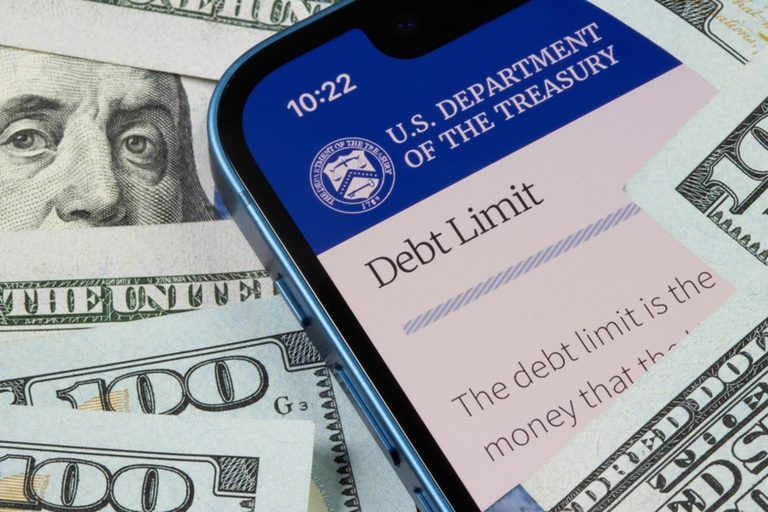
This appetite for intervention is matched only by the willingness to spend without restraint. At the turn of the millennium, America carried about $5.5 trillion in federal debt. By mid‑2025, that figure has exploded to roughly $37 trillion, more than a sixfold increase in just 25 years. Interest on that debt now swallows over $1 trillion annually, about 17 percent of all federal spending, and the government spends roughly 20 percent more than it collects in revenue. The recently enacted One Big Beautiful Bill will only add fuel to the fire: the Congressional Budget Office projects $2.4 trillion in new deficits over the next decade, or $3.1 trillion once interest is factored in. At this pace, the United States will celebrate its 250th birthday burdened by a national debt exceeding $40 trillion. This is not just a failure of governance, it is the abandonment of the very fiscal discipline Republicans once claimed as their defining principle.
Rather than confront this reality, Republican leaders preside over some of the largest peacetime budgets in US history. On the military side, the Pentagon’s budget alone is $820 billion, more than the next ten countries combined, and climbs to $1.2 trillion when veterans’ benefits are included. In real terms, America spends more on defense today than it did during the height of the Iraq and Afghanistan wars.
On the welfare side, Social Security and Medicare already consume more than eight percent of GDP and their combined costs are projected to soar from $1.4 trillion in 2023 to nearly $3 trillion by 2033. The Social Security trust fund is expected to be depleted by 2033, after which incoming payroll taxes will cover only about 77 percent of promised benefits. Medicare’s Hospital Insurance trust fund faces insolvency by 2036, triggering automatic cuts unless Congress intervenes.
The Republican Party once sold itself as the last line of defense against an overreaching federal government. Today, it champions state control over private enterprise, embraces protectionist tariffs that raise consumer prices, and presides over record‑shattering spending that will burden future generations with mountains of debt. What began as a movement to curb Washington’s reach has morphed into a governing philosophy that wields government power to direct markets, pick winners, and paper over self‑inflicted economic wounds. In forsaking the creed of limited government, the GOP has not merely drifted from its roots, it has become the very Leviathan it once vowed to oppose.
Share This Article

Post on Facebook

Post on X

Print Article

Email Article