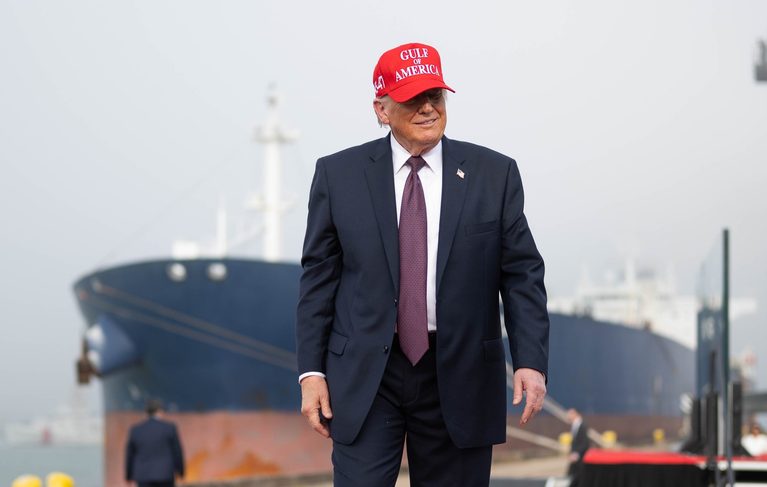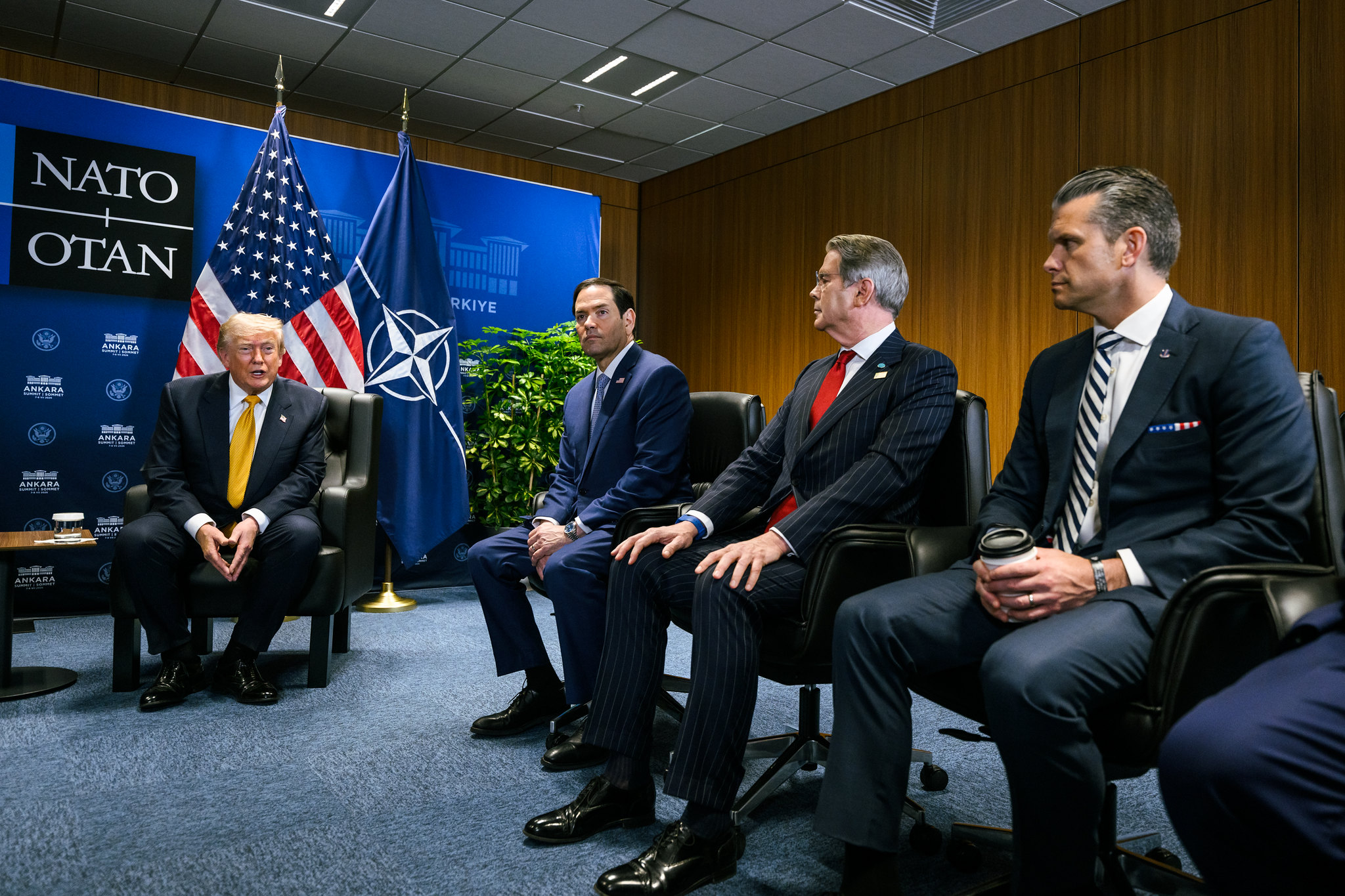
The Ankara NATO summit was a success, at least by today’s relaxed standards for diplomatic behavior. Still, President Donald Trump captured headlines by sharply criticizing some of NATO’s European members.
At least he ended his participation on a positive note.
“There was tremendous unity in that room,” declared the president. “There was a love in that room. It was great. So this was a tremendously successful summit.” Of greatest policy relevance was his announcement that “We want to remain with you.”
These came after an unnamed NATO diplomat told Politico Europe: “I’m sick and tired of panicking about Trump.” The diplomat nevertheless praised Europe’s increased defense efforts: “We have to do this for ourselves.”
Most European states are taking their defense responsibilities more seriously, which is welcome. Washington’s overwhelming military role in NATO was necessary at the beginning of the Cold War. Western Europe and Japan had been ravaged by war and were vulnerable to diplomatic coercion and even military attack. No one knew if the Soviet Union would do so, but no one wanted to risk such dangerous uncertainty.
That world disappeared, however, after America’s defense dependents recovered economically. Unfortunately, both sides continued to support the US military dole. Members of Washington’s bipartisan foreign policy “Blob” preferred to dominate global and allied affairs, despite the policy’s significant cost. Allies preferred to focus on domestic development, including their burgeoning welfare states, leaving security to the US.
Eventually, the imbalance grew too great, and a succession of American officials pushed the Europeans, in particular, to do more, with only indifferent success. In 2011 Defense Secretary Robert Gates famously warned future American officials “may not consider the return on America’s investment in NATO worth the cost.”
Donald Trump seemed to be that person. Despite his rhetorical excess, though, the president did not make good on his threat to leave the alliance in either his first term or the first 18 months of his second term. Rather than negotiate a structured political and military withdrawal from NATO, leaving the Europeans to decide on their own security policy, he evidently prefers using America’s continuing presence to shake down allies economically, imposing tariffs, obstructing regulations, and forcing investment. For him, the military is more a mercantilist than a security tool, and it worked on Europeans who abhorred the cost of declaring independence from the US.
Now he is reversing that approach, turning mercantilism into a security tool, though in practice he is more likely to harm America’s international position by doing so. Trump has long targeted Spain’s Prime Minister Pedro Sánchez for rejecting NATO’s increasing spending standards, despite their manifold loopholes. Sánchez’s position is understandable: no one believes that Vladimir Putin’s legions will imminently approach the gates of Zaragoza, Barcelona, Seville, Valencia, or Madrid. Moreover, Sánchez’s stand against US military and foreign policy, along with other high-profile progressive advocacy, has bolstered his popularity, a particularly important factor given the political misconduct scandals besetting his government.
Now Trump is considering reverse mercantilism by cutting off US trade with Spain even though the latter buys more from America than it sells, thereby reducing America’s global trade deficit, a long-time Trump goal. Last year the president complained that Spain was “unbelievably disrespectful” and threatened to end trade with that nation, and in March repeated that position. The issue then faded as he appeared to lose interest in favor of his Washington, DC construction projects and Middle East warmaking.
Alas, the latest NATO summit apparently rekindled his anger and he again threatened economic war against Madrid. He termed it a “terrible partner in NATO” and a “wasted cause. We don’t want to do any trade business with Spain anymore.”
Sánchez denied any tension, responding: “Relations between the United States and Spain are very positive relations in social, cultural, economic and also political terms.”
This time Trump issued instructions. In Ankara, the president publicly told Treasury Secretary Scott Bessent: “I don’t want to do any trade with them, alright?” He added: “I don’t want anything to do with Spain. Cut off all trade with Spain, please, including visits, OK?”
Bessent responded “yes, sir” and several agencies began developing a “menu” of products to be banned. Most likely, the administration would use the International Emergency Economic Powers Act to embargo some or all Spanish imports. This follows similar threats from four months ago. Then the president appeared to flip-flop again, declaring: “They honored a request for lots of payments, and if they didn’t, we wouldn’t have even talked to them.” (Apparently, Madrid convinced him that it met the current NATO standard.)
Had he moved forward, the administration would have had to ground its decision in national security and declare a national emergency, as it previously did against Cuba and North Korea. But Spain poses no comparable challenge, no threat by any serious definition. No doubt, the issue would have ended up in court. As the president discovered in February, his power over trade is not plenary. The Supreme Court rejected his attempt to use the IEEPA to launch trade wars with virtually every other nation on earth. Although jurists tend to defer to presidential claims in such cases, they recognized that he was grossly abusing emergency provisions for partisan policy purposes. Trump’s continuing, extravagant demands stirred opposition even among the long-submissive GOP congressional caucuses.
Cutting off Spain would be bad policy. Americans benefit from commerce with the Spanish.
From them, Americans purchase olive oil, refined petroleum, electrical transformers, perfumes, vaccines, ceramics, wine, gas turbines, tires, aircraft parts, and nuts. From us, the Spanish buy crude petroleum, pharmaceuticals, petroleum gas, vaccines and other medical products, gas turbines, aircraft and spacecraft, soybeans, and nuts. Then there’s investment banking: “BlackRock holds €104 billion ($119 billion) worth of Spanish equities, debt and other assets, and Spain is the US-based firm’s main bet at a global level for the next six months,” Reuters reported.
Fundamental liberty is also at stake. Trade is not government-to-government, but person-to-person and firm-to-firm. Nor is it a restricted legal privilege. Commerce occurs because both sides gain. The president might want nothing to do with Spain, but millions of Americans do. They trade with people and visit Spain. US policy should not be based on a president’s arbitrary anger and personal pique. It should reflect America’s national interest, not his belief that he is “running the world” and therefore is entitled to arbitrarily impose his will. Ironically, Sánchez is implementing Trump’s governing philosophy, a form of “Make Spain Great Again,” acting in Spain’s interest rather than that of other nations, including the US.
Mercantilism was largely abandoned because it hindered economic success and undermined national development. It was bad when Trump adopted that failed model as America’s new approach. It became much worse when Trump malformed security policy to reinforce his mercantilist approach. Punishing Spain, or any other nation that ends up in his sights, would hurt Americans even more.
NATO’s Ankara summit delivered little of the expected fireworks. Unfortunately, however, though superficially successful, it reinforced the outdated policies of American primacy and European dependency. It also highlighted Trump’s mercantilist bent and willingness to sacrifice Americans’ economic interests for dubious political ends.
We all are likely to be poorer as a result.
Share This Article

Post on Facebook

Post on X

Print Article

Email Article