
Robert Hughes

Senior Research Faculty
Robert Hughes joined AIER in 2013 following more than 25 years in economic and financial markets research on Wall Street. Bob was formerly the head of Global Equity Strategy for Brown Brothers Harriman, where he developed equity investment strategy combining top-down macro analysis with bottom-up fundamentals. Prior to BBH, Bob was a Senior Equity Strategist for State Street Global Markets, Senior Economic Strategist with Prudential Equity Group and Senior Economist and Financial Markets Analyst for Citicorp Investment Services. Bob has a MA in economics from Fordham University and a BS in business from Lehigh University.
-

•
Retail Sales Rise in April
Retail sales rose 0.3 percent in April following a 0.8 percent increase in March. The April gain suggests that second-quarter GDP growth is off to a solid start.
-

•
Labor-Market Outlook Remains Strong as Job Openings Surge
Total job openings in the United States rose to a record 6.550 million in March while private-sector job openings totaled 5.928 million. Overall, the data relating to the labor market continue to show strength with payrolls rising, few layoffs, rising quits, and a declining number of available workers per opening.
-
•
Economic Outlook Remains Positive Despite Slower GDP Growth
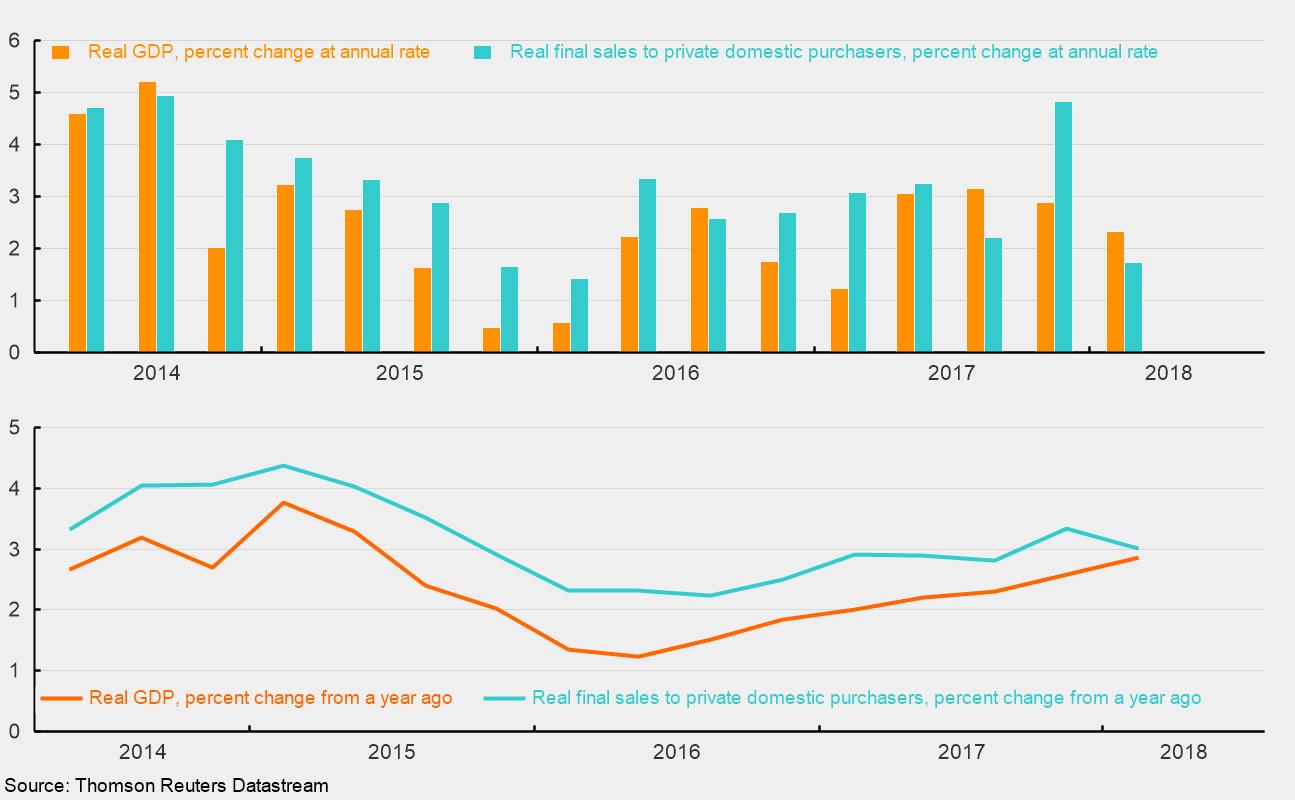
Real gross domestic product rose at a 2.3 percent annualized rate in the first quarter, down from a 2.9 percent pace in the fourth quarter of 2017. However, growth over the past four quarters hit 2.9 percent, the fastest four-quarter gain since the second quarter of 2015.
-

•
Small-Business Optimism Ticked Down in March but Remains High; Quality of Labor Remains the Most Important Problem
The small-business-optimism index from the National Federation of Independent Business fell in March but the result extends a run of 16 consecutive months above 100, a very high level by historical comparison. A significant concern among small businesses is the declining quality of the available labor force, particularly in the context of an already tight…
-

•
Suspiciously Pessimistic March Jobs Report
The employment report was weaker than expected for March, adding just 103,000 new jobs for the month. However, there are a number of tensions among the details of the report and with other measures of the labor market. Certainly, the BLS report could be the first of a string of weaker reports on the labor…
-
•
Fourth-Quarter Real GDP Rises 2.9 Percent as Domestic Demand Surges
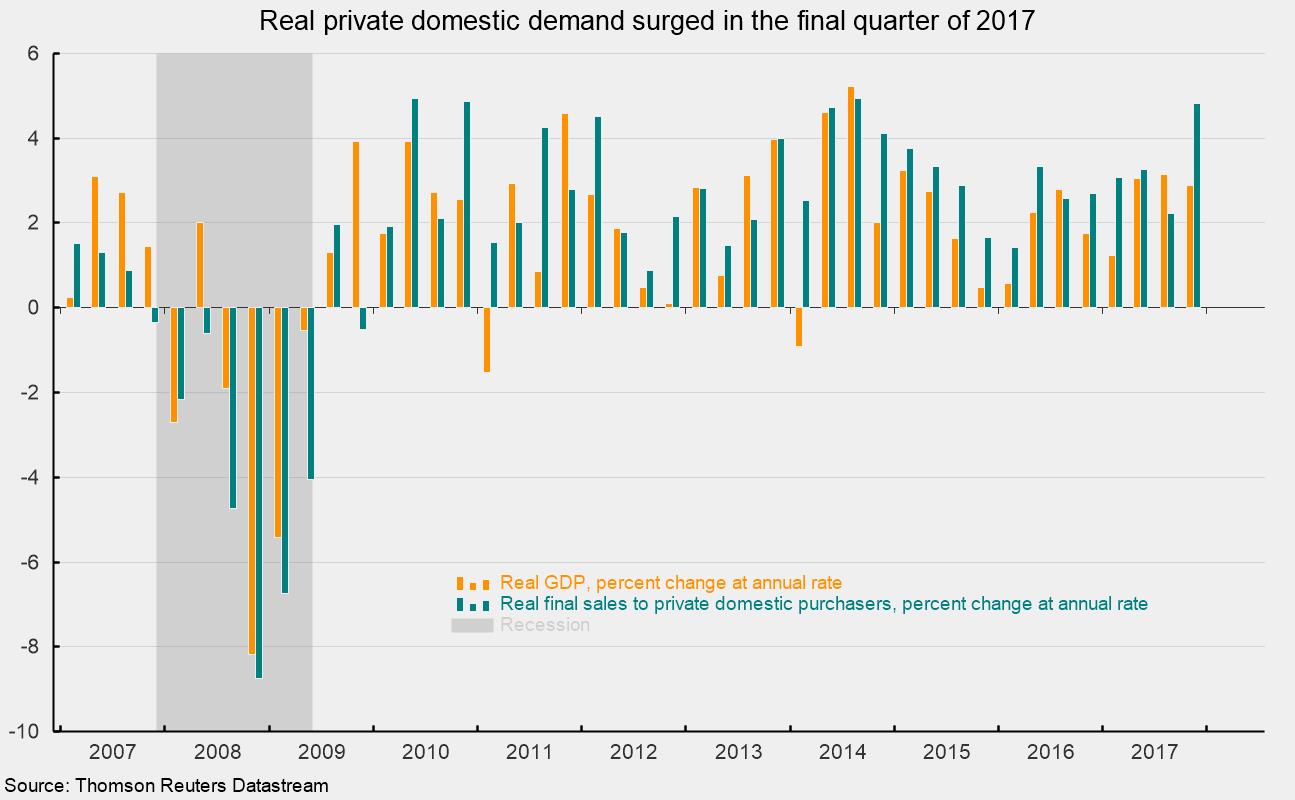
Real GDP grew at a 2.9 percent pace in the fourth quarter as domestic demand surged. Most of the major components of GDP made positive contributions, and core consumer prices rose at a modest pace, however, corporate profits did show a decline.
-

•
Consumer Confidence Ticked Down in March but Remains at a Very High Level
The Consumer Confidence Survey from The Conference Board shows consumer attitudes pulled back slightly in March but remain at historically favorable levels overall, suggesting support for ongoing economic expansion.
-

•
Economic Growth Accelerated in February, According to the Chicago Fed National Activity Index
The Chicago Fed’s National Activity Index jumped in February with the index coming in at 0.88, its second-highest reading over the past 11 years. The six-month average came in at 0.435, the highest since March 2006, suggesting economic growth remains above its long-term trend.
-

•
Durable-Goods Orders Rebound in February, Maintain Upward Trend
New orders for durable goods rose 3.1 percent in February to $247.7 billion. Over the past 12 months, total durable-goods orders are up 8.9 percent, and since hitting a recent low of $211.5 billion in June 2016, the gain is 17.1 percent.
-

•
Home-Price Increases Are Accelerating; Initial Claims Remain Low
Home prices are accelerating as a result of a limited supply of homes for sale and continued strong consumer fundamentals including a very low level of initial claims for unemployment insurance.
-
•
Retail Sales Rise in April
Retail sales rose 0.3 percent in April following a 0.8 percent increase in March. The April gain suggests that second-quarter GDP growth is off to a solid start.
-
•
Labor-Market Outlook Remains Strong as Job Openings Surge
Total job openings in the United States rose to a record 6.550 million in March while private-sector job openings totaled 5.928 million. Overall, the data relating to the labor market continue to show strength with payrolls rising, few layoffs, rising quits, and a declining number of available workers per opening.
-
•
Economic Outlook Remains Positive Despite Slower GDP Growth
Real gross domestic product rose at a 2.3 percent annualized rate in the first quarter, down from a 2.9 percent pace in the fourth quarter of 2017. However, growth over the past four quarters hit 2.9 percent, the fastest four-quarter gain since the second quarter of 2015.
-
•
Small-Business Optimism Ticked Down in March but Remains High; Quality of Labor Remains the Most Important Problem
The small-business-optimism index from the National Federation of Independent Business fell in March but the result extends a run of 16 consecutive months above 100, a very high level by historical comparison. A significant concern among small businesses is the declining quality of the available labor force, particularly in the context of an already tight…
-
•
Suspiciously Pessimistic March Jobs Report
The employment report was weaker than expected for March, adding just 103,000 new jobs for the month. However, there are a number of tensions among the details of the report and with other measures of the labor market. Certainly, the BLS report could be the first of a string of weaker reports on the labor…
-
•
Fourth-Quarter Real GDP Rises 2.9 Percent as Domestic Demand Surges
Real GDP grew at a 2.9 percent pace in the fourth quarter as domestic demand surged. Most of the major components of GDP made positive contributions, and core consumer prices rose at a modest pace, however, corporate profits did show a decline.
-
•
Consumer Confidence Ticked Down in March but Remains at a Very High Level
The Consumer Confidence Survey from The Conference Board shows consumer attitudes pulled back slightly in March but remain at historically favorable levels overall, suggesting support for ongoing economic expansion.
-
•
Economic Growth Accelerated in February, According to the Chicago Fed National Activity Index
The Chicago Fed’s National Activity Index jumped in February with the index coming in at 0.88, its second-highest reading over the past 11 years. The six-month average came in at 0.435, the highest since March 2006, suggesting economic growth remains above its long-term trend.
-
•
Durable-Goods Orders Rebound in February, Maintain Upward Trend
New orders for durable goods rose 3.1 percent in February to $247.7 billion. Over the past 12 months, total durable-goods orders are up 8.9 percent, and since hitting a recent low of $211.5 billion in June 2016, the gain is 17.1 percent.
-
•
Home-Price Increases Are Accelerating; Initial Claims Remain Low
Home prices are accelerating as a result of a limited supply of homes for sale and continued strong consumer fundamentals including a very low level of initial claims for unemployment insurance.